What this code means
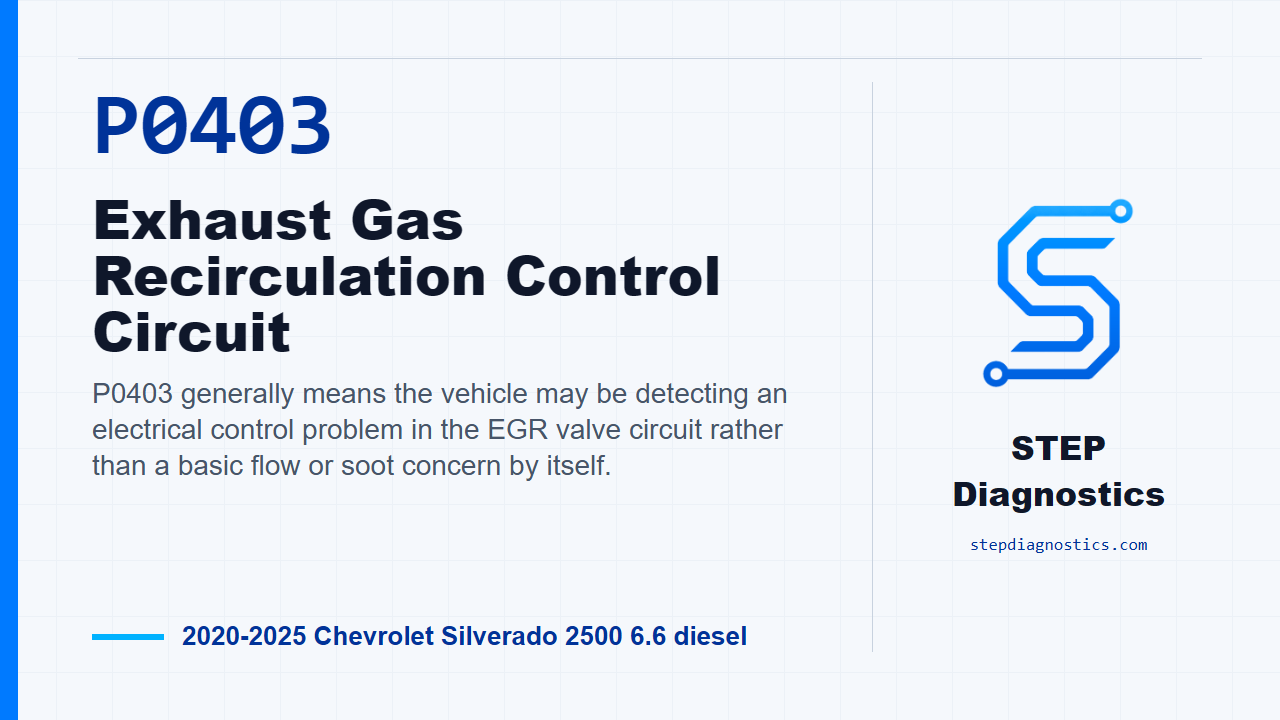
P0403 generally means the vehicle may be detecting an electrical control problem in the EGR valve circuit rather than a basic flow or soot concern by itself.
What the vehicle may do
- The vehicle may turn on an emissions-related warning message.
- The engine may run normally, or drivability may be affected depending on how the EGR system responds.
- A driver information message or speed limitation may remain until the related fault runs and passes.
Possible fault areas
- The EGR valve or its internal electrical control side may be involved.
- The valve connector, terminals, or harness may have a possible open, short, or high-resistance condition.
- The engine control module side can be a possible fault area after the valve and circuit checks are proven.
Diagnostic path
Opening context
On this Silverado 2500 diesel, P0403 points to an electrical control problem in the EGR valve circuit. In plain terms, the engine control module may be commanding the EGR valve, but the control side of the circuit may not be behaving the way it should. The truck may show an emissions-related warning, and in some cases a driver information message or speed limitation may stay active until the fault that triggered it runs and passes. Broadly, you’re thinking about the EGR valve, its connector and harness, possible opens, shorts, high resistance, and only after the circuit path is proven, the control module side. For this code, keep the diagnostic path electrical and work it in order.
Start with the basic checks
Before getting into pinpoint testing, start with the basic system checks and follow a structured diagnostic approach. If other codes are present, check what they mean first so you do not chase an EGR circuit symptom that is being driven by another problem.
What the monitor is looking for
The EGR control output is switched from ground to 12 V to activate the component. For P0403, the important failure pattern is an open control circuit for greater than 2.5 s. The monitor runs after its gates are met, including the engine running and ignition voltage greater than 11 V, then it continues watching the circuit.
Initial command check
With the ignition on and the vehicle in service mode, use the scan tool to command the EGR valve increase function. Watch the EGR Position Sensor. It should read 0 to 70% and it should change. If it does not fall in that range or it does not move, go into circuit testing. If it does respond correctly, reproduce the operating conditions for the code, or the captured conditions from the failure data, and confirm P0403 does not reset. If the code resets, move on to circuit testing. If it does not reset, the check is passing at that time.
Control circuit terminal 1 testing
For circuit testing, turn the ignition, vehicle, and all vehicle systems off. Disconnect the EGR valve electrical connector, then disconnect the engine control module electrical connector. Turn the ignition on with the vehicle in service mode. At control circuit terminal 1 on the component harness, test to ground for less than 1 V. If you see 1 V or greater, repair the short to voltage on that circuit. If voltage is below that limit, test terminal 1 to ground for infinite resistance. If it is less than infinite resistance, repair the short to ground. If that passes, test from control circuit terminal 1 at the component harness to terminal 95 X2 at the control module harness. You want less than 2 Ω. If it is 2 Ω or greater, repair the open or high resistance in that circuit.
Control circuit terminal 5 testing
Next, make the same style of checks on control circuit terminal 5. Test terminal 5 at the component harness to ground for less than 1 V. If it is 1 V or greater, repair the short to voltage. If that passes, test terminal 5 to ground for infinite resistance. If it is less than infinite resistance, repair the short to ground. If that passes, test from control circuit terminal 5 at the component harness to terminal 94 X2 at the control module harness. The circuit should be less than 2 Ω. If it is 2 Ω or greater, repair the open or high resistance. If terminal 5 is also less than 2 Ω after the previous checks have passed, the diagnostic path calls for replacing the EGR valve. Then reconnect the engine control module connector.
Repair confirmation
After the EGR valve repair path, operate the vehicle under the conditions that run the code, or under the captured failure conditions, and verify P0403 does not set. If the code sets after that repair path, the diagnostic decision points to replacing the engine control module. If the code does not set, continue with the normal final repair verification and confirm the code stays gone.
Event data and final takeaway
There is one more confirmation step for the EGR-related warning data. With the ignition on and the vehicle in service mode, check that all parameters under the EGR system malfunction warning event data display No. If any parameter displays Yes, drive or operate the vehicle under the conditions needed for the code identified by that event data to run. That matters because the message or speed limitation may not clear until the responsible fault runs and passes. Bottom line: for P0403, prove the command response first, then prove the control circuits for voltage, shorts to ground, and continuity before condemning the valve or moving farther upstream. For more diagnostic training, visit stepdiagnostics.com.
Final check
P0403 is best approached as a guided electrical circuit diagnosis: verify command response, test the control circuits in order, then verify the repair under the conditions that run the code.
For more guided automotive diagnostics, visit STEP Diagnostics.