
Mechanic Guides
Brake Fluid Tester: Conductivity vs. Boiling Point Is a Method Question
Compare brake-fluid tester conductivity indications with boiling-point measurements. Record method, sample identity, applicability and the service comparison still required.
Published · 5 min read
Quick answer
Identify what the tester actually measures. Preserve sample and method context; a conductivity indication is not a directly measured boiling point or a complete service verdict.
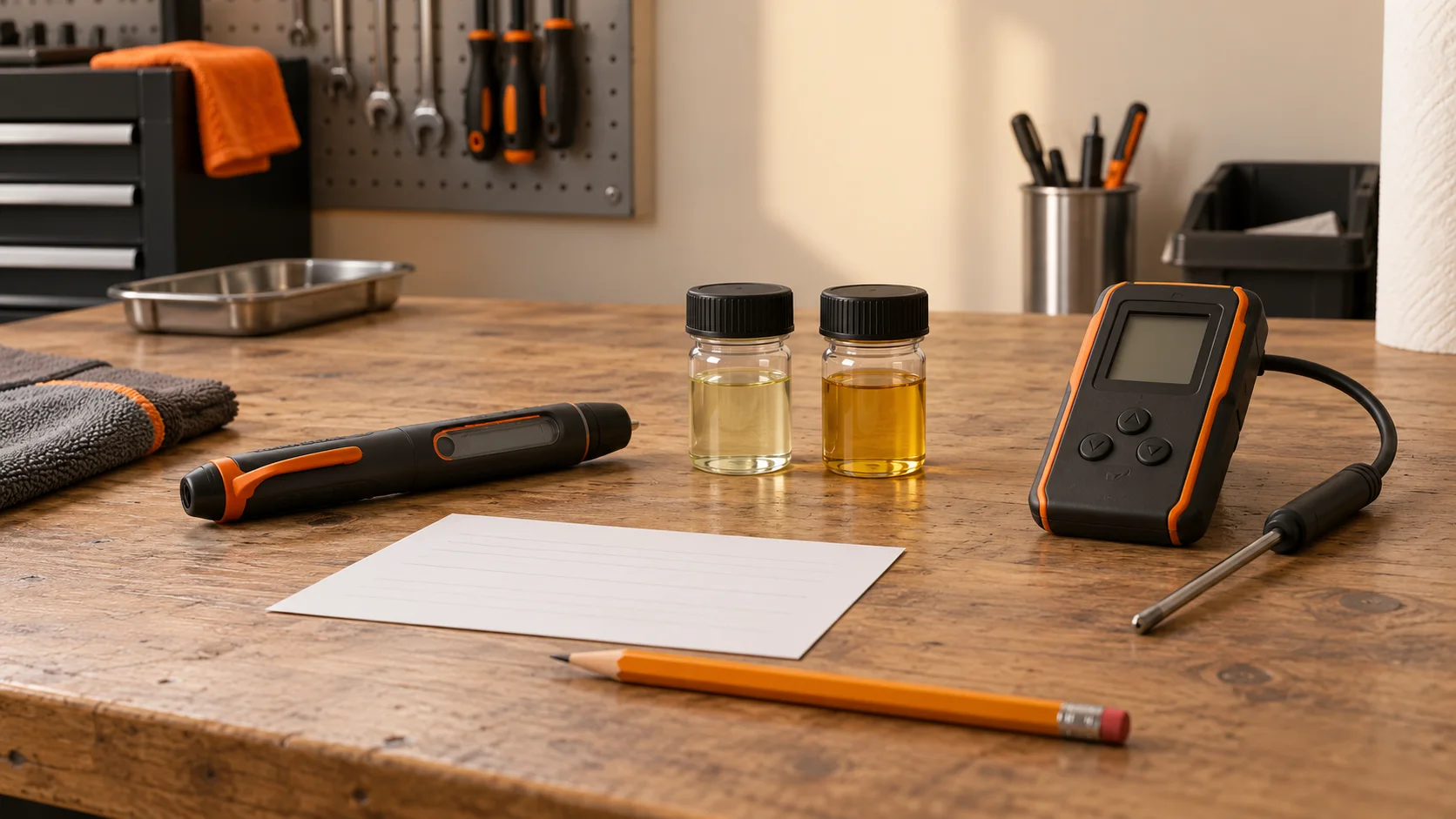
Before interpreting a brake-fluid tester, identify the measurement method. A conductivity-based indication and a measured boiling point are different observations. The useful shop question is not simply "what color did the tester show?" It is "what did this instrument measure for this identified sample, and what comparison is supported?"
That distinction helps a technician explain a result without turning a displayed percentage or temperature into an unsupported service decision.
Understand the indication before naming the result
Eurol's published test discussion describes conductivity pens that convert an electrical measurement into a moisture indication. Fluid composition can affect that conversion. In its reported DOT 4 test series, the conductivity devices gave inconsistent or misleading indications; the boiling-point device it tested behaved more reliably.
That is evidence from a particular test series, not a claim that every instrument of one shape behaves identically. Identify the specific tester, supported fluids, instructions and output before applying a result to a shop decision.
NAPA's Carlyle tester page also distinguishes conductivity from boiling-point measurement. The product description says its named tester measures boiling point and notes that additives can affect conductivity readings. This guide does not adopt the page's marketing promises as an accuracy guarantee for another device.
A displayed number does not identify the physical method. Even if a device shows a temperature, confirm whether it measures that quantity directly or reports an estimate derived through another method. Read the instrument documentation instead of deciding from the screen or housing alone.
Preserve sample identity and applicability
An original worksheet can keep five inputs together: vehicle, sample location, known fluid information, tester identity and the method the tester uses. If an input is unknown, preserve that uncertainty rather than supplying it from fluid color or an assumed service history.
Follow applicable vehicle, fluid and instrument instructions for access, sampling and safe handling. This article does not specify a reservoir-opening procedure, a probe connection, a heating routine or a sample-return method. It does not authorize mixing fluids or choosing a replacement product.
The result belongs to the sampled material under the recorded conditions. If a question remains about whether that sample represents the relevant part of the system, record it as a separate unresolved question.
Keep output, interpretation and action separate
Use three lines on the job card:
- Original output: exactly what the instrument displayed, with its units or indicator wording.
- Supported interpretation: what the identified method and applicable instructions allow the technician to conclude.
- Next action: the vehicle-directed comparison, additional evidence or service decision still required.
For example, an invented record could read: "Conductivity-based moisture indication recorded; tester/fluid applicability not yet confirmed; comparison pending." It should not become "boiling point verified" just because the display looks precise.
A second invented record might read: "Boiling-point result recorded under the instrument procedure; applicable vehicle service requirement not yet retrieved." That record is more complete in one respect, but it still leaves the service comparison open. Neither example contains a real measurement or a pass/fail threshold.
Resolve conflicting indications as a method problem
If two testers disagree, first preserve both outputs with their method and sample details. Ask whether they observed the same material, used supported settings and followed their respective instructions. Do not average unlike outputs into a single apparent answer.
Eurol recommends boiling-point testing based on its trials. A shop applying that lesson still needs the actual instrument's suitability and the vehicle's requirements. Repeating a test should have a recorded reason and should retain the first result; a later observation does not erase the earlier uncertainty.
Do not convert conductivity to boiling point or moisture content with an invented general formula. Any conversion or comparison needs support for the specific method and fluid. A reference reading, where the manufacturer requires one, should be recorded under that instrument's instructions.
Do not make one result answer every service question
A boiling-point observation answers a bounded thermal-property question for the sample. It is not by itself a complete statement about every property of the fluid, the system's condition or the remaining service interval.
Retrieve the applicable vehicle maintenance and service guidance before making the service decision. Keep that source reference separate from the instrument output. This guide supplies no universal replacement temperature, moisture percentage, fluid grade or interval.
A customer explanation can therefore stay concrete: "We recorded this result using this method; here is the applicable comparison, and here is what remains unresolved." That is more useful than presenting an instrument light as a complete system verdict.
A worksheet for the next technician
The downloadable method-to-result worksheet asks for:
- Vehicle and sample identification, known fluid information and remaining uncertainty.
- Tester model, method, supported application and instruction reference.
- Required conditions and any required reference-check result.
- Original output, units, repeats and reasons for repeating.
- Applicable vehicle requirement and completed or pending comparison.
- Supported conclusion, unresolved question and the next authorized step.
These fields organize evidence; they do not establish instrument accuracy or prescribe a brake repair. See STEP's diagnostic methodology and editorial policy. Independent shops can request Early Access to share how they document diagnostic work. This article does not claim that STEP tests brake fluid or selects a repair from a tester reading.