
Mechanic Guides
Thread Pitch Gauge: Keep Metric Pitch, TPI and Part Identity Together
Read a thread pitch gauge with its family and units. Keep metric pitch, TPI, diameter and part identity separate from replacement approval.
Published · 5 min read
Quick answer
Identify the gauge family and leaf convention. A pitch match alone does not establish thread diameter, sealing arrangement or an approved replacement part.
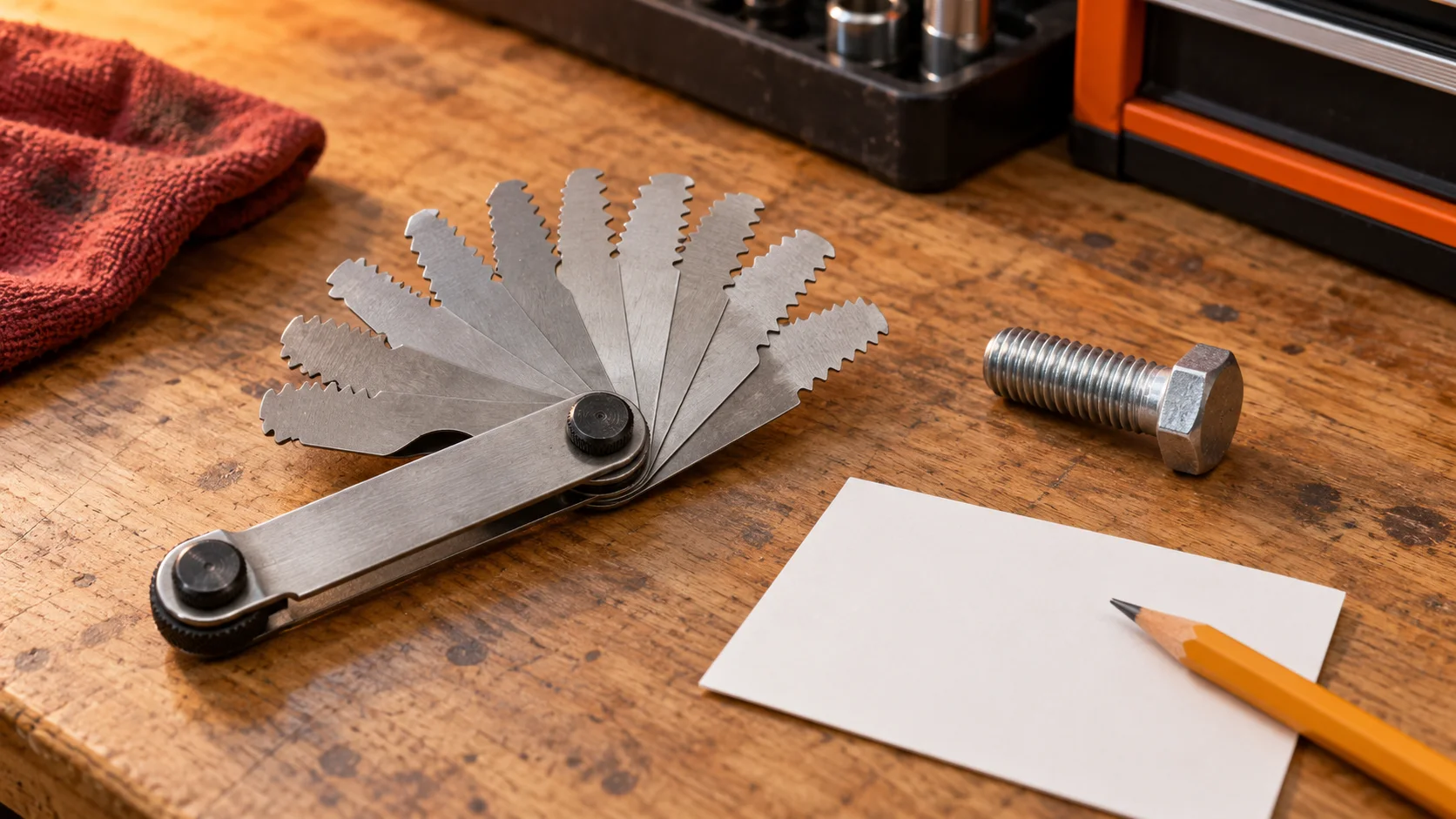
A leaf that appears to match a thread gives a useful pitch observation. It does not, by itself, identify an approved replacement bolt, fitting or adapter. A professional shop needs to keep the gauge family, units, part identity and remaining identification questions with that observation.
The first decision is what the leaf marking means. A metric pitch value and a threads-per-inch value describe thread spacing in different ways. Recording the number without its convention leaves the next technician guessing.
Identify the gauge family before reading a leaf
Starrett's screw pitch gauge description explains that each marked leaf has teeth corresponding to a specific pitch. It lists different thread families, including 60-degree Unified and metric forms and 55-degree Whitworth forms.
Those families are not identified well enough by calling a gauge "standard" or "imperial." Record the actual set, its markings and supported thread form. Follow the gauge instructions for the comparison; this article does not prescribe a universal leaf-contact technique.
If the set's identity is unknown or markings cannot be read, preserve that limitation. An apparent match with an unidentified leaf is not a complete thread designation.
Keep metric pitch and TPI in separate fields
Starrett distinguishes inch threads described in threads per inch from metric threads described by crest-to-crest distance. Parker's thread-identification section also uses millimeters between crests for metric pitch and shows diameter and TPI as separate parts of a Unified thread designation.
In an invented record, "leaf marked 1.5, metric set" and "leaf marked 20, TPI set" are different kinds of entries. They are not interchangeable labels, and neither identifies the thread diameter. These are illustrative markings, not real observations or a recommendation for a vehicle part.
Do not rewrite a leaf's original label from memory. Retain the marking and its units or convention, then compare with the applicable manufacturer's identification information. A calculation converting spacing units would still not establish thread form or fitment.
Keep diameter and geometry with the pitch observation
Pitch is one input to identification. Record a separate diameter observation using an appropriate instrument and applicable instructions. Retain the original units and identify what feature was measured; do not silently round a measured value into a nominal thread designation.
Parker's fitting guide distinguishes multiple thread types, including parallel and tapered forms and different sealing arrangements. It is useful evidence that a spacing match alone is incomplete. Its fitting examples are not authority for every automotive fastener or port.
For an unknown fitting, preserve the visible geometry and the reference used to interpret it. Do not infer a sealing method, pressure rating or compatible adapter solely from pitch and an approximate diameter. This article gives no sealant, assembly-torque or installation instruction.
Separate identification from replacement approval
For a bolt or screw, a thread identification record does not supply the vehicle's required part number, strength, length or other service requirements. For a fitting, it does not establish the required seal or application rating. Retrieve the applicable part and service information before choosing a replacement.
A part starting into a hole is not the evidence this worksheet asks for. Do not use forced engagement as an identification method. Keep an unresolved match unresolved and obtain the required information rather than treating an apparent physical fit as approval.
A useful shop entry could read: "Pitch observation recorded with identified gauge; diameter observation retained; candidate designation pending comparison with vehicle part information." It tells a parts specialist what is known and what still needs confirmation.
Handle an ambiguous match without losing evidence
If more than one leaf appears plausible, record the candidates, the gauge family and the limitation of the comparison. Keep the original part identity and location attached to the record. Do not choose a candidate merely because that replacement is on the shelf.
Use the actual instrument and identification instructions to decide the next check. If damaged or contaminated threads prevent a supported observation, record that condition; the worksheet does not authorize thread repair or chasing.
For a handoff, keep a candidate designation separate from a verified part reference. This prevents another technician from reading an identification note as a completed repair decision.
An identification card for shop use
The downloadable card asks for:
- Vehicle, component, original part identity and location.
- Gauge manufacturer or set identity, supported form and leaf marking.
- Metric crest-distance or TPI convention, with the original observation.
- Diameter observation, instrument and units.
- Relevant geometry, identification source and candidate designation.
- Applicable part reference, unresolved questions and the next authorized check.
The card organizes evidence; it is not a thread acceptance gauge, a replacement approval or an installation procedure. See STEP's diagnostic methodology and editorial policy. Shops can request Early Access to share their diagnostic handoff needs. This guide does not claim that STEP identifies an unknown thread or approves a replacement part.