What this code means
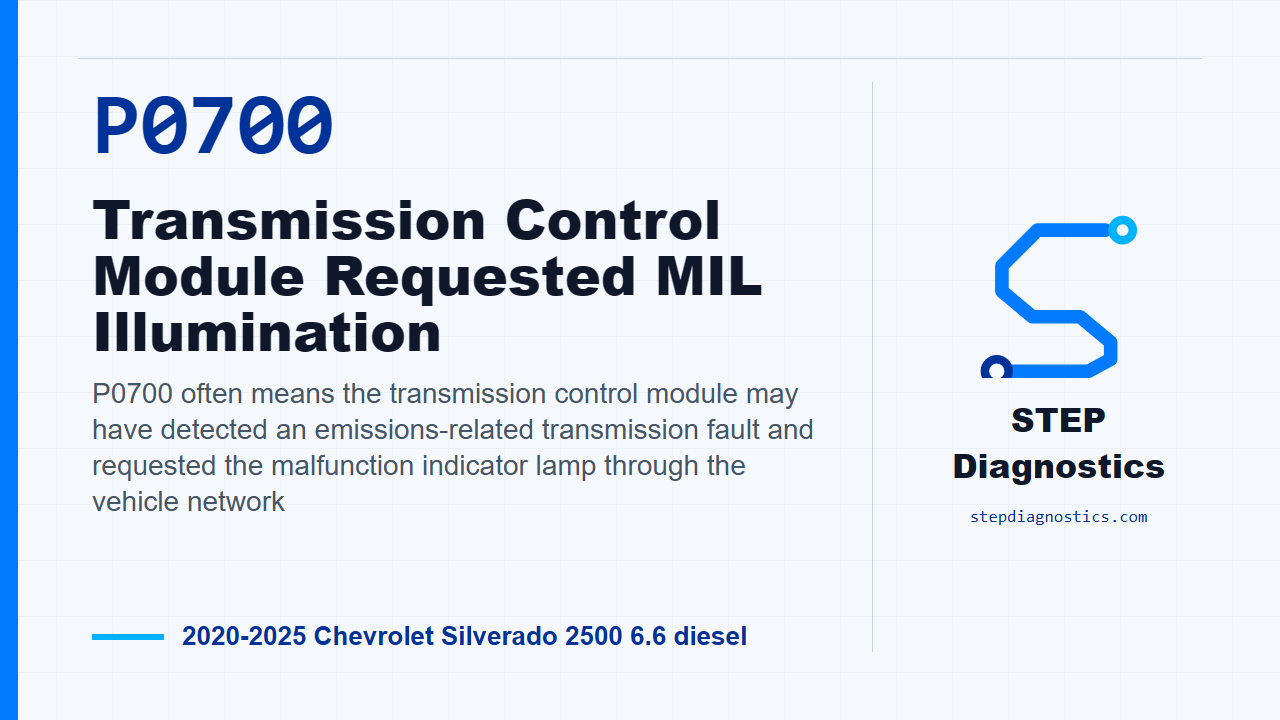
P0700 often means the transmission control module may have detected an emissions-related transmission fault and requested the malfunction indicator lamp through the vehicle network
What the vehicle may do
- The malfunction indicator lamp may be on
- The vehicle may have transmission-related symptoms depending on the underlying fault
- The vehicle can store additional codes that point to the real diagnostic path
Possible fault areas
- Possible transmission control system faults
- Possible serial data communication concerns
- Possible engine-control or fuel-system codes that may need to be handled before transmission diagnosis
Diagnostic path
Opening context
On this Silverado, P0700 is a routing code, not the root-cause transmission fault by itself. In plain language, the transmission control module has set an emissions-related fault and requested the malfunction indicator lamp through serial data. The customer may see the MIL on, and the truck can have transmission behavior that points you toward another stored code. Broadly, you’re thinking about possible transmission-related faults, serial data communication, or engine-control codes that need to be handled first. The key point is this: do not replace a control module just because P0700 is set.
How this code runs and sets
For the monitor gate, the engine has to be running. Once the running conditions are met, this code runs continuously. P0700 sets when an emissions-related DTC is set in the transmission control module, and that module requests the MIL. So treat P0700 as a signpost: it tells you to find the code that caused the request, not to condemn the module that reported it.
Start the diagnostic path
Start with the basic system checks, then follow a structured diagnostic approach before getting deep into this code. The first real split is important: check for Engine Controls and Fuel codes, and check for Serial Data codes. If any of those are present, diagnose those first before going after transmission-related codes.
Then check transmission code context
If there are no related Engine Controls and Fuel codes and no related Serial Data codes, move to the transmission side. Verify whether any transmission-related DTCs are set. If one is present, that is the diagnostic path to follow. P0700 is only telling you the transmission control module requested the light; the other transmission information is what points the diagnosis.
Reproduce the operating conditions
If no related transmission DTC is set, operate the vehicle under the conditions that allow the code to run. You can also use the captured conditions from when the fault was recorded and try to reproduce that operating situation. After that, verify whether any other DTCs set. If other codes return, follow those code paths first. If no other DTCs set, this path is all OK.
Verification and close
After any repair made during the related-code diagnosis, keep verification separate from the testing path. Verify the repair and confirm the code stays gone. The takeaway for P0700 is simple: it is an informational MIL-request code from the transmission side, so use it to route the diagnosis, do not use it as a standalone parts call. For more diagnostic training, visit stepdiagnostics.com.
Final check
P0700 is often a routing code, so the diagnosis may depend on finding and addressing the related codes that caused the MIL request
For more guided automotive diagnostics, visit STEP Diagnostics.