What this code means
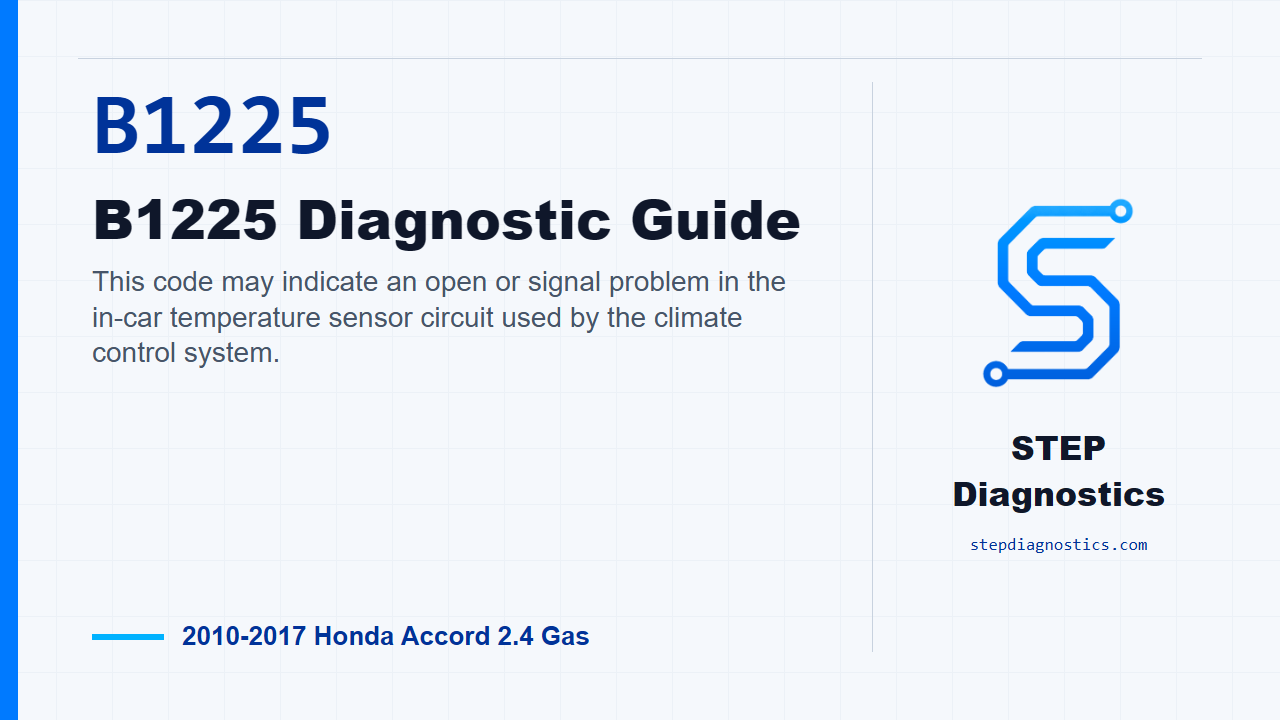
This code may indicate an open or signal problem in the in-car temperature sensor circuit used by the climate control system.
What the vehicle may do
- Automatic temperature control may feel inaccurate or inconsistent.
- Cabin temperature response may seem slow or may not match the selected setting.
Possible fault areas
- Possible wiring or connector issues in the in-car temperature sensor circuit.
- Possible in-car temperature sensor issue.
- Possible climate control unit circuit issue.
Diagnostic path
Opening and code meaning
On this Accord, B1225 points to a possible open in the in-car temperature sensor circuit for the climate control system. In plain terms, the climate control unit may not be seeing the in-cabin temperature signal the way it expects. The driver may notice automatic temperature control that feels inaccurate, slow to respond, or inconsistent. The fault area can include the in-car temperature sensor, the sensor wiring, connector fit, or the climate control unit side of the circuit. The diagnostic path is simple: first prove the code is current, then check the two sensor circuit paths, then check for the short condition in this test, and only then judge the sensor and control unit.
Verify whether the fault is current
Start by verifying the problem. Clear the DTC with the HDS. Then cycle the ignition from LOCK (0) back to ON (II), or use the engine start/stop button to go from OFF mode back to ON mode. Run the self-diagnostic function with the HDS or through the climate control unit, then check for codes again. If B1225, or the matching climate-control self-diagnostic indication, comes right back, continue into the circuit checks. If it does not come back, treat it as an intermittent failure and inspect for loose wires or poor connections in the in-car temperature sensor circuit before going deeper.
Check the TR line for an open
With the ignition at LOCK (0), or the vehicle in OFF mode, disconnect the climate control unit 32P connector and the in-car temperature sensor 2P connector. Now check continuity on the TR circuit. You are checking between climate control unit 32P connector No. 23, the LT BLU wire, and in-car temperature sensor 2P connector No. 2, also the LT BLU wire. If you have continuity, the TR wire is not open, so move on to the SENSOR COM check. If you do not have continuity, repair the open in the wire between the climate control unit and the in-car temperature sensor.
Check the SENSOR COM line for an open
Keep the same disconnected condition: ignition at LOCK (0) or OFF mode, climate control unit 32P connector disconnected, and in-car temperature sensor 2P connector disconnected. Check continuity on the SENSOR COM circuit between climate control unit 32P connector No. 22, the BLU wire, and in-car temperature sensor 2P connector No. 1, the BLU wire. If continuity is present, that SENSOR COM wire is OK, and you can continue to the short check. If continuity is not present, repair the open in the wire between the climate control unit and the in-car temperature sensor.
Check the TR line for a short to the S 5V circuit
Next, still with both connectors disconnected and the ignition at LOCK (0) or OFF mode, check whether the TR line is shorted to the S 5V circuit. Check continuity between climate control unit 32P connector No. 23, the LT BLU wire, and climate control unit 32P connector No. 24, the BLK wire. If there is continuity here, repair the short in the wires between the climate control unit and the in-car temperature sensor. If there is no continuity, the TR wire and the S5V line pass this part of the test, so move on to the sensor check.
Check the in-car temperature sensor
Now test the in-car temperature sensor. If the sensor tests OK after the wiring checks have passed, replace the climate control unit. If the sensor does not test OK, replace the in-car temperature sensor.
Takeaway
The key on B1225 is not to jump straight to a sensor. Prove the code is current, check the TR and SENSOR COM paths for opens, check the TR-to-S 5V short condition, and then make the sensor-versus-control-unit call. For more diagnostic training, visit stepdiagnostics.com.
Final check
B1225 is often diagnosed by first confirming whether the fault is current, then separating wiring faults from a possible sensor or control unit issue.
For more guided automotive diagnostics, visit STEP Diagnostics.