What this code means
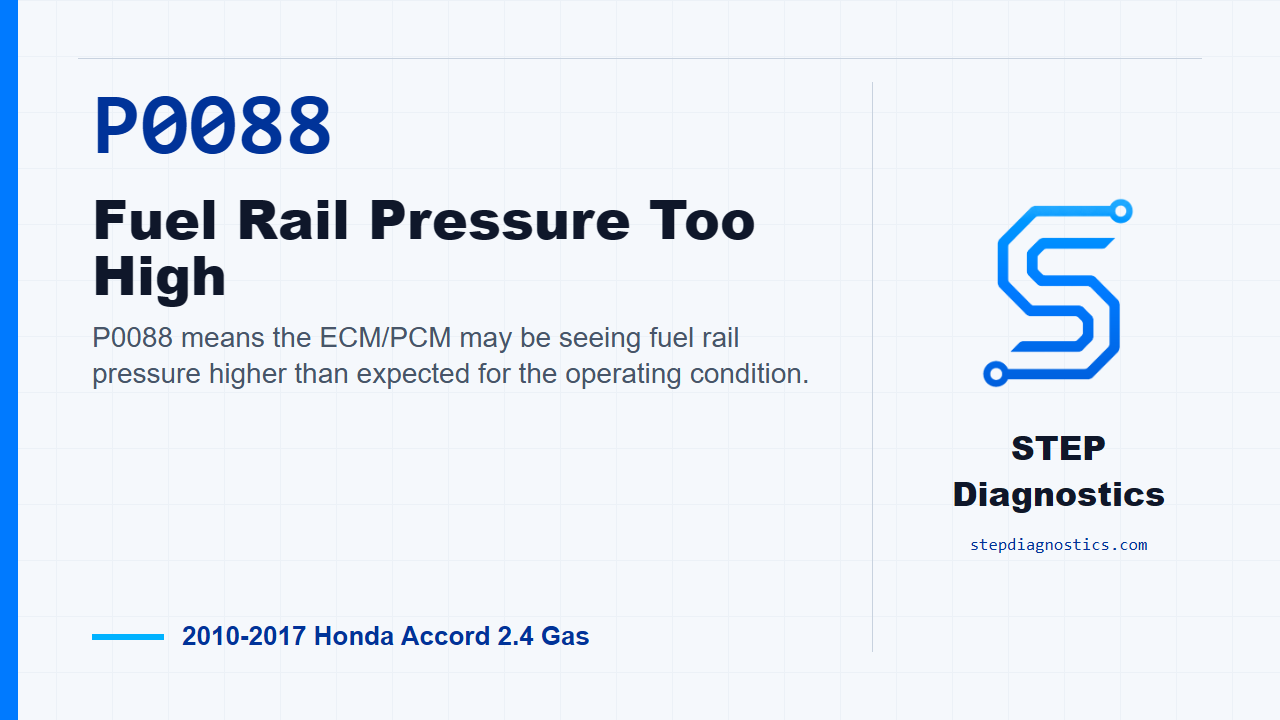
P0088 means the ECM/PCM may be seeing fuel rail pressure higher than expected for the operating condition.
What the vehicle may do
- The vehicle may run rough or hesitate.
- Throttle response can feel inconsistent.
- The warning light may come on with few noticeable symptoms.
Possible fault areas
- A possible fuel rail pressure signal issue.
- A possible high-pressure fuel control issue.
- A possible low-pressure fuel supply issue.
- Possible wiring, connector, or terminal concerns.
- Other engine-control faults may influence the test.
Diagnostic path
Opening context and first checks
On this 2010 to 2017 Honda Accord with the 2.4 gas engine, P0088 means the ECM/PCM is seeing fuel rail pressure higher than expected. The vehicle may run rough, hesitate, lack clean throttle response, or set the light with no obvious complaint. Broadly, this can involve the fuel rail pressure signal, high-pressure fuel control, the low-pressure fuel supply side, wiring or terminal condition, or other engine-control faults influencing the test. Before chasing P0088 by itself, start with the basic system checks. Record the freeze data and on-board snapshots with the HDS. If other related fuel pressure, injector, ignition, mixture, or control codes are present, handle what those codes mean first, then come back and recheck P0088.
Verify the code at idle
Turn the ignition ON, clear the code with the HDS, then start the engine. Bring the engine to operating temperature by holding it at 3,000 rpm with no load, transmission in Park or Neutral on an automatic, or neutral on a manual, until the radiator fan comes on. Then let it idle. Run the DI FUEL PRESSURE TEST in the HDS inspection menu and check for pending or confirmed codes. If P0088 comes back here, move into the fuel rail pressure sensor checks. If it does not come back at idle, reproduce the captured driving conditions next.
Verify the code on a road test
Test-drive the vehicle for several minutes in the range of the recorded freeze data conditions: engine speed, vehicle speed, MAP sensor, throttle position sensor, accelerator pedal position sensor, ECT sensor 1, and IAT sensor. After that, check pending and confirmed codes again with the HDS. If P0088 sets, continue with the fuel rail pressure sensor check. If it does not set, treat it as intermittent for now and inspect for poor connections or loose terminals at the fuel rail pressure sensor, the high pressure fuel pump, and the PCM.
Fuel rail pressure sensor check with pressure relieved
Now check whether the pressure signal responds correctly after fuel pressure is relieved. Turn the ignition OFF, remove PGM-FI main relay 2 from the under-dash fuse and relay box, then start the engine and let it idle until it stalls. After it stalls, press the accelerator pedal to the floor and crank the engine several times. Watch FUEL PRESSURE CONVERTED FROM PF SENSOR on the HDS. The value should change to about 100 kpa. If it does, continue to the next sensor comparison. If it does not, the supported repair path is to replace the fuel rail, which includes the fuel rail pressure sensor, then verify the repair.
Fuel rail pressure sensor comparison under load command
For the second sensor check, turn the ignition OFF and reinstall PGM-FI main relay 2. Start the engine, hold it at 3,000 rpm with no load until the radiator fan comes on, then let it idle. On an automatic, shift to Drive while holding the brake firmly, then press the accelerator pedal. Do not move the shift lever or take your foot off the brake while raising engine speed. On a manual, snap the throttle several times. For a manual transmission, use the HDS Line Graph Setup mode to compare the values. Watch FUEL PRESSURE CONVERTED FROM PF SENSOR, FUEL PRESSURE DIRECT INJECTION SYSTEM, and RELIEF VALVE. The two pressure values should be almost the same, and RELIEF VALVE should indicate CLOSE. If the values match and the relief valve shows CLOSE, the fuel rail pressure sensor is OK and the next check is the low-pressure side. If the pressure values are not the same, replace the fuel rail with the fuel rail pressure sensor, then verify the repair. If OPEN is indicated, replace the high pressure fuel pump, then verify the repair.
Low-pressure side fuel pressure check
Next, check the fuel pressure on the low-pressure side. If that fuel pressure checks OK, the supported path is to replace the high pressure fuel pump, then verify the repair. If the low-pressure side is not OK, stay on the fuel supply system on the low-pressure side and correct that problem before running verification. The point here is to avoid blaming the high-pressure side until the feed side has been checked.
Verify the repair
Keep verification separate from the testing. Turn the ignition ON, reset the PCM with the HDS, and do the PCM idle learn procedure. Then run the DI FUEL PRESSURE TEST again and check for pending or confirmed codes. If P0088 is still indicated, inspect for poor connections or loose terminals at the fuel rail pressure sensor, the fuel rail pressure control valve, the fuel rail pressure regulator, and the PCM, then pause, recheck the earlier diagnostic path, and avoid guessing. If P0088 does not return, troubleshooting for this code is complete. If other codes are present, check what they mean next.
Takeaway and CTA
The clean way through P0088 is to confirm the fault under the captured conditions, prove the fuel rail pressure signal, compare actual pressure reporting against the direct-injection pressure value and relief valve state, then check the low-pressure feed before making a high-pressure call. For more diagnostic training, visit stepdiagnostics.com.
Final check
P0088 is best handled by confirming the fault, checking pressure signal behavior, comparing pressure data, and keeping repair verification separate from testing.
For more guided automotive diagnostics, visit STEP Diagnostics.