What this code means
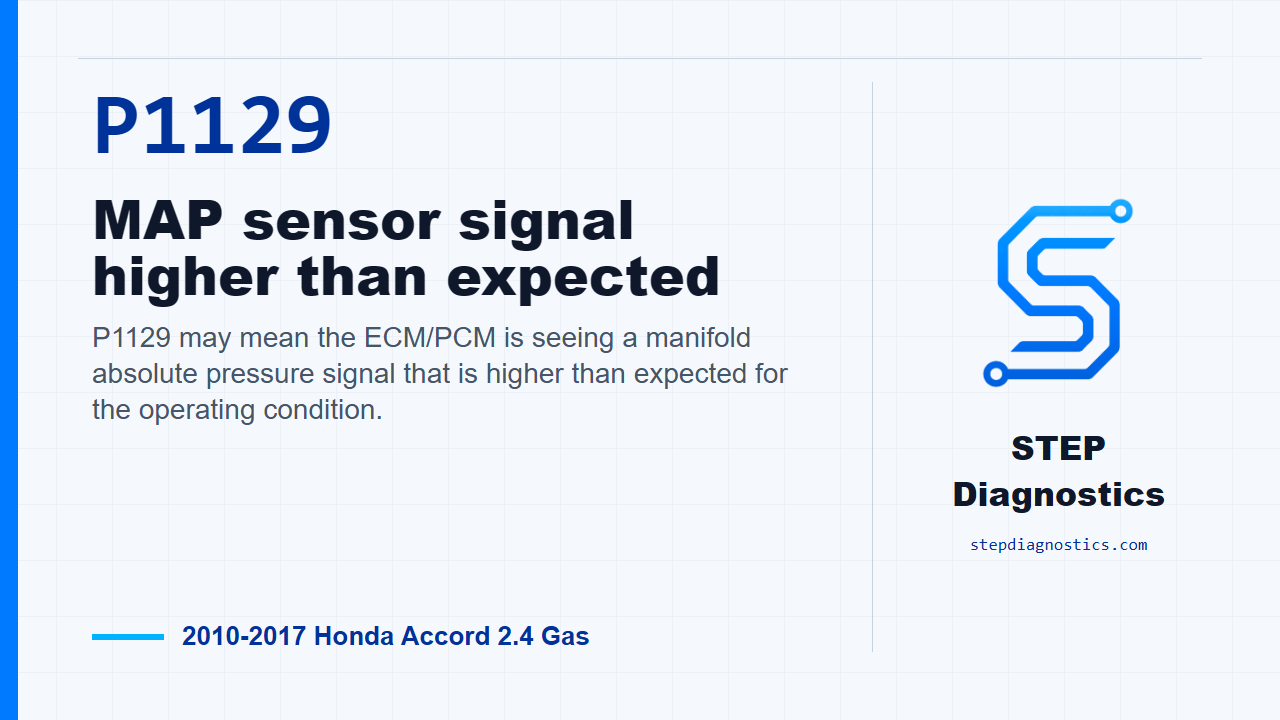
P1129 may mean the ECM/PCM is seeing a manifold absolute pressure signal that is higher than expected for the operating condition.
What the vehicle may do
- The vehicle may have a check engine light.
- It may have a drivability complaint, or it may run normally while the code is stored.
- The fault can be intermittent if the signal or connection concern only happens under certain conditions.
Possible fault areas
- Possible intake or vacuum leaks may affect the MAP reading.
- MAP sensor performance can be involved.
- Connector or terminal condition at the MAP sensor circuit and PCM can be involved.
Diagnostic path
Code overview and starting point
On this 2010 to 2017 Accord with the 2.4 gas engine, P1129 is a MAP sensor signal higher than expected fault watched by the ECM/PCM. In plain terms, the computer may be seeing manifold pressure behavior that does not fit what it expects. The vehicle may have a drivability complaint, or it may only have a warning light. Broadly, this can involve an intake or vacuum leak, MAP sensor performance, or possible connection issues in the MAP sensor circuit. Before getting into the test path, record the freeze data and any on-board snapshot, then start with the basic system checks and follow a structured diagnostic approach.
Check for vacuum leaks first
Start with the vacuum leak check. Look over the common leak points in this path: the PCV valve and hose, EVAP canister purge valve, throttle body area, intake manifold, brake booster, and brake booster hose. If you find a vacuum leak, repair or replace only the leaking part, then move to repair verification. If no vacuum leaks are found, continue into the MAP sensor performance check.
MAP sensor performance check
For the MAP performance check, start the engine and warm it up by holding engine speed at 3,000 rpm with no load. On an automatic, use P or N; on a manual, use neutral. Hold it there until the radiator fan comes on, then let the engine idle. With the HDS, watch the MAP SENSOR parameter for 5 seconds. The diagnostic threshold is MAP SENSOR More than 36.9 kPa, and the question is whether it maintains the malfunction threshold for 5 seconds or more. If it does, replace the MAP sensor, then verify the repair. If it does not, continue to problem verification.
Problem verification
Next, clear the DTC with the HDS and try to duplicate the fault under the required monitor conditions. The drive condition is ECT SENSOR 1 above 158 °F (70 °C), engine speed between 1,400-6,700 rpm, automatic in D or manual in 5th or 6th, then drive steadily between 55-75 mph (90-120 km/h) for 10 seconds and decelerate with the throttle fully closed for 5 seconds. After that, monitor the OBD STATUS for P1129 in the HDS DTCs menu. If the HDS shows FAILED, the failure is duplicated; replace the MAP sensor, then verify the repair. If it shows PASSED, treat it as an intermittent failure and check for poor connections or loose terminals before going further. If it shows NOT COMPLETED, pause, make sure the operating conditions were actually met, and recheck without guessing.
Repair verification
Keep repair verification separate from the testing steps. Turn the ignition to ON (II), or use the engine start/stop button to select ON mode. Reset the PCM with the HDS, then do the PCM idle learn procedure. Start the engine again, hold it at 3,000 rpm with no load until the radiator fan comes on, then let it idle. Run the same verification drive conditions: ECT SENSOR 1 above 158 °F (70 °C), engine speed between 1,400-6,700 rpm, automatic in D or manual in 5th or 6th, steady speed between 55-75 mph (90-120 km/h) for 10 seconds, then throttle-closed decel for 5 seconds. Now monitor OBD STATUS for P1129. If it shows PASSED, troubleshooting is complete, and if other pending or confirmed codes are present, check what they mean first. If it shows FAILED, go back to the vacuum leak check and recheck the path from the beginning. If it shows NOT COMPLETED, meet the test condition and check OBD STATUS again.
Takeaway
The clean way through P1129 is to rule out vacuum leaks first, then prove whether the MAP signal is staying above the threshold, then duplicate and verify the fault with the proper drive conditions. Do not skip verification; it is what confirms the code stays gone. For more diagnostic training, visit stepdiagnostics.com.
Final check
P1129 is best handled by checking for leaks first, then proving MAP sensor performance, duplicating the fault under the right conditions, and finishing with a separate repair verification.
For more guided automotive diagnostics, visit STEP Diagnostics.