What this code means
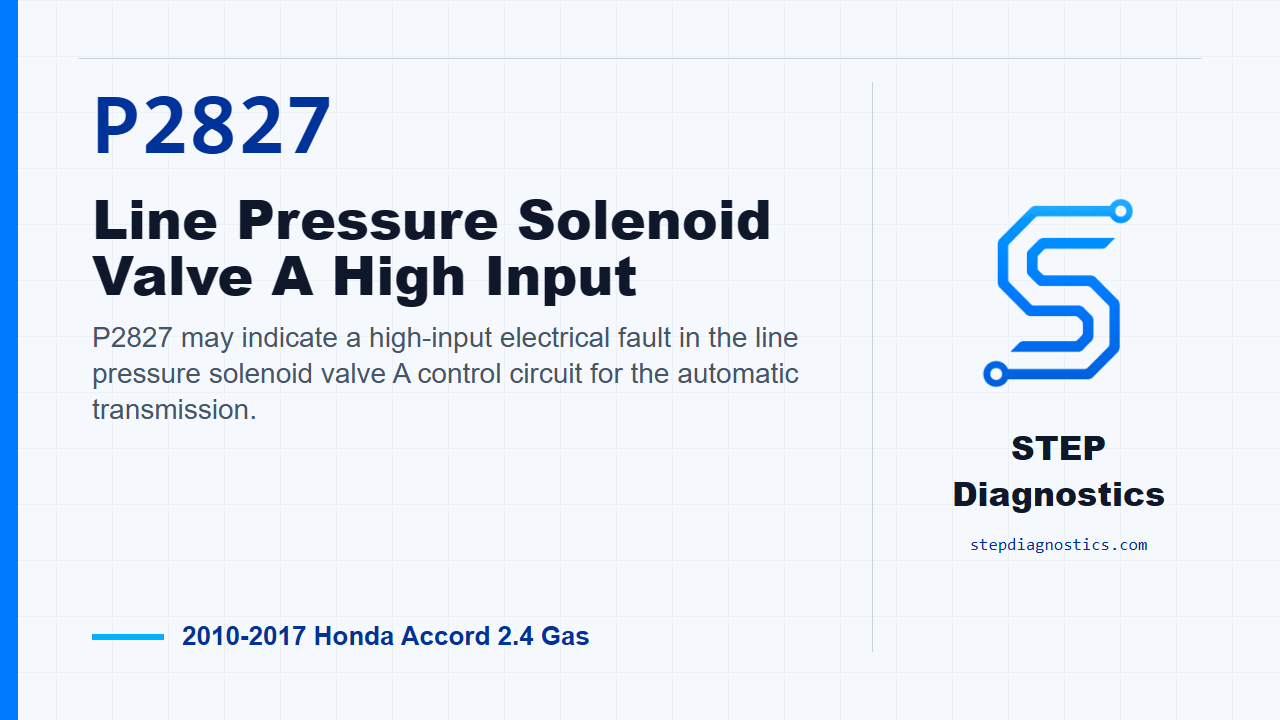
P2827 may indicate a high-input electrical fault in the line pressure solenoid valve A control circuit for the automatic transmission.
What the vehicle may do
- The vehicle may show a transmission warning or check-engine light.
- Shift quality may feel abnormal or inconsistent.
- The transmission can sometimes operate in a reduced or protective strategy.
Possible fault areas
- Possible line pressure solenoid valve A circuit fault.
- Possible connector or terminal problem between the solenoid and PCM.
- Possible ground-side problem.
- Possible open in the PLA signal wire.
- Possible PCM control-side issue.
Diagnostic path
Set the context
On this Accord, P2827 is a high-input fault for line pressure solenoid valve A in the automatic transmission control circuit. The vehicle may have shift complaints, a warning light, or reduced transmission operation, but this diagnostic path treats the code as an electrical circuit problem, not an internal mechanical transmission failure. The broad areas in play are the solenoid circuit, connector and terminal condition, the ground side, the signal wire back to the PCM, and the PCM control side. Before touching the circuit, save the freeze data and any on-board snapshot with the HDS so you know the conditions the car saw when the fault set.
Confirm the code path first
Start with the basic system checks. Select ON mode with the engine start/stop button, then check the PGM-FI system for pending or confirmed codes with the HDS. If other codes are present there, check what they mean first. If there are no PGM-FI codes to chase, move to the automatic transmission system and check for pending or confirmed codes there. If P2827 is not indicated, treat it as intermittent for now: the system is okay at this moment, so inspect for poor connections and loose terminals between line pressure solenoid valve A and the PCM. If P2827 is indicated, the failure is duplicated, and you can move into circuit isolation.
Force the circuit response
Turn the vehicle OFF. Disconnect the line pressure solenoid valve A 2P connector. Jumper connector No. 1, the YEL wire, to body ground. Turn ON mode back on and clear the code with the HDS. For the running portion, either use a lift, or apply the parking brake, block the rear wheels, raise the front of the vehicle, make sure it is securely supported, and allow the front wheels to rotate freely. Start the engine. With the brake pedal pressed, shift to D, then release the brake pedal. Watch APP Sensor (%) on the HDS and press (2 % opened) and release (0 % opened) the accelerator pedal every 2 seconds. Now check again for pending or confirmed transmission codes. If the circuit changes over to the companion low-input fault, continue with the solenoid ground-side check. If it does not, move to the PLA line open-circuit check.
Check the solenoid ground side
For the solenoid ground-side branch, turn the vehicle OFF and remove the jumper wire. With the line pressure solenoid valve A 2P connector still disconnected, check continuity on the PG circuit between connector No. 2, the BLK wire, and body ground. If there is continuity, the fault is in line pressure solenoid valve A, and the repair is to replace the secondary valve body, which includes line pressure solenoid valve A. If there is no continuity, line pressure solenoid valve A is okay on this check. Repair the open in the PG wire between line pressure solenoid valve A and body ground G101, or repair the poor body ground at G101.
Check the PLA wire back to the PCM
If the forced circuit test did not bring in the companion low-input fault, turn the vehicle OFF and remove the jumper wire. Jump the SCS line with the HDS, then disconnect PCM connector B, the 51P connector. With the solenoid connector and PCM connector disconnected, check continuity on the PLA circuit between line pressure solenoid valve A 2P connector No. 1, the YEL wire, and PCM connector B 51P No. 5, also the YEL wire. If there is continuity, the PLA wire is okay, and the repair path is PCM replacement. If there is no continuity, repair the open in the PLA wire between line pressure solenoid valve A and the PCM.
Verify and close
Keep verification separate from fault isolation. After the repair path is completed, verify the repair and confirm P2827 stays gone before delivery. The takeaway is simple: prove the code, force the circuit to respond, then use the continuity checks to separate the solenoid, ground, PLA wire, and PCM sides without guessing. For more diagnostic training, visit stepdiagnostics.com.
Final check
P2827 is best approached as an electrical circuit diagnosis: confirm the code, duplicate the fault, then isolate the solenoid, ground, wiring, and PCM sides in order.
For more guided automotive diagnostics, visit STEP Diagnostics.