A window that moves is not necessarily a window whose controller can track its movement correctly. On the Honda Accord, a position-detection fault can send diagnosis toward related motor feedback faults or a required control-unit reset before a replacement part is justified.
This overview explains the front power-window position-detection function on the 2010–2017 Honda Accord 2.4 Gas. Equipment, body style, control architecture, and service procedures vary across this range. The diagnostic examples are supported by service information for the 2010 Accord 2.4 and 2017 Accord Sedan 2.4; they do not establish one identical reset sequence or wiring arrangement for every intervening configuration. Use the applicable service information for the vehicle being repaired for exact circuit identification, test conditions, tool commands, initialization, and repair verification.
What position detection adds to window movement
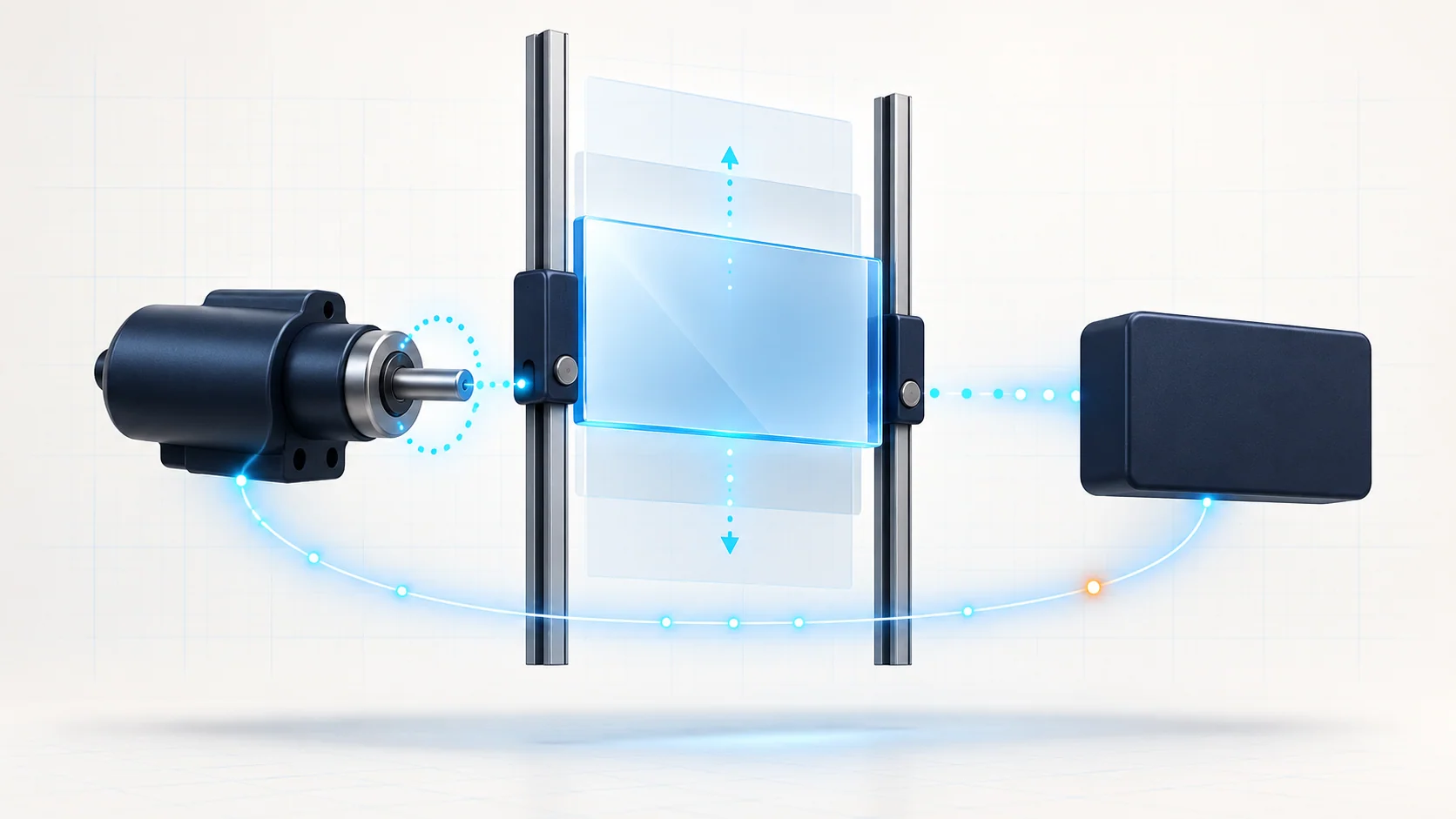
The switch requests movement, the motor and regulator move the glass, and the control system uses movement information to support learned window behavior. Manual movement and automatic operation are different observations: successful manual travel alone does not establish that the controller has a valid learned state or that automatic operation works correctly.
At a useful diagnostic level, separate three functions:
- Command: the driver's master switch or passenger switch requests movement.
- Movement and feedback: the motor/regulator moves the glass, while the position-related signal path supplies information used by the control system.
- Learning and control: the relevant controller uses its learned state to support automatic window operation. Service work can make initialization necessary on the applicable configuration.
The factory position-detection charts direct attention to related motor pulse faults before a reset path. This is why a position code should not be treated as a direct instruction to replace a motor, regulator, or switch.
Driver and passenger codes identify different branches
| STEP guide | Diagnostic role |
|---|---|
| B1140 — Driver's Power Window Position Detect Circuit Malfunction | Starts with the driver's window position-detection concern. Related driver-window faults and the applicable reset path matter before component replacement. |
| B1145 — B1145 Diagnostic Guide | Covers the front passenger position-detection branch. Reproduction using the passenger switch and the related passenger-window faults help select the next step. |
Keep the affected side and the switch used during the complaint in the work order. A successful test from one switch does not automatically reproduce a concern reported from another. When several body-system codes are stored, follow the applicable network and body-system diagnostic order rather than treating each code as an isolated failed component.
Failure categories and possible symptoms
An incomplete or disturbed learned state. A complaint after window-related work may require checking whether the prescribed initialization was completed. The reviewed 2017 reset information covers several kinds of glass, regulator, motor, and switch service, with configuration-specific conditions. That history is a diagnostic clue, not proof that a reset will repair every complaint.
A movement-feedback or electrical fault. Related motor pulse faults can change the direction of diagnosis. An affected circuit, connection, motor feedback function, or control component remains a candidate until the applicable tests distinguish them. Clearing the position code without checking related faults can leave the actual problem unresolved.
A movement problem requiring separate inspection. Poor glass travel, abnormal noise, or obvious interference calls for inspection of the glass and regulator system as well as electrical diagnosis. Do not assume every slow, stuck, or uneven window is caused by lost position learning, or force the glass through an obstruction to complete a reset.
The customer may report loss of one-touch behavior, inconsistent automatic operation, or a code that returns after window use even though manual movement is possible. Symptoms are not guaranteed on every configuration. A nonreturning code establishes only that the fault was not reproduced during that check; it does not prove an intermittent concern is permanently repaired.
A practical diagnostic strategy
- Identify the actual configuration and complaint. Confirm model year, body style, affected window, installed automatic functions, and whether the concern follows recent work. Record whether the complaint involves manual travel, automatic travel, position codes, or more than one of these.
- Record the complete code picture. Use a suitable tool with access to the relevant body/window systems. Save the initial results before clearing anything. The reviewed procedures use Honda's diagnostic tool; a generic engine-code reader may not provide the needed body-system coverage.
- Reproduce the concern under the applicable conditions. Follow the relevant chart for vehicle mode, switch selection, and window operation. Recheck codes after the prescribed operation. Do not transplant a driver's-window confirmation sequence into a passenger-window procedure.
- Resolve related faults in the specified order. The reviewed charts give related motor pulse faults priority over the reset branch. Use the exact vehicle's chart to decide whether circuit, feedback, communication, or control-component testing is required.
- Initialize only when the diagnostic path calls for it. A reset is a controlled service step, not a universal first repair. Follow the correct procedure for that controller and configuration. If the code returns, continue the chart instead of repeatedly resetting it without new evidence.
- Verify both control behavior and code status. After the supported repair or initialization, check normal manual travel and the automatic functions actually fitted, then perform the prescribed DTC confirmation. Complete any applicable obstruction-detection or reversal check using the manufacturer's safe method.
The early and late endpoint charts share the distinction between related faults and a reset path, but their later branches differ. This overview deliberately leaves exact timing, switch sequences, connector tests, and substitute-component decisions to the applicable service procedure.
Repair categories and verification
A supported repair may involve correcting a diagnosed electrical connection or feedback fault, repairing a separately confirmed mechanical travel problem, replacing a component proven faulty by the appropriate chart, or completing required initialization after service. A code by itself does not select among those categories.
Record what changed and what was verified. Normal manual travel, restored automatic operation, and a clean follow-up code check are distinct results. If the initial complaint cannot be reproduced, document that limit and the conditions tested rather than declaring a permanent repair from a single successful cycle.
Safety around moving glass and door components
Keep hands, tools, clothing, and other people clear of the glass travel and regulator mechanism. Do not use a hand or any body part to test obstruction detection, and do not rely on automatic reversal to prevent injury. Follow the manufacturer's approved test method and test object where such a check is required.
Before door disassembly, follow the applicable electrical isolation and restraint-system precautions. Support glass and mechanisms as directed, and remember that restoring power or operating a switch can cause unexpected movement. Do not bypass protection functions or jumper unfamiliar circuits to force operation. Return the vehicle only after the required functional and safety checks have been completed.