What this code means
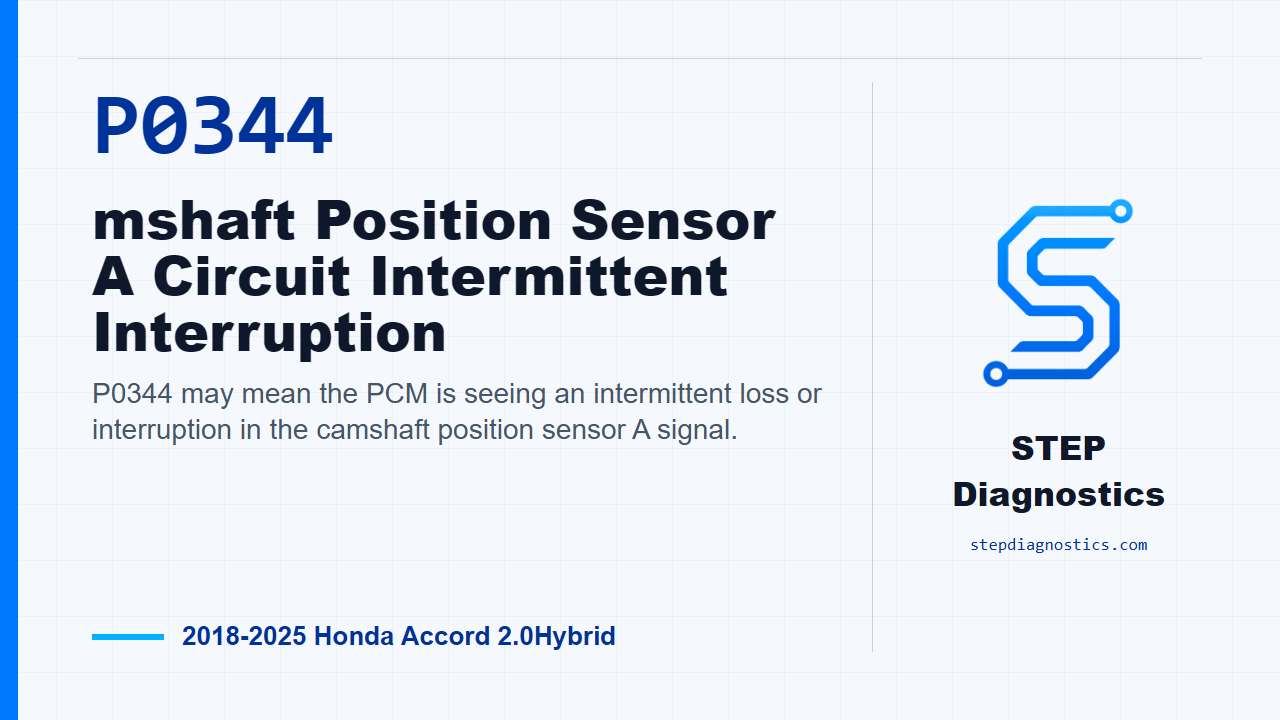
P0344 may mean the PCM is seeing an intermittent loss or interruption in the camshaft position sensor A signal.
What the vehicle may do
- The vehicle may run rough, hesitate, stall, crank longer than usual, or only show a warning light when the fault occurs.
- Because the fault may be intermittent, symptoms can come and go.
Possible fault areas
- Possible areas can include the CMP sensor A signal path, connector or terminal condition, ground integrity, PCM-side connection, and the camshaft pulse plate the sensor reads.
Diagnostic path
Opening context
This episode is for P0344 on a 2018 to 2025 Honda Accord 2.0 hybrid. In plain language, this code points to an intermittent interruption in the camshaft position sensor A signal. The vehicle may have a rough run, a hard start, a stall, or it may only set the light when the fault acts up. Broadly, this can involve the cam sensor signal path, connector or ground integrity, the PCM connection, or the mechanical target the sensor reads. The diagnostic logic here is about proving whether the PCM is losing the expected cam pulse relationship, then working through the circuit and mechanical checks in order.
How the code sets
The PCM is watching the camshaft position sensor A pulses against crankshaft rotation. If those pulses are not what the PCM expects during certain crankshaft revolutions, it flags the signal as abnormal and stores P0344. Because this is an intermittent interruption code, the first job is to reproduce it under controlled conditions before moving into component checks.
Start with the basic checks
Before digging into the pinpoint checks, start with the basic system checks and follow a structured diagnostic approach. If anything obvious is found during those checks, handle that first so the rest of the diagnosis is not chasing a secondary symptom.
Confirmation procedure one
Perform the confirmation procedures in order. First, enter maintenance mode, start the engine, and let it idle for 10 seconds or more. While it is running, monitor the HDS under OBD STATUS for P0344 in PGM-FI. If the failure duplicates during this check, the confirmation procedure is complete.
Confirmation procedure two
If the first confirmation does not duplicate the fault, move to the second confirmation. Test-drive the vehicle for several minutes in the same range as the recorded on-board snapshot parameters, using Engine Speed and Vehicle Speed as the reference points. Then monitor the HDS OBD STATUS for P0344 again. If the failure duplicates here, the confirmation portion is complete.
Use the captured operating data
Use the HDS PGM-FI Data List to watch Engine Speed and Vehicle Speed. Those are the signals called out for matching the operating conditions, so use them to keep the road test close to the conditions where the fault was recorded.
Check the sensor and PCM connections
Next, inspect the CMP sensor A circuit connectors. Check for a secure connection and for loose terminals at the CMP sensor A and at the PCM. If that inspection is abnormal, the problem is in the connections or terminals. If the connections and terminals are OK, continue in order.
Check the ground connections
Now check the connectors and terminals at the engine ground and body ground. Again, the focus is secure connection and loose terminals. If anything is abnormal here, the problem is in those connections or terminals. If the ground-side connections and terminals are OK, move on to the mechanical target inspection.
Inspect the CMP pulse plate
For the CMP pulse plate A visual inspection, remove the cylinder head cover as preparation. Then visually inspect CMP pulse plate A for looseness or damage. If the pulse plate is loose or damaged, the problem is with CMP pulse plate A. If there is no looseness or damage, continue to the final sensor judgment.
Final sensor judgment
If the connector checks, ground checks, and CMP pulse plate inspection all show normal condition, then the remaining CMP sensor A is determined to be the cause. At that point, avoid guessing backward through the tree; the path has already ruled the prior inspection items normal.
Closing takeaway
The key with P0344 is to confirm the intermittent cam signal issue first, then work the path in order: sensor and PCM connections, grounds, pulse plate condition, and only then the remaining CMP sensor A conclusion. For more diagnostic training, visit stepdiagnostics.com.
Final check
P0344 is often best approached by duplicating the fault first, then checking the signal path and mechanical target in order before judging the remaining sensor.
For more guided automotive diagnostics, visit STEP Diagnostics.