What this code means
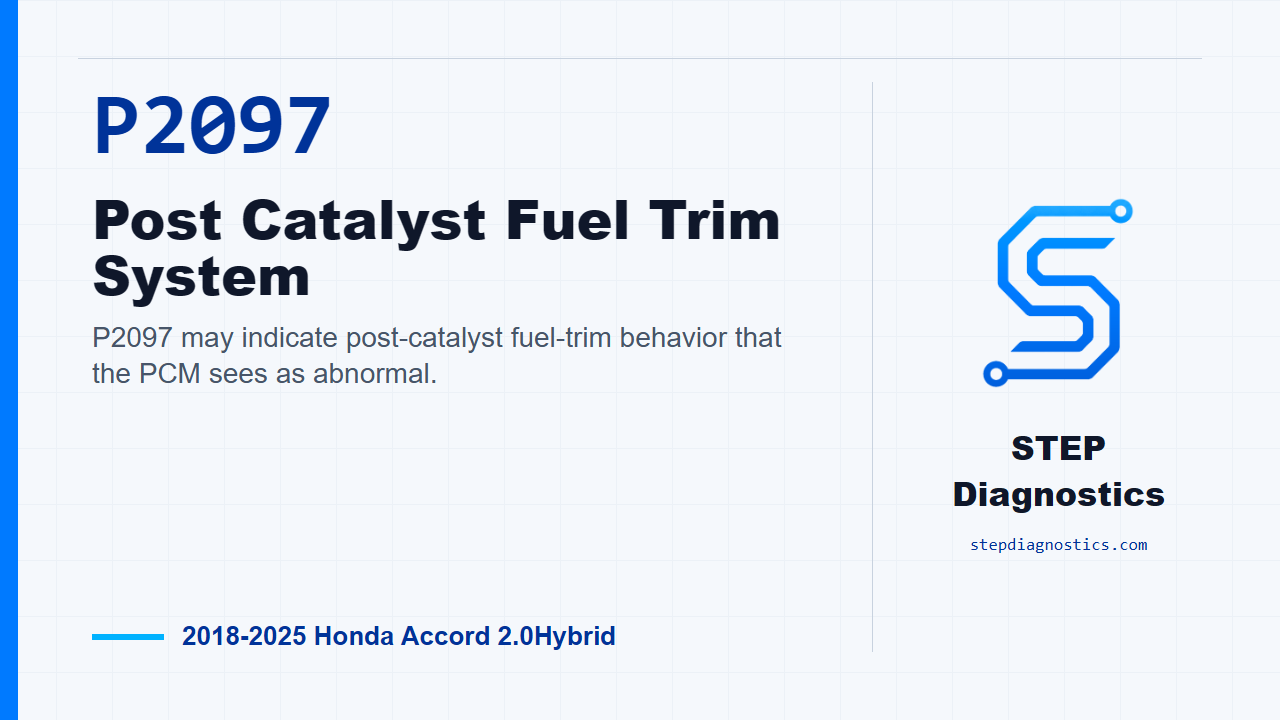
P2097 may indicate post-catalyst fuel-trim behavior that the PCM sees as abnormal.
What the vehicle may do
- The check engine light may be on.
- The vehicle can often feel normal even when the code is stored.
Possible fault areas
- Possible exhaust leakage or restriction concerns.
- Possible A/F sensor or oxygen sensor feedback concerns.
- Possible fuel control, injector, misfire, ignition, or cylinder air-fuel variation concerns.
Diagnostic path
Opening context
On this Accord Hybrid, P2097 points to the post-catalyst fuel trim system. In plain terms, the PCM is seeing fuel-trim behavior after the catalyst that may be outside what it expects. The driver may notice a check engine light, and the vehicle can otherwise feel fairly normal. Broadly, this kind of code can involve exhaust leakage or restriction, air-fuel sensor feedback, oxygen sensor feedback, fuel control, injector balance, misfire, ignition, or cylinder air-fuel variation concerns. Before chasing P2097 by itself, start with the basic system checks and follow a structured diagnostic approach. If other related codes are present in those sensor, fuel, injector, misfire, ignition, or cylinder variation areas, check what they mean first.
Reproduce the monitor conditions
To confirm the P2097 path, enter maintenance mode and start the engine. Hold the engine at 3,000 rpm without load, in P or N, until the radiator fan comes on. Then turn the vehicle to OFF, LOCK mode.
Road-test and watch the code status
Now test-drive the vehicle with ECT Sensor 1 above 158 °F (70 °C), the transmission in D, and drive at a steady speed between 15 - 75 mph (25 - 120 km/h) for 27 seconds or more. Watch the HDS OBD status for P2097. Treat these as the monitor gates; the point is to put the vehicle back into the conditions where the PCM can make the decision.
Check cylinder air-fuel variation
If the P2097 path still needs diagnosis, move into the cylinder air-fuel variation check. Enter maintenance mode again, start the engine, and hold it at 3,000 rpm without load, in P or N, until the radiator fan comes on. Set the test conditions with the A/C off and all electrical loads off, then run the cylinder air-fuel test. A normal result keeps you moving forward in the P2097 path. If that test is abnormal, pause P2097 and diagnose the cylinder air-fuel variation concern first.
Inspect the exhaust system
Next, inspect the exhaust between the A/F sensor, Sensor 1, and the secondary HO2S, Sensor 2. You are looking for leakage, and also for any clogs or restrictions in the exhaust system. If that inspection is abnormal, the problem is in the exhaust system components. If there are no leaks, clogs, or restrictions, continue down the remaining diagnostic path.
Final sensor conclusion and repair check
When the other inspection items are normal, the remaining conclusion in this path is a problem with the A/F sensor, Sensor 1. For the check after your repair, keep verification separate from testing: run the same confirmation routine again, monitor the P2097 status, and confirm the code stays gone. The takeaway is simple: do not jump straight to the sensor until the related-code context, cylinder variation check, and exhaust inspection have been handled in order. For more diagnostic training, visit stepdiagnostics.com.
Final check
A careful P2097 diagnosis often separates operating-condition confirmation from checks for possible fuel control, exhaust, sensor feedback, and cylinder variation concerns.
For more guided automotive diagnostics, visit STEP Diagnostics.