What this code means
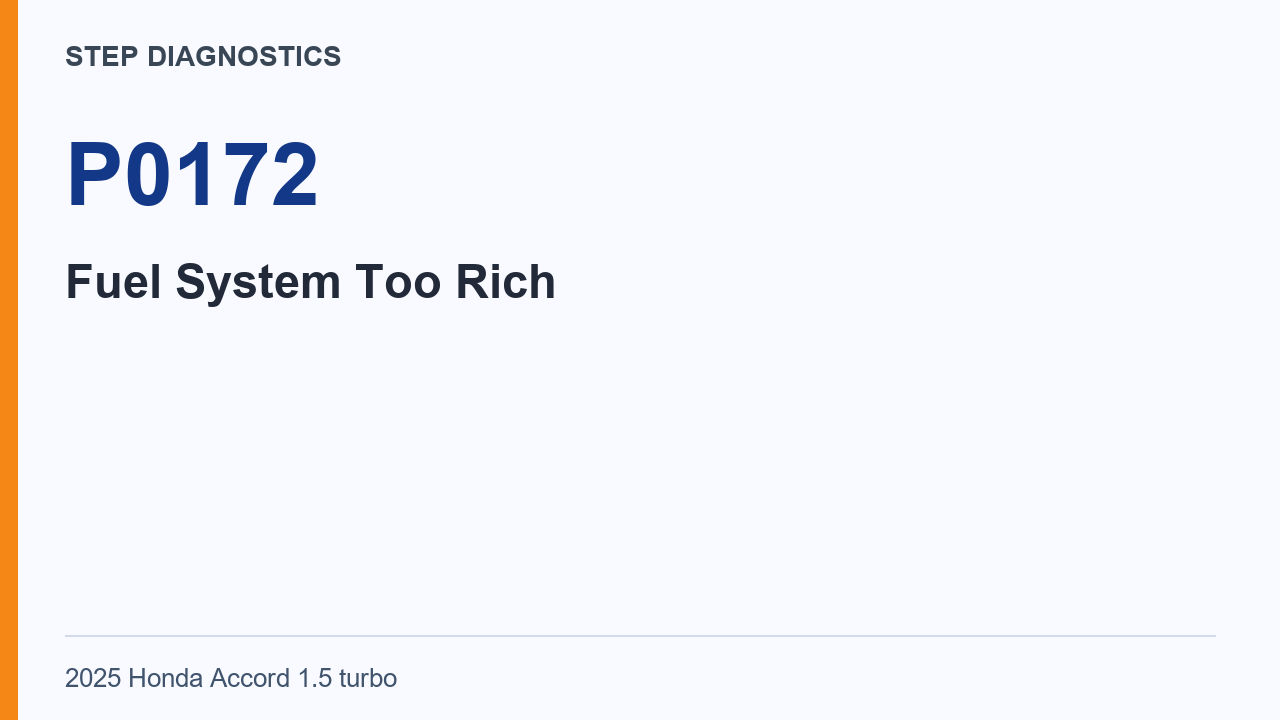
P0172 can indicate a fuel system that is too rich, with long term fuel trim below its specified value.
P0172 concerns a rich fuel-system condition. In this procedure, the PCM monitors fuel-trim information and the diagnosis follows specified confirmation readings before examining the possible causes. Fuel-trim data, the operating condition in which it was recorded, and the component checks need to stay connected throughout that process.
The guide begins by preserving the existing diagnostic information and addressing the listed prerequisite codes or systems. It then works through confirmation at idle and under recorded conditions, followed by fuel pressure, airflow, oil contamination, purge-valve and known-good component checks. This is a sequence of decisions, rather than a list of parts to replace simply because the mixture code is stored.
What the vehicle may do
- Long term fuel trim may fall below its specified value.
- The PCM can store P0172 when that happens.
Possible fault areas
- Possible fault areas include fuel pressure and MAF sensor/IAT sensor 1.
- Fuel contamination in the oil and the EVAP canister purge valve may be involved.
- The fuel, A/F Sensor (Sensor 1), and injector can also be fault areas.
- The PCM may be the remaining cause if the other inspections are normal.
The idle confirmation and the recorded-condition confirmation use their stated comparisons. Keep each comparator with the particular operating condition in which it appears. The same displayed signal can have a different role at another stage of the procedure.
Once the fault has been confirmed, each inspection examines a particular possible cause. Some checks use a numerical reading, others use a stated NORMAL result, and the known-good comparisons ask whether the failure is reproduced. Those result types should remain distinct. The final PCM conclusion is conditional on the other inspection results.
Diagnostic path
Understand the stored condition
P0172 means Fuel System Too Rich. The PCM monitors long term fuel trim, or LTFT.
Before troubleshooting
Before you begin troubleshooting, do not clear the DTC or reset the PCM. Keep that information until you are instructed to clear it. Clearing the DTC or resetting the PCM can delete valuable diagnostic information, even if the on-board snapshot is saved. Before you begin, also inspect for aftermarket fuel system and engine components.
The original code and recorded data are useful because later parts of this procedure refer back to the conditions in which P0172 was set. The instruction to retain that information belongs at the beginning of the diagnosis. Keep the aftermarket-component inspection with this initial assessment as well, so the subsequent tests are interpreted in the vehicle configuration actually being examined.
Codes and systems to address first
Troubleshoot any DTCs listed or indicated systems below first.
- VTC System [PGM-FI]: P0010, P0011, P0013, P25DF, P25E5
- Fuel Rail Pressure Sensor [PGM-FI]: P0087, P0088
- MAF Sensor [PGM-FI]: P006A, P0100, P0101
- MAP Sensor [PGM-FI]: P0107, P0108, P2073, P2074
- A/F Sensor (Sensor 1) [PGM-FI]: P0130, P0133, P2195, P2237, P2238, P2243, P2245, P2251, P2252, P2A00
- A/F Sensor (Sensor 1) Heater [PGM-FI]: P0134, P0135
- Secondary HO2S (Sensor 2) [PGM-FI]: P0137, P0138, P0139, P2270, P2A01
- Secondary HO2S (Sensor 2) Heater [PGM-FI]: P0141
- No. 1–No. 4 Cylinder Injector(s) [PGM-FI]: P0201, P0202, P0203, P0204
- EVAP Canister Purge Valve [PGM-FI]: P0443
- VTEC System [PGM-FI]: P055B, P055C, P055D, P2651, P2652, P2653, P2654
- Intake Air Leakage [PGM-FI]: P2279
HDS functions and readings
The HDS function paths are PGM-FI > Function Test > DI FUEL PRESSURE TEST and PGM-FI > Data List. The Data List signals are AF FB (ST Fuel Trim), Engine Speed, Vehicle Speed, REL TP Sensor, APP Sensor, ECT Sensor 1, and MAF Sensor.
Confirm the fault at idle
Follow the confirmation procedures in order. Once you duplicate the failure, the confirmation procedure is complete. Start the engine and let it idle without load, in P or N. Check HDS [AF FB (ST Fuel Trim)]. If the value is less than 0.79, you have duplicated the failure.
Confirm under the recorded conditions
For the second confirmation procedure, review the HDS [On-board snapshot]. Record [AF FB (ST Fuel Trim)] from when P0172 was set. Test-drive under those same recorded conditions, matching Engine Speed, Vehicle Speed, REL TP Sensor, and APP Sensor. Watch HDS [AF FB (ST Fuel Trim)] while driving under those conditions. If the value is more than 0.79 while test-driving, you have duplicated the failure.
The snapshot ties the confirmation reading to Engine Speed, Vehicle Speed, throttle-related information and accelerator-pedal information. The procedure asks for those recorded conditions to be matched during the drive. Read the fuel-trim comparison with that condition, retaining the exact direction of the comparison written in this step.
Check high-side fuel pressure
Start the engine. With no load and the transmission in P or N, hold engine speed at 3,000 rpm until the radiator fan comes on. Let the engine idle, then run the HDS [DI FUEL PRESSURE TEST]. The result should be NORMAL. If the result is abnormal, troubleshoot DTC P0087 and P0088.
Check the MAF reading
Start the engine and let it idle. Before this check, HDS [ECT Sensor 1] must be above 158 degrees Fahrenheit, or 70 degrees Celsius. The transmission must be in P or N, with all engine and electrical loads turned off. Monitor HDS [Engine Speed] as you hold engine speed at 2,500 rpm for 30 seconds. While holding 2,500 rpm, check HDS [MAF Sensor]. The reading should be between 4.1 grams per second and 5.7 grams per second.
If the result is abnormal, there is a problem with MAF sensor/IAT sensor 1.
Check for fuel contamination in the oil
Start the engine and let it idle. Gently pinch the PCV hose while checking HDS [AF FB (ST Fuel Trim)]. The value should be less than 0.79. If the result is abnormal, there is a problem causing contaminated oil, such as faulty injectors. If that is the result, replace the engine oil and oil filter.
Check the purge valve
In warm weather, fuel vapor from the canister line to the fuel tank enters the intake manifold. This enriches the mixture excessively and can cause the engine to stall in some cases. Use a Vacuum Pump/Gauge, 0-30 inHg, Snap-on YA4000B or equivalent, commercially available. With the EVAP canister purge valve connector (2P) disconnected, disconnect the vacuum hose—the purge line—from the purge valve in the engine compartment. Connect the vacuum pump/gauge, 0-30 inHg, to that connection on the purge valve.
Start the engine and let it idle. Watch the gauge while the engine idles. There should be no vacuum. If the result is abnormal, there is a problem with the purge valve.
Check with known-good fuel
Drain the existing fuel, then refill with known-good fuel. Try to reproduce the failure. If the failure is reproduced, there is a problem with other related components. If the symptom or DTC goes away, the fuel must be faulty.
This is a comparison using the named known-good item. Its result is whether the failure is reproduced under the stated check. Keep that outcome attached to the item used for this particular comparison. It supplies the branch described in this step, rather than substituting for the separate pressure, airflow or purge checks.
Check with a known-good A/F sensor
Install a known-good A/F Sensor (Sensor 1), then try to reproduce the failure. If the failure is reproduced, there is a problem with other related components. If the symptom or DTC goes away, the A/F sensor must be faulty.
Check with a known-good injector
Install a known-good injector, then try to reproduce the failure. If the failure is reproduced, there is a problem with other related components. If the symptom or DTC goes away, the injector must be faulty.
When the PCM remains
If the other inspection results are normal, the PCM is the remaining cause.
Final check
Fuel pressure, sensor readings, oil contamination, purge operation, fuel, and injectors can be involved; the PCM remains conditional on normal results elsewhere.
The final assessment should bring the findings together without merging their conditions: the confirmation readings, the high-side pressure test, the MAF reading, the oil and purge findings, and each known-good comparison. This makes the reasoning behind the identified fault area visible. Apply the remaining-PCM conclusion only under the normal-earlier-inspections condition stated by the procedure.