What this code means
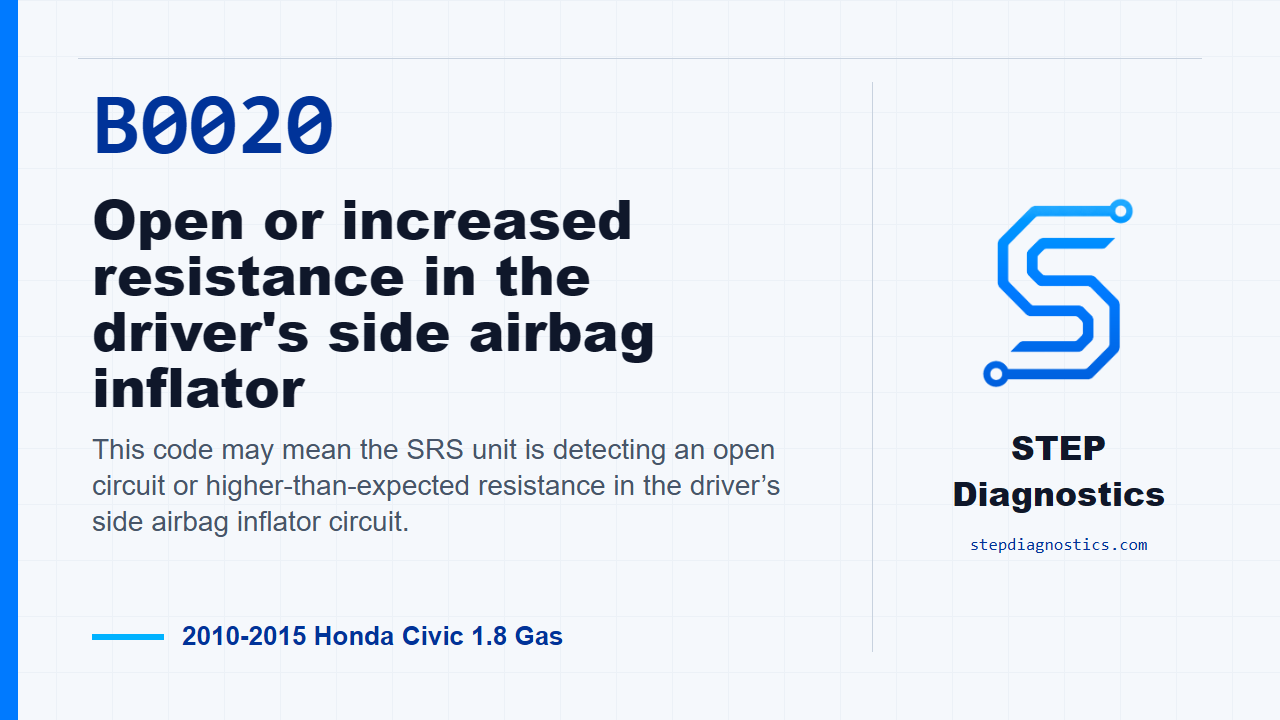
This code may mean the SRS unit is detecting an open circuit or higher-than-expected resistance in the driver’s side airbag inflator circuit.
What the vehicle may do
- The SRS warning light may be on.
- The vehicle can limit restraint system operation while the fault is active.
- The fault may be current or intermittent depending on whether it returns during verification.
Possible fault areas
- Possible issue in the driver’s side airbag inflator circuit.
- Possible issue in the floor wire harness.
- Possible poor connection at the SRS unit connector area.
- Possible SRS unit software or SRS unit concern.
Diagnostic path
Open and safety setup
On this Civic, B0020-13 may mean the SRS unit is seeing an open or higher-than-expected resistance in the driver’s side airbag inflator circuit. The SRS light may be on, and the vehicle can limit restraint system operation while the fault is active. The broad areas in play are the driver’s airbag inflator circuit, the floor wire harness, the SRS unit connector area, and possibly the SRS unit or its software. Before you start, find out whether the vehicle was in a collision. If it was, make sure the required components were replaced with new parts, with the correct part numbers, and installed properly. Also review the airbag safety steps, general troubleshooting approach, and the battery disconnect and reconnect procedure before handling the SRS circuit.
Verify the fault first
Start by clearing the DTCs with the HDS. Turn the ignition switch to ON (II), wait for 10 seconds, and then check for DTCs again with the HDS. If B0020-13 comes right back, the failure is duplicated and you move into circuit isolation. If B0020-13 is not indicated, treat it as an intermittent condition and the system is OK at this time. If another code shows up, check what that code means first instead of chasing this path blindly.
Isolate the driver’s side airbag inflator
For the inflator check, turn the ignition switch to LOCK (0). Disconnect the negative battery cable and wait at least 3 minutes. Then disconnect the driver’s side airbag inflator 2P connector on the floor wire harness. Connect the terminals of SRS simulator lead L to the SRS inflator simulator with the 2 Ω connectors, and connect SRS simulator lead L to the driver’s side airbag inflator 2P connector on the floor wire harness. Reconnect the negative battery cable, clear the DTCs with the HDS, turn the ignition switch to ON (II), wait for 10 seconds, and check for DTCs again. If B0020-13 is still indicated, keep going to the open-wire check. If B0020-13 is not indicated, the fault is open or increased resistance in the driver’s side airbag inflator; replace the driver’s side airbag, then clear the DTC.
Check the LSA+ and LSA- wiring for an open
Next, check the LSA+ and LSA- lines. Turn the ignition switch to LOCK (0). Disconnect the negative battery cable and wait at least 3 minutes. Disconnect SRS unit connector B (39P). Then disconnect the SRS inflator simulator from SRS simulator lead L, but leave SRS simulator lead L connected to the driver’s side airbag inflator 2P connector on the floor wire harness. With IG at LOCK (0), the driver’s side airbag inflator 2P connector disconnected at the floor wire harness, SRS unit connector B (39P) disconnected, and the floor harness connector still connected to SRS simulator lead L, measure resistance on the LSA+ and LSA- circuit at the black terminal of SRS simulator lead L. The decision point is whether the reading is 1.0 Ω or less.
Use the wiring result to choose the next move
If the resistance is 1.0 Ω or less, the LSA+ and LSA- wires are OK. At that point, look for a poor connection at SRS unit connector B (39P) and the SRS unit. Before replacing the SRS unit, check the SRS unit software version with the HDS. If the software is not the latest, update the SRS unit software and retest. If the connector-to-unit connection is OK, replace the SRS unit. If the DTC does not clear after that, replace the floor wire harness. If the resistance is not 1.0 Ω or less, the fault is open or increased resistance in the floor wire harness; replace the floor wire harness, then clear the DTC.
Close and verify
Keep verification separate from the actual testing. After the indicated repair, clear the DTC and use the same HDS check to confirm B0020-13 is no longer indicated. The takeaway: isolate the inflator first with the correct simulator, then prove the LSA+ and LSA- path before condemning the SRS unit or the floor harness. For more diagnostic training, visit stepdiagnostics.com.
Final check
This diagnosis often comes down to isolating the inflator from the harness, then proving whether the LSA+ and LSA- wiring path is intact.
For more guided automotive diagnostics, visit STEP Diagnostics.