What this code means
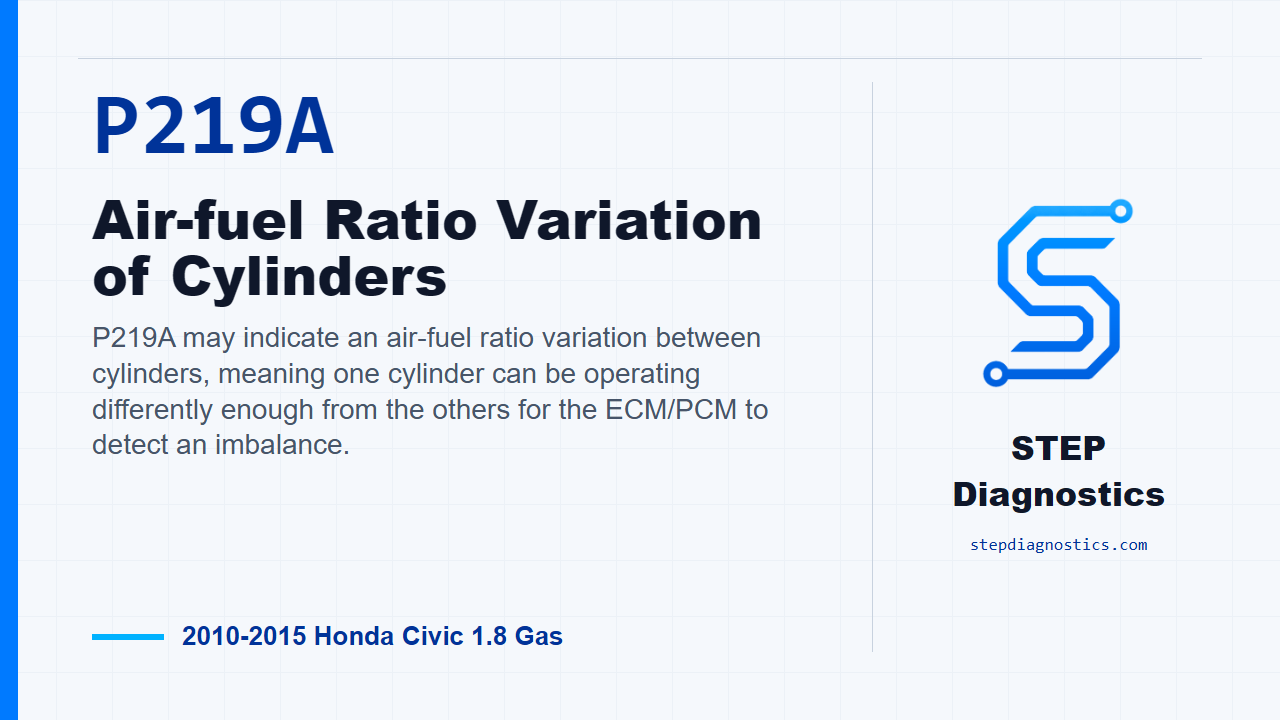
P219A may indicate an air-fuel ratio variation between cylinders, meaning one cylinder can be operating differently enough from the others for the ECM/PCM to detect an imbalance.
What the vehicle may do
- The vehicle may have a check engine light.
- The engine may run rough or feel uneven.
- Engine speed may fluctuate during some driving conditions.
Possible fault areas
- Possible cylinder sealing or compression concerns.
- Possible valve clearance concerns.
- Possible injector-related concerns.
- Possible EGR flow restriction from carbon or sludge.
- Possible intake or exhaust carbon build-up.
- Possible oil leak contribution to deposit formation.
Diagnostic path
Opening context
On this Civic, P219A is an air-fuel ratio variation between cylinders. In plain terms, one cylinder may be operating differently enough from the others that the ECM/PCM can see an imbalance in the fuel-control pattern. The vehicle may have a check engine light, it may run rough or feel uneven, and if engine speed fluctuates at highway speeds, carbon or sludge in the EGR line can be part of the picture. Broadly, possible fault areas can include cylinder sealing, valve clearance, injector behavior, EGR flow restriction, carbon build-up, and oil leaks that may contribute to deposits. Before chasing P219A by itself, if other codes are present, check what they mean first, then come back and recheck P219A.
Capture data and run the first cylinder air-fuel test
Start by saving the freeze data and on-board snapshot information. With the ignition switch ON, record the HDS snapshot parameters: vehicle speed, engine speed, MAP sensor, ECT sensor 1, APP sensor, AF FB, EGR command, and EGR lift. Then warm the engine by holding it at 3,000 rpm with no load — automatic in Park or Neutral, manual in Neutral — until the radiator fan comes on, then let it idle. Run the test with the A/C off and all electrical loads off. Run the CYLINDER AF TEST three times with the HDS. If the result is OK, move into the road-test confirmation. If it is not OK, go after the mechanical side first.
Confirm whether the fault duplicates on the road
For the road-test confirmation, drive the vehicle in the same range as the recorded snapshot data: vehicle speed, engine speed, MAP sensor, ECT sensor 1, APP sensor, AF FB, EGR command, and EGR lift. Watch the OBD STATUS for P219A on the HDS. If the status shows FAILED, the failure is duplicated, and the path moves to valve clearance and EGR flow checks. If it shows PASSED, treat it as an intermittent condition and the system is OK at this time. If it is still EXECUTING, keep driving and recheck the status rather than making a call too early. If it is OUT OF CONDITION, pause, get the operating conditions back where the monitor can run, and recheck instead of guessing.
If the cylinder air-fuel test fails right away, check compression first
When the initial CYLINDER AF TEST does not pass, the next check is cylinder compression. Compare the cylinders. If one cylinder is lower than the others, correct the engine compression problem, then verify the repair. If compression is not lower on one cylinder, continue to valve clearance.
Check valve clearance before moving deeper
Inspect the valve clearance. If the valve clearance is not OK, adjust it and then verify the repair. If the valve clearance checks OK, warm the engine again the same way: hold 3,000 rpm with no load — automatic in Park or Neutral, manual in Neutral — until the radiator fan comes on, then let it idle. Keep the A/C off, keep all electrical loads off, and run the CYLINDER AF TEST three times with the HDS. If the result is OK now, treat it as an intermittent failure and the system is OK at this time. If it still fails, move to the injector swap check.
Use the injector swap to see whether the fault follows the injector
For the injector check, turn the ignition switch to LOCK. Move the injector from the problem cylinder to another cylinder. Then warm the engine by holding it at 3,000 rpm with no load — automatic in Park or Neutral, manual in Neutral — until the radiator fan comes on, then let it idle. Keep the A/C off, keep all electrical loads off, and run the CYLINDER AF TEST three times with the HDS. The key question is whether the injector failure is now indicated at the cylinder where that injector was moved. If it follows the injector, replace the faulty injector and verify the repair. If it does not follow the injector, continue to the carbon and oil-leak checks.
If the road test duplicates the fault, check valve clearance and EGR flow
When the road test duplicates P219A, inspect the valve clearance first. If it is not OK, adjust it and verify the repair. If valve clearance is OK, inspect the EGR flow path for carbon or sludge. If carbon or sludge is present, clean the intake manifold EGR port, the EGR pipe, and the passage inside the EGR valve with throttle plate cleaner, then verify the repair. If the EGR line is clear, continue to the intake and exhaust carbon inspection.
Inspect for carbon build-up and oil leak contribution
Next, check for carbon build-up in the intake manifold and exhaust manifold area. If carbon build-up is found in the intake manifold or cylinder head, check the engine for oil leaks. Repair the engine if needed, remove the carbon, and then verify the repair. If that carbon build-up is not found, treat the condition as intermittent and the system is OK at this time, but still check the engine for oil leaks.
Verify the repair and confirm the code stays gone
Keep verification separate from the testing. After a repair, turn the ignition switch to LOCK, reset the ECM/PCM with the HDS, and do the ECM/PCM idle learn procedure. Then road-test the vehicle in the range of the recorded snapshot data and monitor OBD STATUS for P219A. If the status shows PASSED, troubleshooting is complete. If any other pending or confirmed codes remain, handle those separately. If P219A shows FAILED, go back to the beginning and recheck the diagnostic path. If it is EXECUTING, keep the test condition until a result appears. If it is OUT OF CONDITION, meet the test condition and check OBD STATUS again.
Closing takeaway
The clean way to handle P219A is to prove whether the cylinder imbalance is current, then separate mechanical causes, valve clearance, injector behavior, EGR restriction, and carbon or oil-related deposits without jumping to parts. For more diagnostic training, visit stepdiagnostics.com.
Final check
P219A is often best approached by confirming the fault, then separating mechanical, injector, EGR flow, and carbon or oil-related possibilities in order.
For more guided automotive diagnostics, visit STEP Diagnostics.