What this code means
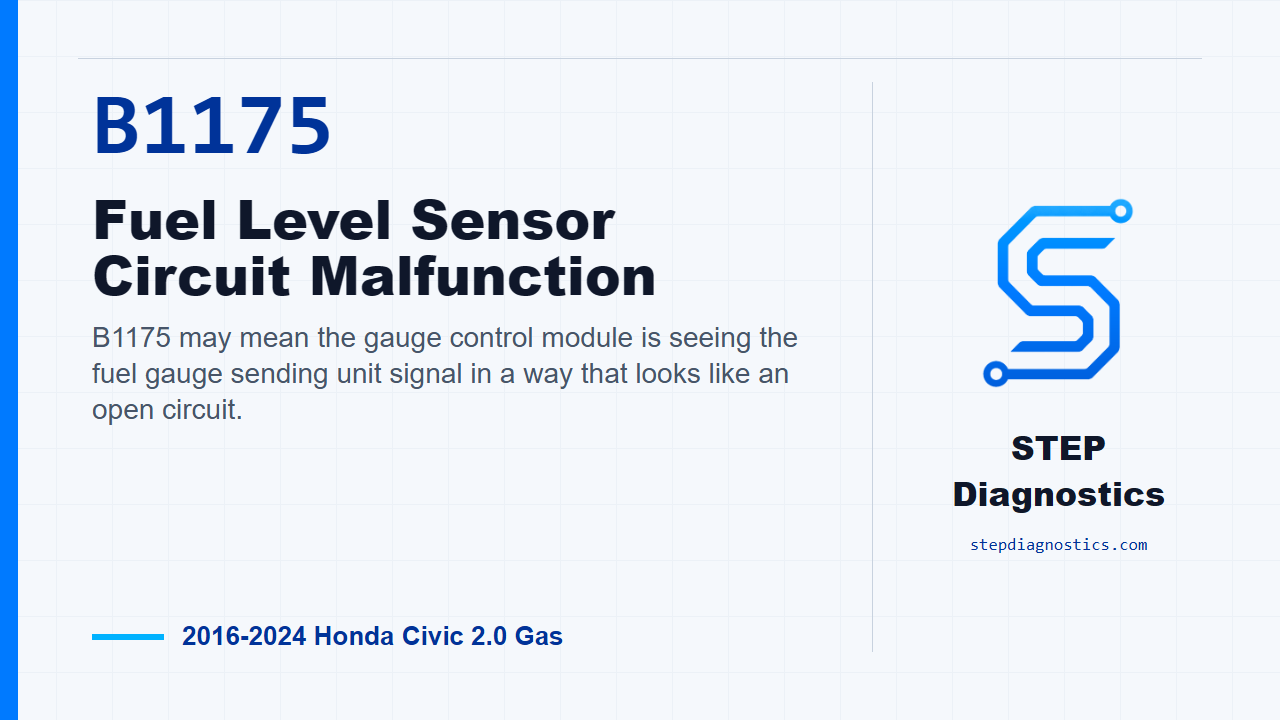
B1175 may mean the gauge control module is seeing the fuel gauge sending unit signal in a way that looks like an open circuit.
What the vehicle may do
- The fuel gauge may read incorrectly.
- The fuel gauge may not respond normally.
- The vehicle may store a body-system fault related to fuel level sensing.
Possible fault areas
- Possible fuel gauge sending unit concern.
- Possible FUEL_GAUGE plus or minus circuit concern.
- Possible connector or terminal concern.
- Possible gauge control module concern.
Diagnostic path
Opening context
On this Civic, B1175 is a fuel level sensor circuit malfunction. In plain language, the gauge control module may be seeing the fuel gauge sending unit signal like an open circuit for long enough to set a code. The driver may notice an inaccurate fuel gauge, a gauge that does not respond normally, or a warning tied to the gauge system. The possible fault areas are the fuel gauge sending unit in the tank, the FUEL_GAUGE plus and minus circuits, connector condition, or the gauge control module itself. Start with the basic system checks and follow a structured diagnostic approach. If other codes are present, check what they mean first so you do not chase this circuit out of order.
Confirm the code path
For the confirmation step, turn the vehicle to ON mode and let the system sit for at least 30 seconds. That gives the gauge control module the operating window it needs to evaluate the fuel level signal. Treat that as the monitor gate before moving into circuit testing.
Prepare for open-circuit testing
Next, set up for the FUEL_GAUGE plus and FUEL_GAUGE minus open-wire checks. Disconnect the fuel tank unit 4P connector, then disconnect gauge control module connector A, the 32P connector. Before putting the meter on it, positively identify the correct FUEL_GAUGE plus and minus terminals and connector cavities. Do not guess at probe points.
Check the two fuel gauge circuits
With IG Mode OFF, check the FUEL_GAUGE plus circuit for an open. A normal result is less than 1 Ω. Then check the FUEL_GAUGE minus circuit the same way, also with IG Mode OFF. That circuit is normal when it measures less than 1 Ω. If either one is abnormal, the problem is in that circuit, so stay with the wiring and connection side before blaming the module.
Interpret the result
If the other inspection items are normal, the remaining suspect in this diagnostic path is the gauge control module, and the test result points to a problem there. The important part is the order: confirm the code conditions, check the open circuits, and only then use the module conclusion if the circuit checks are normal.
Verification and takeaway
After the fault found in this path has been corrected, keep verification separate from testing. Recreate the same ON-mode confirmation condition and make sure B1175 does not reset. The takeaway is simple: B1175 is an open-circuit style fuel level signal diagnosis, so prove the FUEL_GAUGE plus and minus circuits before condemning the gauge control module. For more diagnostic training, visit stepdiagnostics.com.
Final check
This code is often approached by confirming the monitor condition, checking the fuel gauge signal circuits for an open, and only then considering the gauge control module if the circuit checks are正常.
For more guided automotive diagnostics, visit STEP Diagnostics.