What this code means
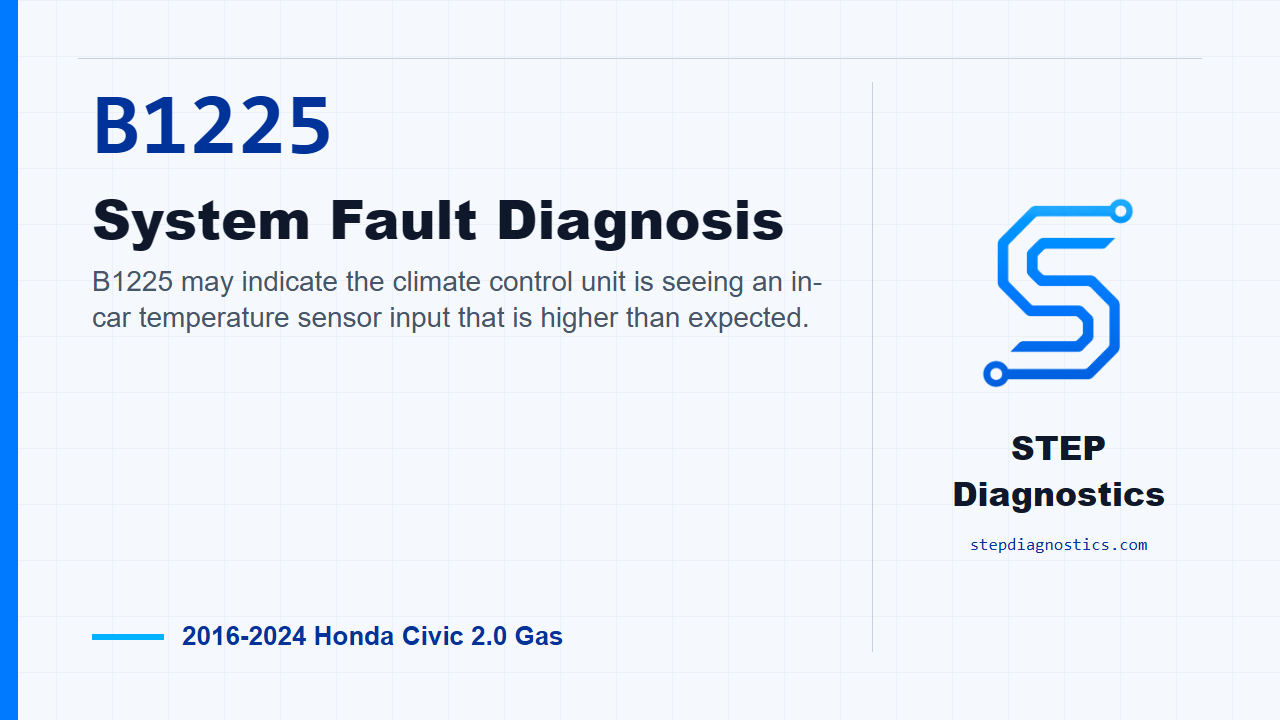
B1225 may indicate the climate control unit is seeing an in-car temperature sensor input that is higher than expected.
What the vehicle may do
- Automatic climate temperature control may be inaccurate.
- Cabin temperature response can feel inconsistent.
- Some vehicles may have no obvious symptom beyond the stored code.
Possible fault areas
- Possible in-car temperature sensor signal circuit issue.
- Possible sensor common circuit issue.
- Possible connector or wiring issue.
- Possible climate control unit fault if the circuit checks are normal.
Diagnostic path
Opening context
On this 2016 to 2024 Honda Civic with the 2.0 gas engine, B1225 is a climate control unit code tied to the in-car temperature sensor signal. In plain terms, the climate control unit may be seeing that sensor input higher than it expects. The customer may notice automatic temperature control acting inaccurate or inconsistent, although symptoms can vary. The broad fault areas are the in-car temperature sensor signal circuit, the shared sensor common circuit, connector or wiring issues, and, if those checks are normal, a possible climate control unit fault.
Start with the setup
Before getting into circuit checks, start with the basic system checks and follow a structured diagnostic approach. Then turn the vehicle to ON mode for the confirmation step. If other codes or basic system issues are present, sort out what they mean before chasing this one too far.
Prepare for the circuit inspection
For the TR and SENSOR_COM circuit inspection, power down as required for the check, then disconnect the in-car temperature sensor 2P connector and disconnect climate control unit connector A, the 28P connector. Make sure the connector and terminal identification is correct before probing. If the terminal locations are not clear, pause and recheck the earlier diagnostic path rather than guessing at pin locations.
Check the open circuits first
With the in-car temperature sensor 2P connector disconnected and climate control unit connector A, 28P, disconnected, do the TR open wire inspection with IG Mode OFF. A normal result is less than 1 Ω. Then, with the same connectors still disconnected, do the SENSOR_COM open wire inspection with IG Mode OFF. That normal result is also less than 1 Ω.
Check for a short to power
Next, use the proper open and short inspection method for the shorted-circuit check. Turn IG Mode ON and inspect the TR circuit for a short to power. The expected result is not shorted.
Interpret the results
If any of those circuit inspections are abnormal, treat it as a circuit problem in that area. If the other inspection items all show normal, then the remaining fault determination is the climate control unit. At that point, do not jump around the test plan; use the results you have, pause if anything does not line up, and avoid guessing.
Verification and takeaway
Keep the final verification separate from the circuit testing. After the fault has been corrected, verify the repair and confirm B1225 stays gone. The takeaway is simple: for B1225, prove the TR and SENSOR_COM wiring first, check TR for short to power, and only consider the climate control unit after the circuit checks are normal. For more diagnostic training, visit stepdiagnostics.com.
Final check
For B1225, prove the in-car temperature sensor signal and sensor common circuits before blaming the climate control unit.
For more guided automotive diagnostics, visit STEP Diagnostics.