What this code means
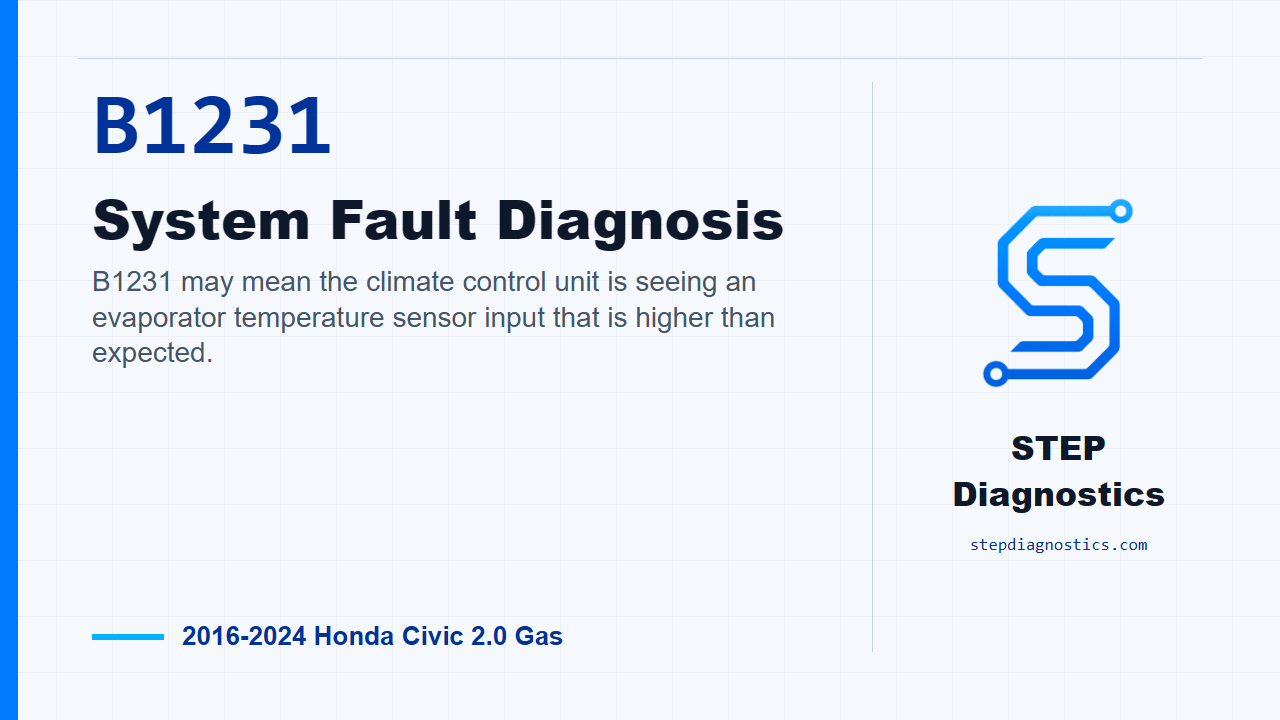
B1231 may mean the climate control unit is seeing an evaporator temperature sensor input that is higher than expected.
What the vehicle may do
- The A/C or temperature control may not behave normally.
- The climate system may store the code with limited obvious symptoms.
Possible fault areas
- Possible evaporator temperature sensor signal circuit issue.
- Possible sensor common circuit issue.
- Possible connector or wiring integrity issue.
- Possible climate control unit involvement after circuit checks pass.
Diagnostic path
Opening context
On this Civic, B1231 points to the climate control unit seeing an evaporator temperature sensor signal that may be higher than expected. The driver may notice A/C or temperature control behavior that does not seem right, or the system may simply store the code. Broadly, this can involve the evaporator temperature sensor circuit, the sensor common side of the circuit, connector condition, wiring integrity, or the climate control unit itself. Before diving in, start with the basic troubleshooting routine so you know the vehicle and system are in the right state for testing.
Set up the test
Begin by turning the vehicle to the ON mode. Then set up for the TEVA and SENS-COM circuit checks. Disconnect the evaporator temperature sensor 2P connector, and disconnect climate control unit connector B, the 24P connector. Before probing, make sure the correct terminal locations are identified. The extracted connector views and terminal identifiers are not available here, so do not guess at terminals.
Check the TEVA and SENS-COM circuits
With the connectors disconnected, perform the TEVA and SENS-COM circuit inspection in the listed order. With IG Mode OFF, check the TEVA side for an open between the disconnected evaporator temperature sensor 2P connector female terminals and the disconnected climate control unit connector B 24P female terminals. The normal condition is less than 1 Ω. Then, still with IG Mode OFF, check the SENS-COM side for an open between those disconnected connector terminals. The normal condition is also less than 1 Ω.
Check for a short to power
Next, inspect for a shorted circuit as the diagnostic path calls for. With IG Mode ON, perform the TEVA short-to-power inspection. The normal result is not shorted. If the earlier terminal identification is unclear, pause, recheck the earlier diagnostic path, and avoid guessing before applying power or probing the circuit.
Make the circuit decision
Now evaluate the TEVA and SENS-COM circuit inspection results. The code sets when the climate control unit sees evaporator temperature sensor input voltage above the specified value. If the circuit inspection is abnormal, treat that as a circuit problem and stay on that path. Do not move on to the control unit decision until the circuit checks are normal.
Control unit decision
Only if the other inspection items show a normal condition, continue to the climate control unit inspection. At that point, the diagnostic path determines the remaining climate control unit is the cause. Evaluate that inspection result separately; if that result is abnormal, the fault is with the climate control unit.
Takeaway
The clean way through B1231 is simple: confirm the TEVA and SENS-COM wiring first, check for a TEVA short to power, and only consider the climate control unit after the circuit side has passed. For more diagnostic training, visit stepdiagnostics.com.
Final check
B1231 is best approached as a circuit-first diagnosis before judging the climate control unit.
For more guided automotive diagnostics, visit STEP Diagnostics.