What this code means
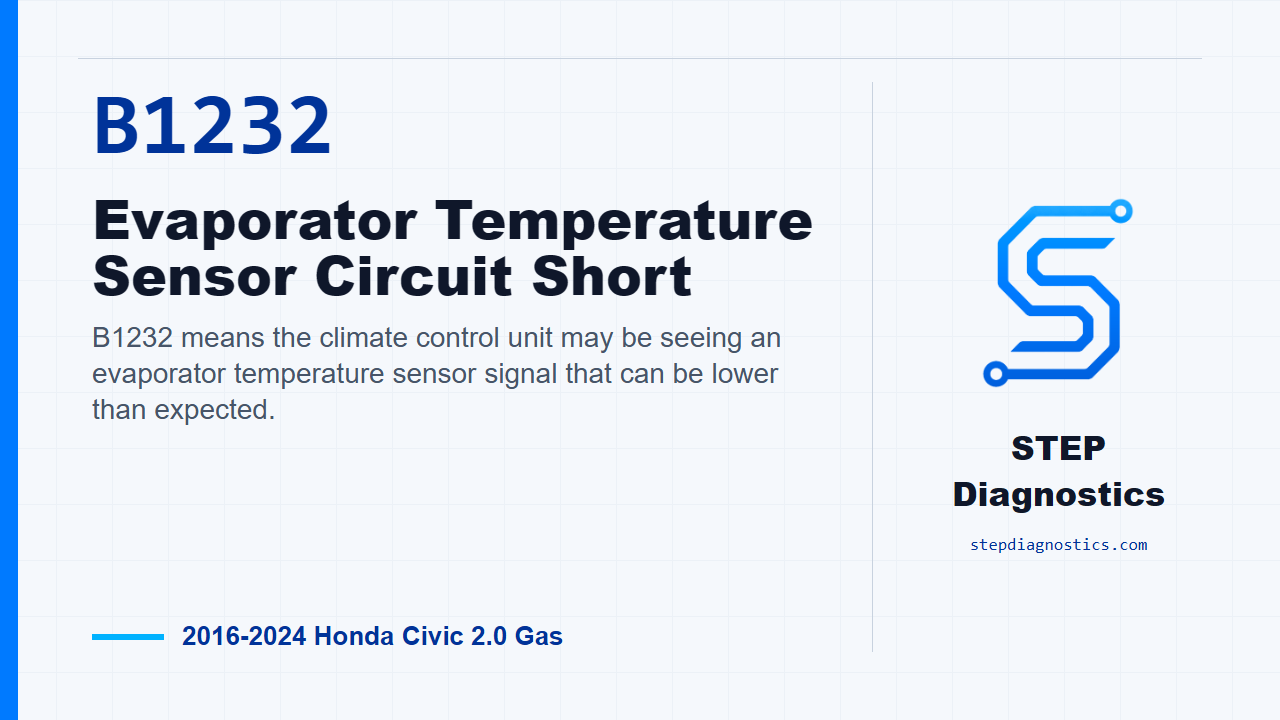
B1232 means the climate control unit may be seeing an evaporator temperature sensor signal that can be lower than expected.
What the vehicle may do
- The A/C system may not regulate evaporator temperature normally.
- Cooling performance may be affected.
- The climate control system may store a fault.
Possible fault areas
- Possible evaporator temperature sensor issue.
- Possible TEVA or SENS-COM wiring short condition between the sensor and the climate control unit.
- Possible climate control unit fault after the sensor and circuit checks indicate normal conditions.
Diagnostic path
Opening context
Today we’re diagnosing B1232 on a 2016 to 2024 Honda Civic with the 2.0 gas engine. In plain terms, the climate control unit may be seeing the evaporator temperature sensor signal lower than it expects. When that happens, the A/C system can act up, cooling control may be affected, and the climate control unit may store this fault. The broad areas to think about are the evaporator temperature sensor, the TEVA and SENS-COM wiring between the sensor and the climate control unit, and, only after the other checks pass, a possible climate control unit problem.
Set up the diagnosis
Before you get into B1232 testing, start with the basic troubleshooting approach for the system. That keeps you from jumping straight into circuit checks before the overall diagnostic path is lined up.
How the code sets
The logic for this code is straightforward: if the input voltage from the evaporator temperature sensor is less than the specified value, the climate control unit judges that as abnormal and stores B1232. So the diagnostic path has to prove whether the sensor, the external circuit, or the climate control unit is responsible.
Confirm the condition
Start by turning the vehicle to the ON mode. That sets up the confirmation side of the check before you move into circuit testing.
Sensor check comes first
The first inspection item is the evaporator temperature sensor test. If you do not have the exact evaporator temperature sensor test routine available, pause there and do not guess at a substitute test. Clear that part of the path first, because the rest of the diagnosis depends on knowing whether the sensor side has already passed or failed.
Prepare for the external circuit check
If you’re moving into the external circuit check, prepare the circuit with the evaporator temperature sensor 2P connector disconnected. Then disconnect climate control unit connector B, the 24P connector. At this point, make sure you have the correct connector and terminal information in front of you. If the connector views or terminal references are not available, stop and verify them before probing anything.
Check TEVA to SENS-COM for a wire-to-wire short
With IG Mode OFF, perform the TEVA to SENS-COM shorted wire-to-wire inspection. The normal condition is more than 1 MΩ. If that check is abnormal, the problem is in the circuit, not something to push past.
Check TEVA for a short to ground
Next, still with IG Mode OFF, perform the TEVA short-to-ground inspection. The normal condition is not shorted. If this check is abnormal, that also points to a circuit problem.
Climate control unit decision point
Once the evaporator temperature sensor check and the external circuit inspections have indicated normal conditions, the remaining fault area is the climate control unit. At that point, the diagnostic decision is that there is a problem with the climate control unit.
Takeaway and CTA
The takeaway: B1232 is a low evaporator temperature sensor input fault, so work it in order—basic system checks, sensor test first, then TEVA and SENS-COM circuit checks, and only then judge the climate control unit. For more diagnostic training, visit stepdiagnostics.com.
Final check
This code is often approached by proving the sensor and its wiring first, then considering the climate control unit only after those checks pass.
For more guided automotive diagnostics, visit STEP Diagnostics.