What this code means
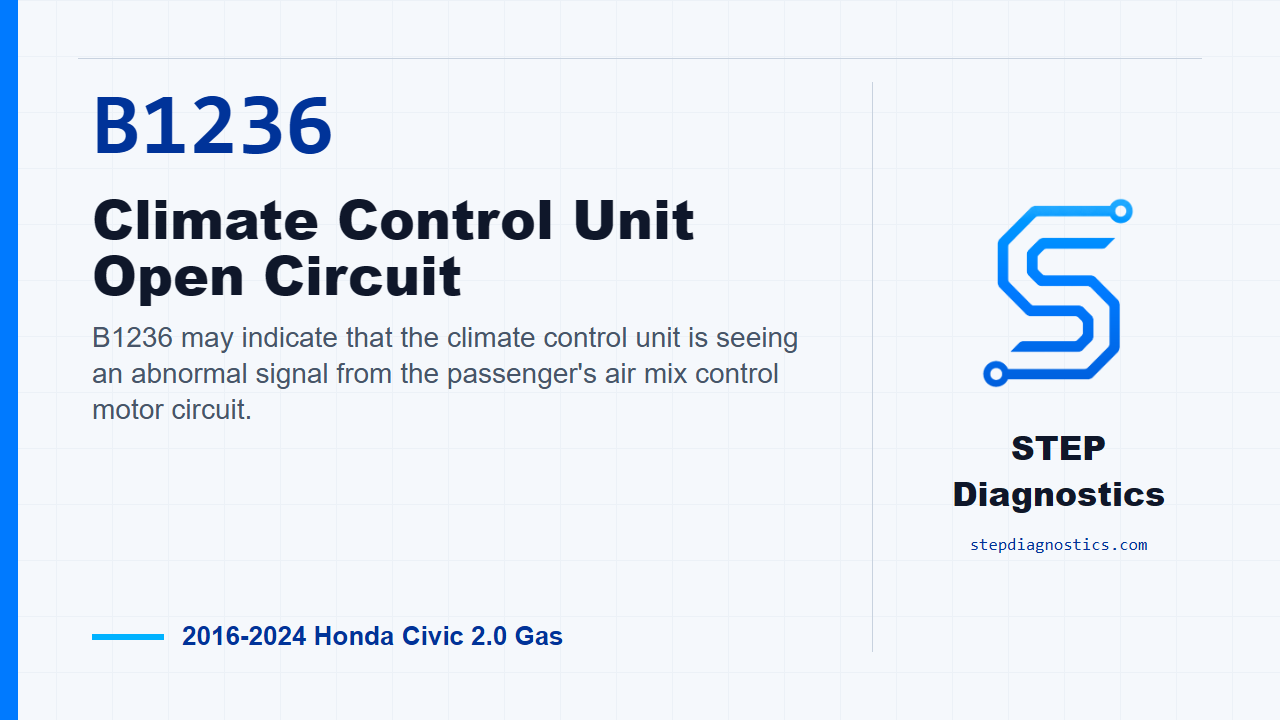
B1236 may indicate that the climate control unit is seeing an abnormal signal from the passenger's air mix control motor circuit.
What the vehicle may do
- The passenger-side temperature blend may not respond normally.
- The HVAC temperature output may feel incorrect or inconsistent on the passenger side.
- The climate control system can store the fault even if the symptom is intermittent.
Possible fault areas
- A possible open or poor connection in the passenger air mix control motor circuit.
- A possible issue with the passenger's air mix control motor signal path.
- A possible climate control unit circuit concern.
- Other related HVAC control components may also be involved.
Diagnostic path
Code overview and diagnostic direction
On this 2016 to 2024 Honda Civic with the 2.0 gas engine, B1236 is a climate control fault in the passenger's air mix control motor circuit. In plain language, the climate control unit is seeing the input voltage from that motor go higher than the allowed range, so it flags an abnormal signal. The customer may notice passenger-side temperature control acting wrong or not responding normally. The broad fault areas can include an open in the related signal or common circuit, the passenger's air mix control motor, the climate control unit, or another related component. Before going into pinpoint checks, start with the basic system checks. Also, there is not a direct stand-alone component test here, so this diagnosis works through the related circuits and control outputs in order.
Reproduce the operating condition
For the confirmation step, turn the vehicle to ON mode. That gives the system the operating state needed before moving into the circuit checks for this code.
Check the open-wire paths first
Start the pinpoint testing with the AMD-P-AS and SENS-COM open-wire inspection. Disconnect the passenger's air mix control motor 5P connector, and disconnect climate control unit connector B, the 24P connector. With IG Mode OFF, check the AMD-P-AS open-wire path at the specified test points. Normal is less than 1 Ω. Then check the SENS-COM open-wire path the same way, still with IG Mode OFF. Normal there is also less than 1 Ω. If either of those checks is abnormal, treat it as a circuit problem before moving farther down the diagnostic path.
Check the passenger air mix motor side
If the open-wire checks do not point to the circuit, move to the passenger's air mix control motor inspection. Disconnect the passenger's air mix control motor 5P connector. With IG Mode ON, perform the unit output voltage inspection at the specified test points. Normal is about 5 V. If that result is normal, the diagnostic direction points to a problem with the passenger's air mix control motor. If that result is abnormal, the direction shifts toward other related components instead.
Check the climate control unit side
Next, move to the climate control unit inspection. Disconnect the passenger's air mix control motor 5P connector. With IG Mode ON, perform the unit internal circuit inspection at the connected climate control unit connector B, the 24P connector, using the female terminals called out for the test. Normal is about 5 V. If this check is abnormal, the diagnostic direction points to a problem with the climate control unit.
Takeaway
The takeaway on B1236 is to stay in order: confirm the code condition, prove the two open-wire paths first, then use the output and internal circuit voltage checks to separate a circuit issue from the passenger air mix motor, related components, or the climate control unit. For more diagnostic training, visit stepdiagnostics.com.
Final check
This code is often approached by proving the related circuit paths first, then using the voltage checks to narrow the fault area.
For more guided automotive diagnostics, visit STEP Diagnostics.