What this code means
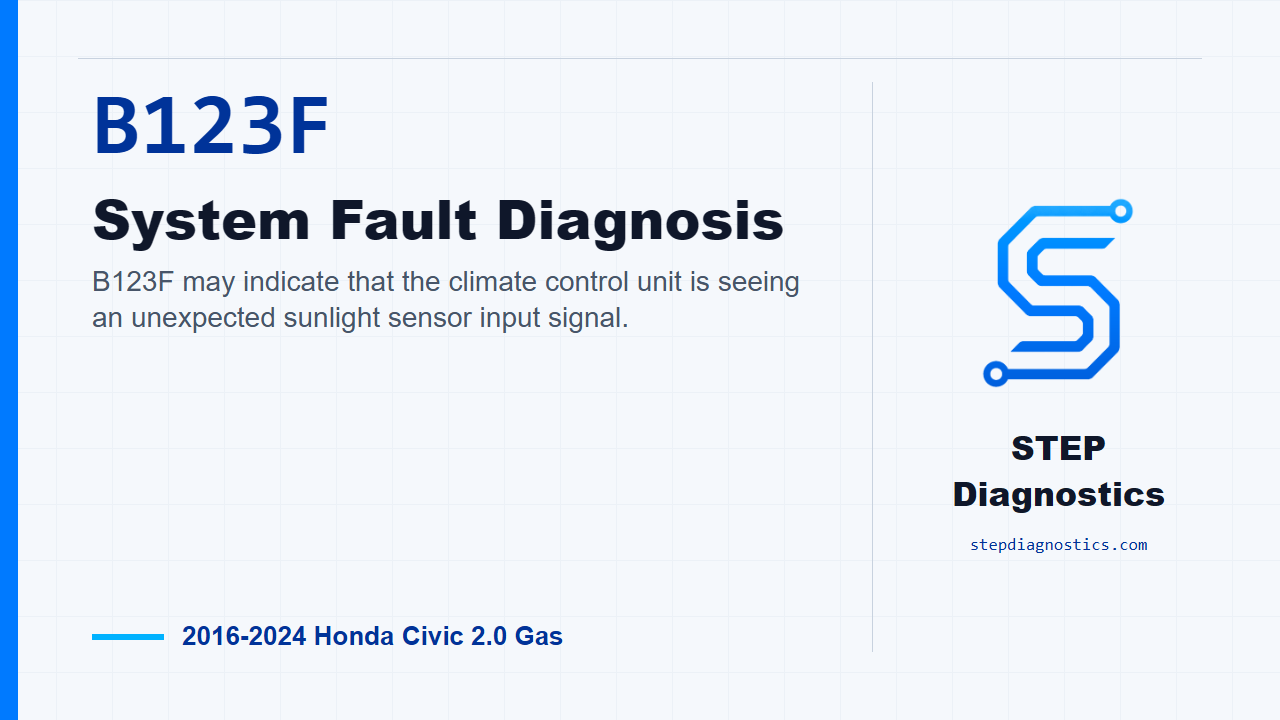
B123F may indicate that the climate control unit is seeing an unexpected sunlight sensor input signal.
What the vehicle may do
- Automatic climate control may react incorrectly to sun load.
- Cabin temperature regulation may feel inconsistent.
- The vehicle may only have a stored body code with no obvious driveability symptom.
Possible fault areas
- Possible TSUN signal circuit issue.
- Possible SENSOR_COM circuit issue.
- Possible short between related sensor circuits.
- Possible short to ground.
- Possible connector or terminal condition concern.
- Possible climate control unit fault after circuit checks pass.
Diagnostic path
Code overview and approach
On this Civic, B123F is a climate control fault tied to the sunlight sensor input circuit. The climate control unit may set this code when the input voltage is not where it expects it to be. From the driver’s seat, the automatic climate control may react incorrectly to sun load, or the issue may only show up as a stored body code. Broadly, this can involve the TSUN signal circuit, the SENSOR_COM circuit, a short between the two, a short to ground, connector condition, or the climate control unit itself. Before getting into the circuit checks, start with the basic system checks and follow a structured diagnostic approach. If other codes are present, check what they mean first so you do not chase a symptom out of order.
Confirm the code can be evaluated
Begin the confirmation by turning the vehicle to the ON mode. The monitor logic is simple from a diagnostic standpoint: if the climate control unit sees an input voltage that does not match its expected threshold, it determines an abnormality and stores B123F. The video can show that as the monitor gate and fault formula, but in the bay, the important point is to get the system powered in the same operating state before testing the circuit.
Prepare the circuit for testing
With the circuit powered down for resistance testing, disconnect the sunlight sensor 2P connector, then disconnect climate control unit connector A, the 28P connector. Make sure the connector views and terminal identification are correct before putting meter leads on the circuit. If the terminal identification is not clear, pause, recheck the earlier diagnostic path, and avoid guessing.
Check the TSUN and SENSOR_COM circuit integrity
Now inspect the TSUN and SENSOR_COM circuits in order. First, with IG Mode OFF, check the TSUN circuit for an open. A normal result is less than 1 Ω. Next, still with IG Mode OFF, check the SENSOR_COM circuit for an open. That normal result is also less than 1 Ω. If either open-circuit check is abnormal, the problem is in the circuit and should be handled there before moving on.
Check for shorts between circuits and to ground
After the open checks pass, keep IG Mode OFF and check whether TSUN and SENSOR_COM are shorted to each other. A normal result is more than 1 MΩ. Then check the TSUN circuit for a short to ground. The expected result is not shorted. If either short check is abnormal, stay with the wiring side of the diagnosis; the circuit has not passed yet.
Evaluate the remaining suspect
If the TSUN open check, the SENSOR_COM open check, the wire-to-wire short check, and the TSUN short-to-ground check all indicate normal, the remaining fault area is the climate control unit. At that point, the circuit checks have not found the fault, and the diagnostic result points back to the unit rather than the external wiring.
Verify the result
Keep verification separate from the circuit testing. After the fault path has been corrected, verify the repair and confirm B123F stays gone under the conditions that allow the climate control unit to evaluate the sunlight sensor input. The takeaway is straightforward: prove the TSUN and SENSOR_COM wiring first, then only blame the climate control unit after those checks are normal. For more diagnostic training, visit stepdiagnostics.com.
Final check
This diagnosis can often be narrowed down by proving the sunlight sensor signal and common circuits before judging the climate control unit.
For more guided automotive diagnostics, visit STEP Diagnostics.