What this code means
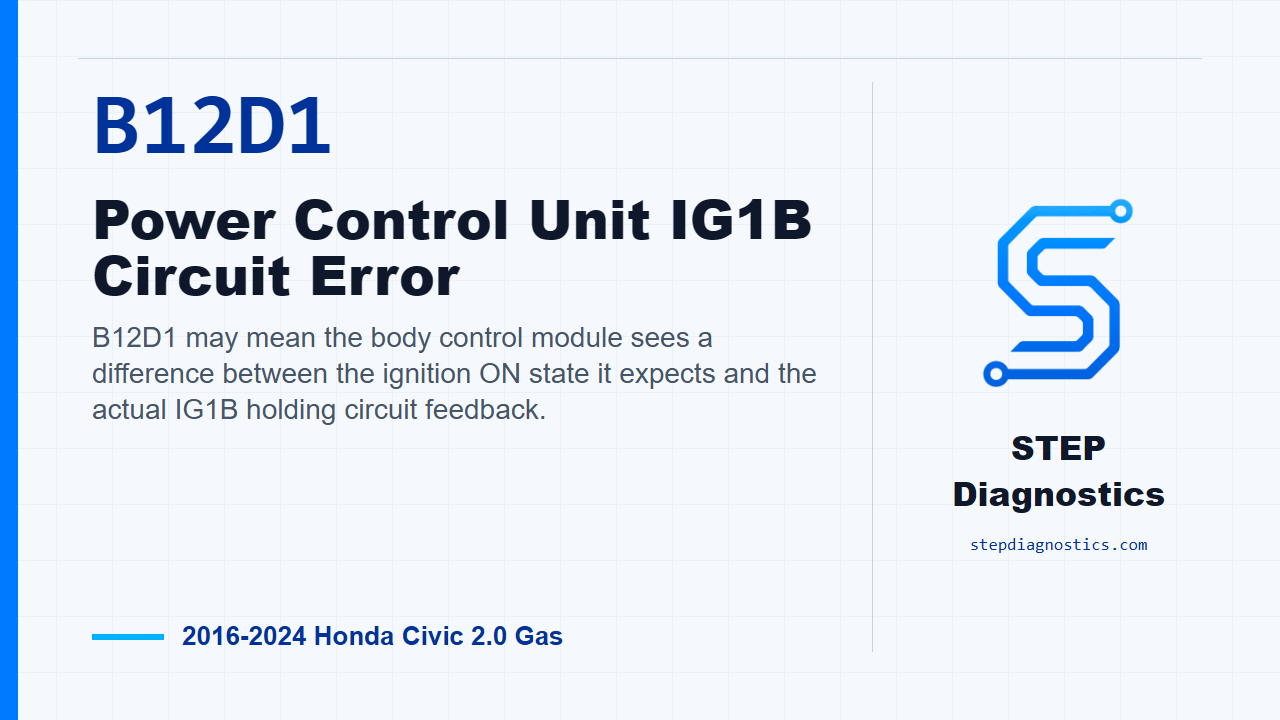
B12D1 may mean the body control module sees a difference between the ignition ON state it expects and the actual IG1B holding circuit feedback.
What the vehicle may do
- The vehicle may show keyless access or body electrical behavior that does not match the selected ignition mode.
- The ignition mode indication or related body-control operation may be inconsistent when the fault is active.
Possible fault areas
- Possible fault areas can include the IG1B signal circuit, the IG1 coil feed side, wiring or connector issues, relay-circuit behavior, or the under-dash fuse and relay box.
Diagnostic path
Opening and code logic
On this Civic, B12D1 is for the power control unit IG1B circuit. In plain terms, the body control module may be seeing a mismatch between the ignition ON state it thinks it commanded and the actual IG1B holding circuit feedback. The vehicle may show keyless access or body electrical behavior that does not match the ignition mode, and the possible fault areas can include the IG1B signal circuit, the IG1 coil feed side, related wiring, connector condition, or the under-dash fuse and relay box. We are going to keep the diagnosis focused on that command-versus-response problem.
Initial checks before testing
Before getting into circuit testing, start with the basic system checks and follow a structured diagnostic approach. If other codes are present, handle the multiple-code process first so you are not chasing a body network problem as a single circuit fault. Also make sure aftermarket accessories are not installed, because added equipment can interfere with this kind of ignition-hold circuit.
Reproduce the monitor conditions
Next, reproduce the operating conditions for the code. Turn the vehicle to the ON mode and wait for at least 10 seconds. Then turn the vehicle to the OFF (LOCK) mode and wait for at least 5 seconds. That gives the system the same basic mode change it uses to judge whether the IG1B circuit is behaving correctly.
Prepare for circuit inspection
For the circuit checks, turn the system back to the required state for testing and disconnect the under-dash fuse and relay box connector D, the 16-pin connector. Then disconnect body control module connector C, the 66-pin connector. From here, the inspection is aimed at the IG1-B signal circuit, the IG1 coil positive side, and the IG1B relay circuit.
Open-circuit checks
With IG Mode OFF, check the IG1-B_SIG circuit for an open. A normal result is less than 1 Ω. Then, still with IG Mode OFF, check the IG1_COIL+ circuit for an open. That circuit should also be less than 1 Ω. If either of these open-wire checks is abnormal, treat it as a circuit problem and stay with the wiring side of the diagnosis.
Short-to-ground check and decision
After the open checks, move to the shorted-circuit inspection. With IG Mode OFF, check IG1-B_SIG for a short to ground. The expected result is not shorted. If the inspection is abnormal, the fault is in the circuit. If the circuit inspection is normal, the diagnostic path points to a problem with the under-dash fuse and relay box. Do not jump ahead or guess; if the result does not fit the path, pause and recheck the earlier tests, connector state, and ignition mode before making a call.
Verification and takeaway
Keep verification separate from the testing. After the fault area has been corrected, repeat the same confirmation routine: ON mode for at least 10 seconds, then OFF (LOCK) mode for at least 5 seconds, and confirm B12D1 stays gone. The takeaway is simple: this code is about whether the body control module’s ignition ON command agrees with the IG1B circuit feedback, so prove the open checks, prove the short-to-ground check, and let the results decide whether the problem is in the circuit or the under-dash fuse and relay box. For more diagnostic training, visit stepdiagnostics.com.
Final check
The diagnosis often comes down to proving whether the IG1B-related circuits are open, shorted to ground, or normal before deciding where the fault is located.
For more guided automotive diagnostics, visit STEP Diagnostics.