What this code means
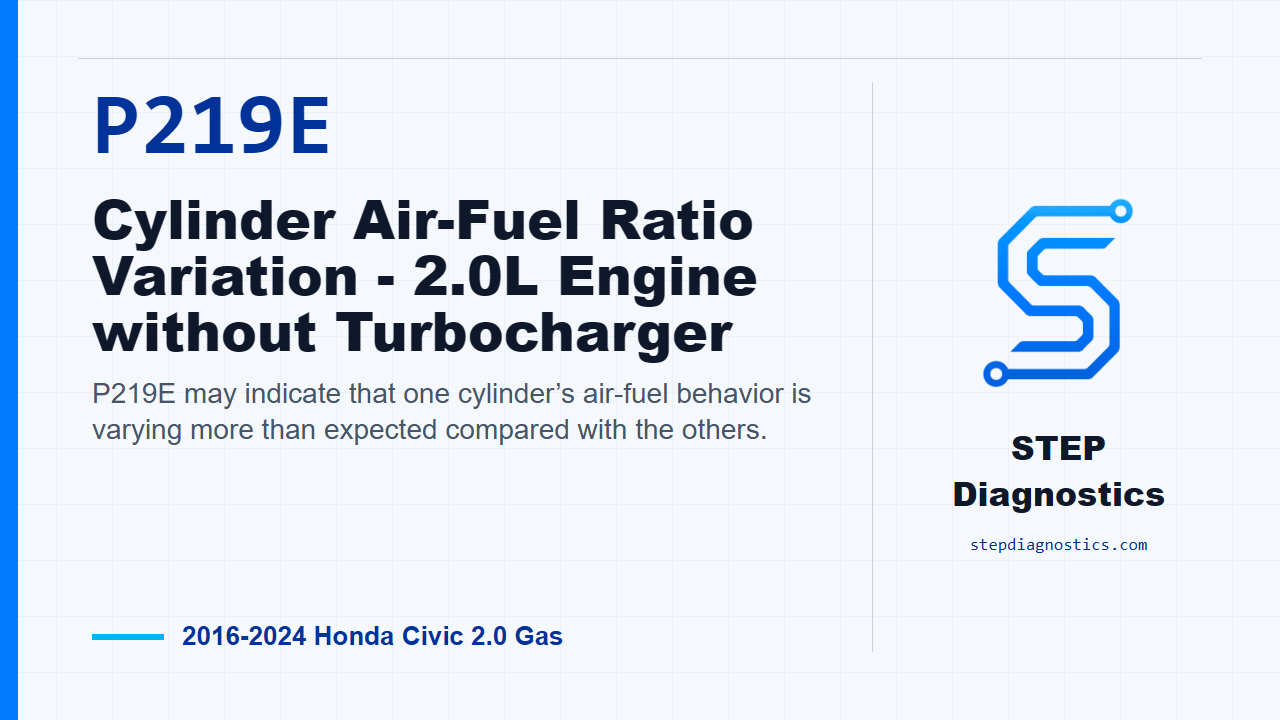
P219E may indicate that one cylinder’s air-fuel behavior is varying more than expected compared with the others.
What the vehicle may do
- The vehicle may turn on the MIL.
- The engine may run normally, or it may feel uneven during certain driving conditions.
- Symptoms can overlap with fuel delivery, ignition, or mechanical concerns.
Possible fault areas
- Possible broad areas include air-fuel sensing and fuel control, injector operation, ignition or misfire-related concerns, valve clearance or compression, and intake or exhaust path
- The fault can often require confirming the operating conditions before deciding where to test next.
Diagnostic path
Open on what P219E means
On this Honda Civic with the 2.0L engine without turbocharger, P219E is a cylinder air-fuel ratio variation fault. In plain terms, the ECM/PCM may be seeing one cylinder’s fuel correction behave differently than expected compared with the rest. The vehicle may run normally, or it may feel uneven, set the MIL, or show symptoms that overlap with fuel, ignition, mechanical sealing, valve clearance, intake, or exhaust issues. For this code, keep the diagnosis controlled: don’t jump straight to parts. First, make sure any related air-fuel sensor, injector, misfire, or ignition coil faults are handled, because those can steer this test in the wrong direction.
Start with the base checks
After the basic system checks, the diagnostic path starts with the engine itself. Do the engine compression inspection, then do the valve clearance adjustment. From there, continue into the intake and exhaust manifold visual inspection, and then the injector inspection. The point is to separate a cylinder balance problem caused by mechanical airflow or sealing from one caused by fuel delivery.
Reproduce the operating conditions
Now reproduce the operating conditions for the monitor. Start the engine. Hold engine speed at 3,000 rpm with no load, with the CVT in P or N, or the manual transmission in neutral, until the radiator fan comes on, then let it idle. Then drive at a steady engine speed between 1,000 - 1,200 rpm, accelerate up to 3,400 rpm at about 10 - 15 seconds, and repeat that 3 times or more if needed.
Use the correct fuel factor for P219E
With the conditions duplicated, check the HDS fuel factor study value that matches the stored code. For P219E, use the fuel factor study value of No3 cylinder. If that value is out of 0.83 - 1.16, the failure is duplicated. That tells you the PCM is seeing the cylinder fuel coefficient outside the expected range for this fault path.
Inspect the intake and exhaust path
For the intake manifold and exhaust manifold visual inspection, remove the intake manifold as preparation. Then visually check for carbon build-up in the intake manifold and exhaust manifold. The expected result is no carbon build-up. If that inspection is abnormal, the path points to a problem in the intake manifold or exhaust manifold area, including an oil leakage concern noted in the diagnostic path.
Check whether the injector concern follows the injector
For the injector inspection, exchange the injector from the problem cylinder with an injector from another cylinder. Then start the engine, hold it at 3,000 rpm with no load until the radiator fan comes on, and let it idle. Run the HDS CYLINDER AF TEST three times with the A/C off and all electrical loads off. The expected result is that the injector failure cylinder does not change. If the injector inspection is abnormal, the path points to a problem with the injector.
Close and verify
Keep verification separate from the category testing. Once the fault area is corrected, verify the repair and confirm the code stays gone by repeating the appropriate operating conditions and checking that the P219E fault does not return. The takeaway: prove whether the No3 cylinder fuel factor is actually out of range, then work through mechanical, manifold, and injector checks in order instead of guessing. For more diagnostic training, visit stepdiagnostics.com.
Final check
Use the fuel factor data to confirm the fault, then follow the mechanical, manifold, and injector checks in order.
For more guided automotive diagnostics, visit STEP Diagnostics.