What this code means
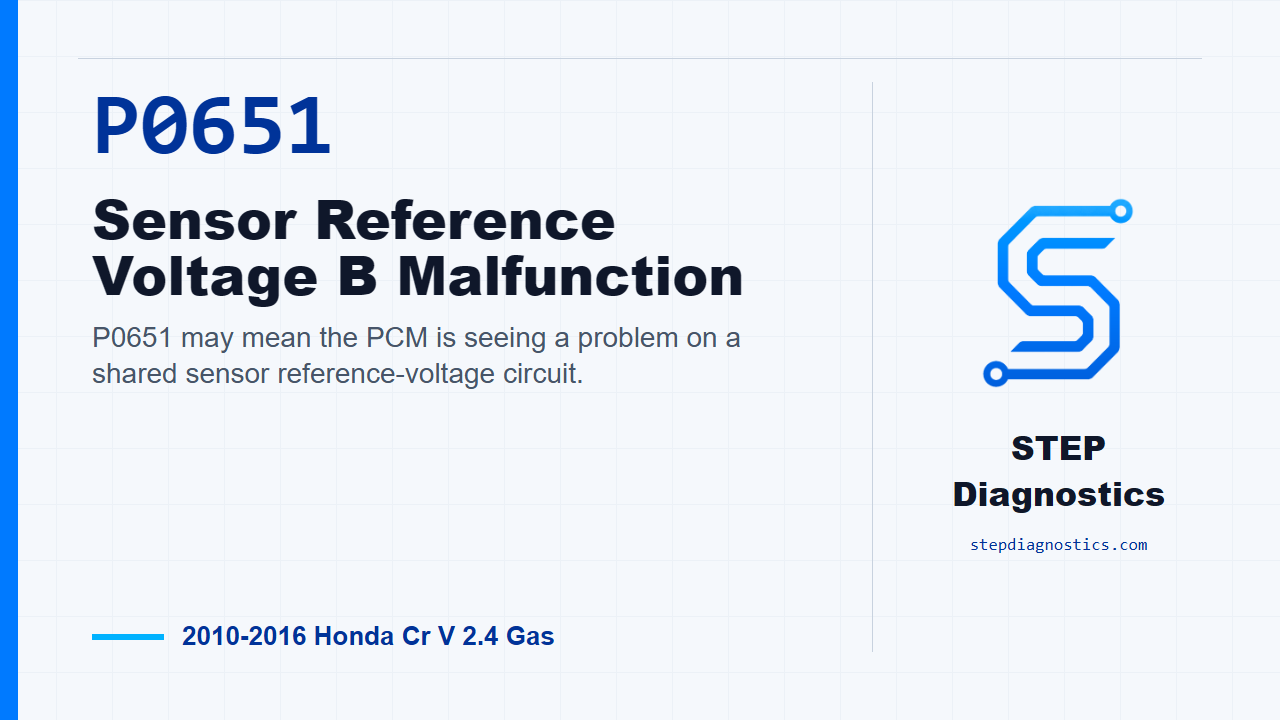
P0651 may mean the PCM is seeing a problem on a shared sensor reference-voltage circuit.
What the vehicle may do
- The vehicle may show throttle or accelerator-pedal related behavior.
- The vehicle may show CVT-related behavior.
- The issue can be intermittent and may not be present during the first check.
Possible fault areas
- Possible shared-circuit sensors or throttle body involvement.
- Possible poor connector contact or loose terminals at the PCM or connected parts.
- Possible short in the VCC wiring.
- Possible PCM software or PCM-side concern after circuit checks.
Diagnostic path
Opening context
On this 2010 to 2016 Honda CR-V with the 2.4 gas engine, P0651 is a Sensor Reference Voltage B malfunction. In plain language, the PCM may be seeing a problem on a shared reference-voltage circuit. The vehicle may show throttle, accelerator-pedal, or CVT-related behavior, and the problem can also be intermittent. The broad fault areas here are the shared sensors and throttle body on that circuit, connector or terminal problems, a possible short in the VCC wiring, or the PCM and its software side. Before chasing the circuit, start with the basic system checks and follow a structured diagnostic approach.
Verify the problem first
Start by turning the vehicle to the ON mode. Clear the DTC with the HDS, then check for Pending or Confirmed DTCs with the HDS and see if P0651 is indicated. If P0651 comes right back, the failure is duplicated, and the next move is to isolate whether the problem is on the VCC lines or somewhere else. If P0651 is not indicated, treat it as an intermittent at this point. The system is OK right now, so check for poor connections or loose terminals at the PCM, the APP sensor, the throttle body, and the CVT-related sensors on this shared circuit. If captured data is available from when the code set, try to reproduce those same conditions.
Separate the shared circuit from the connected parts
Next, turn the vehicle to the OFF, LOCK, mode. Disconnect the APP sensor 6P connector, the throttle body 6P connector, the CVT speed sensor 3P connector, the CVT driven pulley pressure sensor 3P connector, and the torque converter turbine speed sensor 3P connector. Then turn the vehicle back to the ON mode, clear the DTC with the HDS, and check again for Pending or Confirmed P0651. If P0651 is still indicated with those parts disconnected, move on to checking the VCC wiring for a short. If P0651 is not indicated now, the next step is to reconnect those parts one at a time and see which one brings the code back.
Find a shorted connected part
With the code gone while the parts are disconnected, reconnect the APP sensor, throttle body, CVT speed sensor, CVT driven pulley pressure sensor, and torque converter turbine speed sensor one at a time. After each reconnection, check for Pending or Confirmed P0651 with the HDS. If the code appears when one specific part is reconnected, replace the part that caused the DTC. If none of the parts brings the code back, check for poor connections or loose terminals at the PCM and those same components, then return to the original problem-verification check.
Check the VCC lines for a short to ground
If P0651 stayed active even with the shared-circuit parts disconnected, turn the vehicle to the OFF, LOCK, mode. Jump the SCS line with the HDS and wait more than 1 minute. With the APP sensor, throttle body, CVT speed sensor, CVT driven pulley pressure sensor, and torque converter turbine speed sensor still disconnected, disconnect PCM connector A, 51P, PCM connector B, 51P, and PCM connector C, 51P. Now check for continuity to body ground individually at PCM connector A terminal No. 40, PCM connector B terminal No. 48, and PCM connector C terminal No. 30. If there is continuity, repair the short in the VCC wire between the PCM terminal involved, A40, B48, or C30, and the parts that were disconnected for the isolation test.
If the VCC wiring checks OK
If there is no continuity to body ground on those VCC checks, the VCC wires are OK by this test. At that point, update the PCM if it does not have the latest software, or substitute a known-good PCM, then recheck. If P0651 goes away after the PCM update, the troubleshooting is complete. If P0651 goes away with the known-good PCM installed, replace the original PCM.
Verification and takeaway
Keep the final verification separate from the isolation work. After the correction, go back to the initial HDS check: clear the code, check for Pending or Confirmed P0651, and make sure it stays gone. The takeaway is simple: prove the code first, unplug the shared VCC loads to divide the circuit, reconnect one at a time to catch a shorted part, and if the code remains with the loads unplugged, test the VCC wires before moving toward PCM software or PCM substitution. For more diagnostic training, visit stepdiagnostics.com.
Final check
Diagnose P0651 by proving the fault, separating the shared VCC loads from the wiring, checking for the part that brings the code back, and only then moving toward wiring repair or PCM-level checks.
For more guided automotive diagnostics, visit STEP Diagnostics.