What this code means
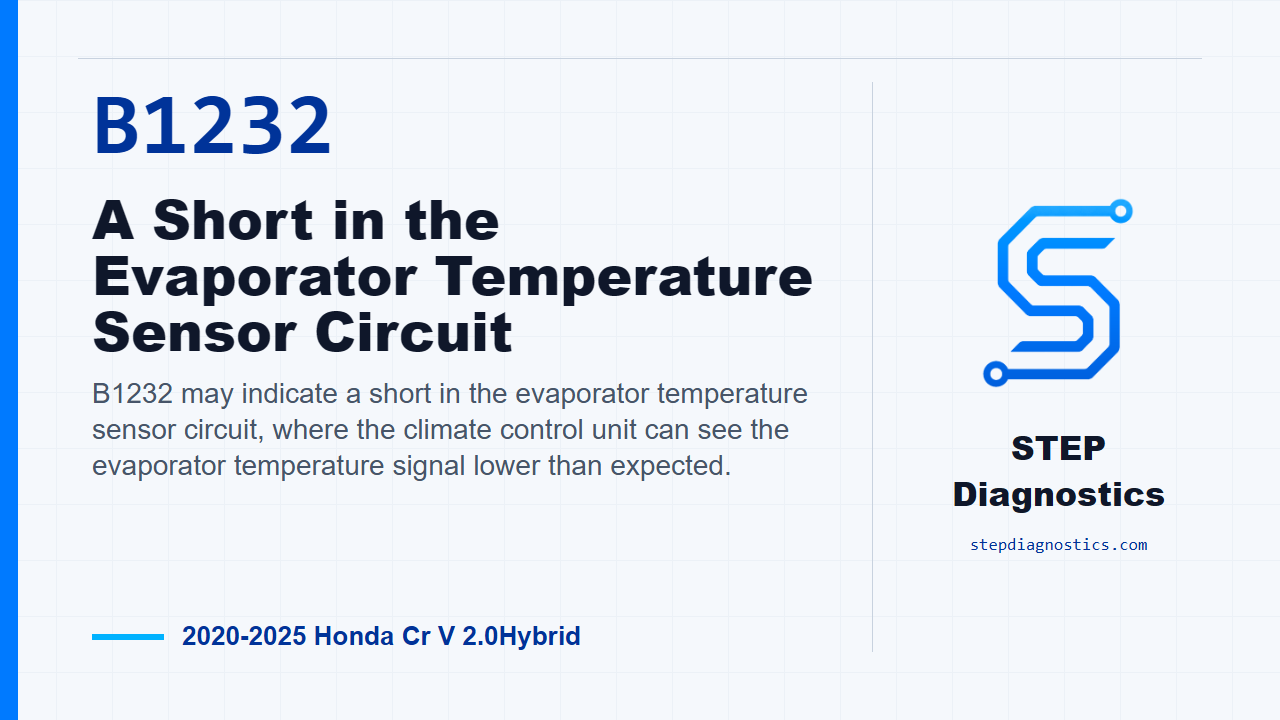
B1232 may indicate a short in the evaporator temperature sensor circuit, where the climate control unit can see the evaporator temperature signal lower than expected.
What the vehicle may do
- The air conditioning system may behave abnormally.
- The vehicle may store the code without an obvious driver complaint.
- Climate control performance can be affected if the evaporator temperature signal is not believable.
Possible fault areas
- Possible evaporator temperature sensor circuit wiring concern.
- Possible connector or terminal condition issue.
- Possible evaporator temperature sensor side circuit concern.
- Possible climate control unit involvement after circuit checks are normal.
Diagnostic path
Open on B1232
On this 2020 through 2025 Honda CR-V Hybrid, B1232 points to a possible short in the evaporator temperature sensor circuit. In plain terms, the climate control unit may be seeing the evaporator temperature signal pulled lower than it should be. The driver may notice air conditioning behavior that seems off, or the system may simply store the code. The likely areas to think about are the evaporator temperature sensor circuit wiring, connector condition, the sensor side of the circuit, and the climate control unit. This code sets when the input voltage from the evaporator temperature sensor is less than the specified value, and the climate control unit decides that is an abnormal condition.
Start with confirmation
Before getting into pinpoint testing, start with the basic system checks so you are not chasing a symptom created by a broader HVAC or electrical issue. Then turn the vehicle to the ON mode. With the HDS, go into Body Electrical, then HVAC, then Data List. That gives you the starting point for checking what the climate control unit is seeing from the evaporator temperature sensor side of the system.
Set up the circuit isolation
Next, isolate the circuit before doing resistance checks. Disconnect the evaporator temperature sensor connector, which is the 2P connector. Then disconnect climate control unit connector B, the 24P connector. The next check is done at the disconnected climate control unit connector B female terminals, using the inspection table for that connector. The exact terminal callouts for that table are not available here, so do not guess at the cavities. Pause at that point and verify the correct connector view and terminal positions before probing.
Check TEVA to SENS-COM for a short
With IG Mode OFF, perform the TEVA, SENS-COM shorted wire to wire inspection. A normal result is more than 1 MΩ. If that check is abnormal, treat it as a circuit problem and stay on the wiring side of the diagnosis instead of moving ahead too quickly.
Check TEVA for a short to ground
After that, use the standard open and shorted wire inspection method for the affected circuit and inspect based on what the circuit condition is showing you. With IG Mode OFF, perform the TEVA shorted to ground inspection. A normal result is more than 1 MΩ. If this check is abnormal, that again points you back to a circuit problem.
Evaluate the climate control unit only after the circuit checks
If the other inspection items all indicate a normal condition, then perform the climate control unit inspection. At that point, the remaining climate control unit is determined to be the cause. The takeaway is to prove the wiring checks first: TEVA to SENS-COM, then TEVA to ground, and only move to the climate control unit after those inspections are normal. For more diagnostic training, visit stepdiagnostics.com.
Final check
B1232 is approached by confirming the HVAC data, isolating the evaporator temperature sensor circuit, checking for shorts, and only then evaluating the climate control unit.
For more guided automotive diagnostics, visit STEP Diagnostics.