What this code means
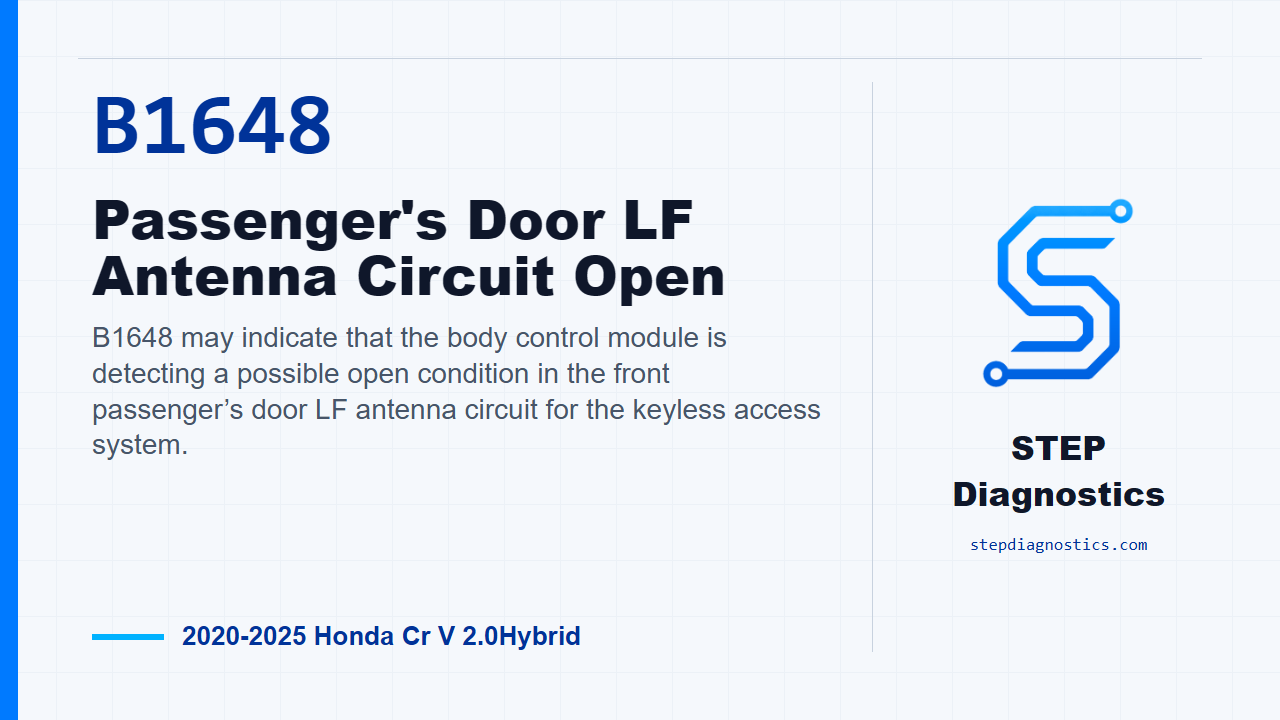
B1648 may indicate that the body control module is detecting a possible open condition in the front passenger’s door LF antenna circuit for the keyless access system.
What the vehicle may do
- The keyless access system may not respond normally at the front passenger door area.
- The vehicle may store the code during a self check even if the symptom is intermittent.
- A customer may report possible entry or detection issues related to the passenger side.
Possible fault areas
- Possible open or high resistance in the front passenger’s door LF antenna circuit.
- Possible connector or terminal issue in that circuit path.
- Possible body control module side circuit issue.
- Possible front passenger’s door LF antenna issue.
Diagnostic path
Opening context
Today we’re looking at B1648 on a 2020 to 2025 Honda CR-V Hybrid. In plain language, this code means the body control module may be seeing an open, or disconnected, condition in the front passenger’s door LF antenna circuit. The customer may notice possible keyless access trouble around that passenger door area, or the system may simply store the code during a self check. The broad fault areas are the antenna circuit wiring, the body control module side of the circuit, or the front passenger’s door LF antenna itself. The goal here is not to guess at parts — it’s to separate the circuit, the module output, and the antenna in order.
Start with system context
Before getting into pin checks, start with the basic system checks. If the vehicle has multiple body network or keyless access codes stored, deal with that diagnostic context first instead of chasing B1648 by itself. Then run the HDS self check to confirm the code and make sure you’re working from the current fault information.
Check the passenger door LF antenna circuit for an open
The first hands-on check is the open-wire inspection for the EXT_FR_AS plus and EXT_FR_AS minus circuits. Prepare for that by disconnecting body control module connector C, the 66 pin connector, and disconnecting the front passenger’s door LF antenna 8 pin connector. Before probing, verify the connector face and terminal locations at the vehicle. Don’t guess on pin placement. With the connectors disconnected, check the two antenna circuit legs at the female terminals. With IG Mode OFF, the normal condition for EXT_FR_AS plus is: There is less than 1 Ω. The normal condition for EXT_FR_AS minus is also: There is less than 1 Ω. If either side is abnormal, the problem is in the circuit, so stay with the wiring and connector path instead of moving on too quickly.
Only move to the module check after the external circuit passes
The body control module inspection comes after the external circuit has checked normal. For this check, disconnect the front passenger’s door LF antenna 8 pin connector and perform the module inspection at the disconnected antenna connector female terminals. The listed normal result for the module internal circuit inspection with IG Mode ON is Voltage. No numeric voltage threshold is provided here, so don’t create one. There is also a note that this circuit is affected by permanent power supply, so be careful not to over-read the vehicle mode wording. If this module inspection is abnormal, the problem is with the body control module side of the diagnosis.
If the circuit and module checks are normal
If the open-wire inspection is normal and the body control module inspection is normal, the remaining suspect in this diagnostic path is the front passenger’s door LF antenna. At that point, the circuit and module checks have done their job: they’ve narrowed B1648 down to the antenna side instead of leaving it as a general keyless access problem.
Verification and takeaway
After the fault area is corrected, run the self check again and make sure B1648 is no longer being set. The key on this one is sequence: confirm the code, check the two antenna circuit legs for less than 1 Ω, move to the module check only after the external circuit is normal, and leave the antenna as the conclusion only after the other checks pass. For more diagnostic training, visit stepdiagnostics.com.
Final check
B1648 is best handled by narrowing the fault in order: confirm the code, test the antenna circuit, check the module side only after the external circuit passes, and then consider the antenna if the前面的
For more guided automotive diagnostics, visit STEP Diagnostics.