What this code means
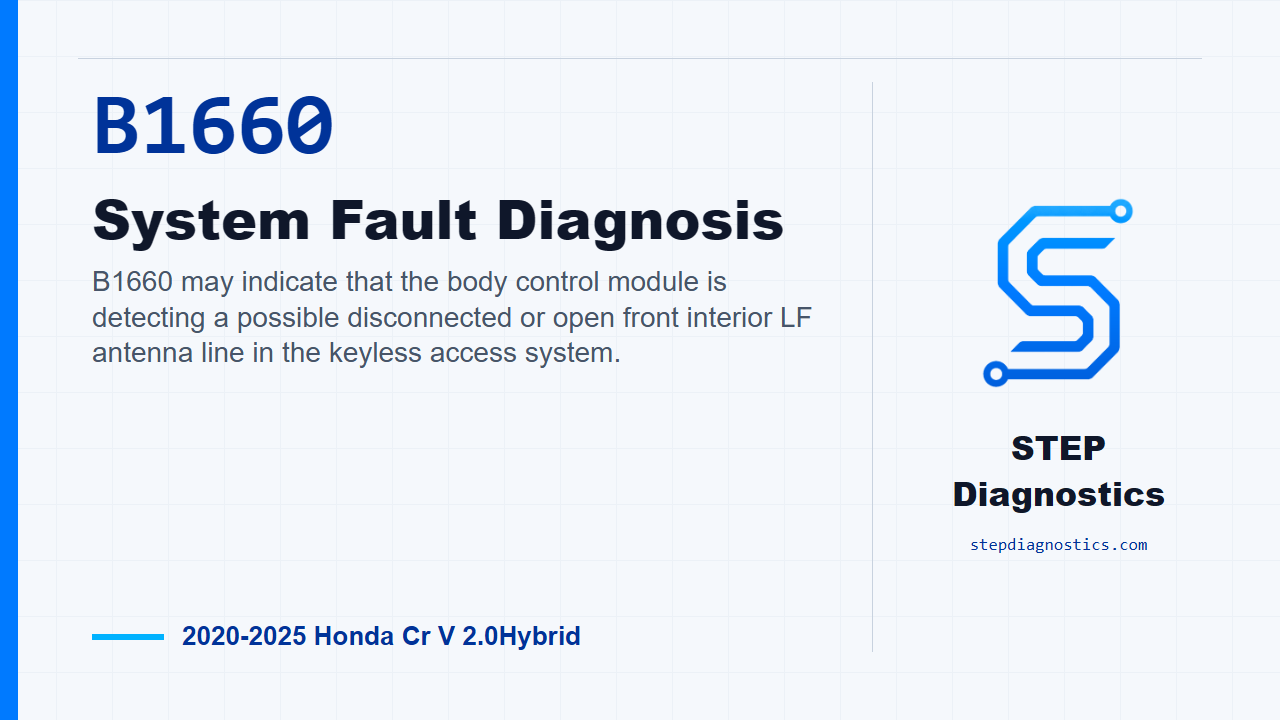
B1660 may indicate that the body control module is detecting a possible disconnected or open front interior LF antenna line in the keyless access system.
What the vehicle may do
- Keyless access operation may be inconsistent.
- The vehicle may not respond normally to keyless access inputs in situations that depend on the front interior LF antenna.
Possible fault areas
- Possible front interior LF antenna circuit issue.
- Possible connector or terminal condition issue.
- Possible body control module side circuit issue.
- Possible front interior LF antenna issue.
Diagnostic path
Opening context
On this CR-V Hybrid, B1660 is a keyless access code tied to the front interior LF antenna circuit. In plain language, the body control module may be seeing that antenna line as disconnected. The driver may notice keyless access operation that is inconsistent or does not respond normally, and the broad fault areas can include the antenna circuit, connector or terminal condition, the body control module side of the circuit, or the front interior LF antenna itself.
Start with the scan and system checks
Start with the basic system checks before getting into circuit testing. If other codes are present, especially in a multiple-code situation, check what they mean first and follow the proper network diagnostic path instead of chasing B1660 by itself. After that, run the HDS self check and use that result to begin the B1660 diagnostic path.
Check the front interior LF antenna wires first
The first hands-on inspection is the EXT_F plus and EXT_F minus open wire check. Disconnect the front interior LF antenna 2P connector, then disconnect body control module connector C, the 66P connector. With the circuit isolated, perform the open wire inspection using the specified test points. A normal result is less than 1 Ω on EXT_F plus with the inspection OFF, and less than 1 Ω on EXT_F minus with the inspection OFF. If that open wire inspection is abnormal, the problem is in the circuit, so stay with the wiring and connection side before moving on.
Evaluate the body control module side
Next, move to the body control module inspection only with the external circuit confirmed normal. This inspection can be run before the other inspections because it includes the inspection items, but if it fails, do not stop there and guess; continue checking the individual items so you know which part of the path failed. For this body control module check, disconnect the front interior LF antenna 2P connector and perform the inspection. The expected result for the module internal circuit inspection ON is voltage. If that result is abnormal, the problem points to the body control module.
Isolate the remaining antenna fault
If the other inspection items show normal, the remaining suspect in this diagnostic path is the front interior LF antenna. At that point, the procedure is no longer pointing at the external wiring or the body control module check; it identifies a problem with the front interior LF antenna.
Verification and takeaway
Keep final verification separate from the testing. Once the fault area has been corrected, verify the repair and confirm B1660 stays gone. Takeaway: prove the two antenna wires first, evaluate the body control module side next, and only after those checks are normal should the front interior LF antenna be considered the cause. For more diagnostic training, visit stepdiagnostics.com.
Final check
This code is often approached by proving the antenna circuit first, then checking the body control module side, and then considering the antenna if the other checks are normal.
For more guided automotive diagnostics, visit STEP Diagnostics.