What this code means
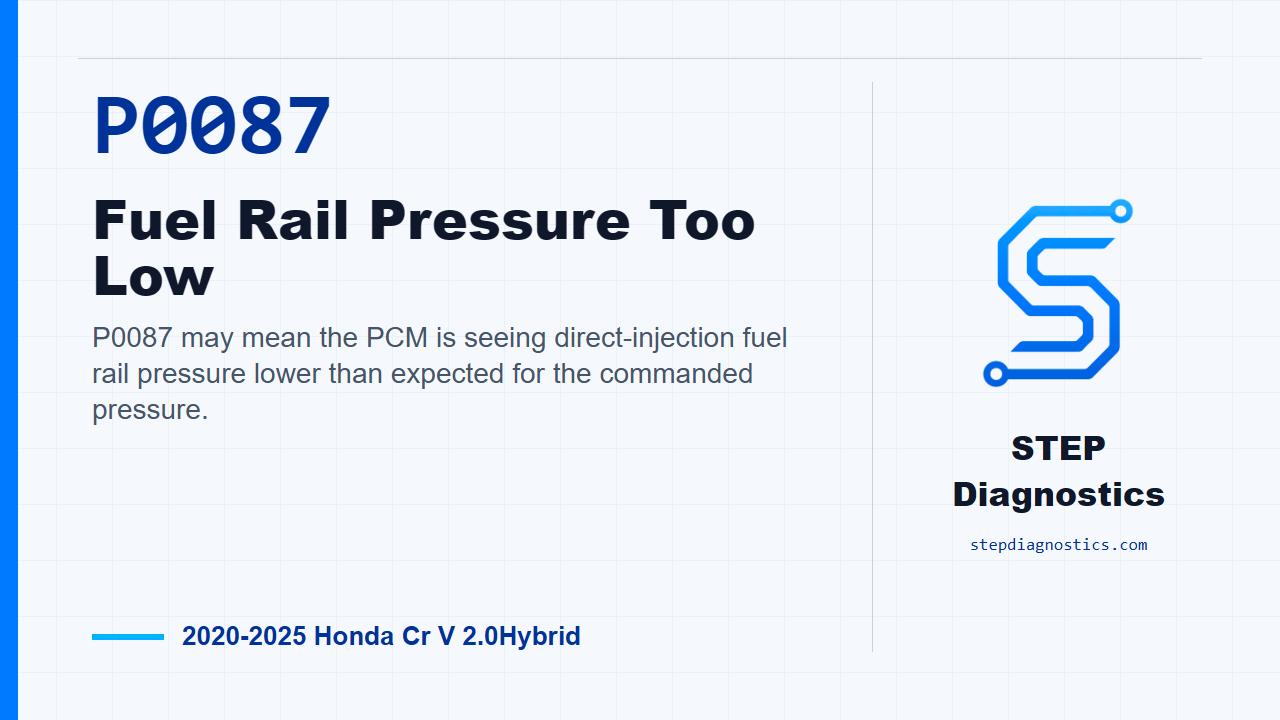
P0087 may mean the PCM is seeing direct-injection fuel rail pressure lower than expected for the commanded pressure.
What the vehicle may do
- The vehicle may hesitate or feel low on power.
- The engine may crank longer than normal.
- The engine can stall if pressure drops far enough.
- The malfunction indicator may come on.
Possible fault areas
- A low fuel or fuel supply condition may be involved.
- A fuel leak can cause this type of fault.
- The fuel rail pressure sensor signal or fuel rail area may be involved.
- The high-pressure pump cam, lifter contact area, or high-pressure pump may be involved.
Diagnostic path
Opening context
On this 2020 to 2025 Honda CR-V Hybrid, P0087 means the direct-injection fuel rail pressure is being seen as too low. In plain language, the commanded fuel pressure and the actual pressure are not lining up the way the PCM expects. The vehicle may hesitate, lack power, crank longer than normal, or stall, depending on when the pressure drops. Broadly, this can involve fuel supply issues, a leak, the fuel rail pressure signal, the fuel rail, the high-pressure pump drive, or the high-pressure pump itself. Start with the basic system checks and follow a structured diagnostic approach, because this code is about pressure control and response, not just one part.
Check context before running the P0087 path
Before getting deep into P0087, check the context. If the vehicle ran out of fuel and stalled before the code set, refuel it and clear the DTC with the HDS. If there is a fuel leak, repair the leak before continuing with this diagnostic. Also, if other fuel rail pressure sensor or high-pressure fuel pump codes are present, diagnose those indicated systems first. For P0087 itself, the logic is simple: if actual high-pressure fuel pump pressure is lower than the target pressure, the PCM sees that as abnormal and stores the code.
Duplicate the failure first
To confirm the fault, enter maintenance mode and start the engine. Hold the engine speed at 3,000 rpm with no load, in Park or Neutral, until the radiator fan comes on, then let the engine idle. Run the HDS DI fuel pressure test. If that test result is not OK, the failure has been duplicated and the confirmation procedure is complete.
If needed, reproduce the captured driving conditions
If the shop test does not catch it, drive the vehicle for several minutes in the same range as the recorded snapshot. Match the operating pattern rather than just taking a random road test: engine speed, vehicle speed, load-related sensor readings, temperature inputs, and the fuel pressure data all matter here. The goal is to make the pressure command-and-response problem show up under the same conditions that set P0087.
Fuel rail pressure sensor check, loaded comparison
For the first fuel rail pressure sensor inspection, the low-pressure side fuel pressure test needs to be normal. This check can be used early because it covers several inspection items, but if it fails, continue with the individual checks to isolate what failed. Enter maintenance mode, start the engine, then hold it at 3,000 rpm with no load in Park or Neutral until the radiator fan comes on, and let it idle. With the brake pedal held firmly, shift to Drive and press the accelerator pedal. Do not shift the transmission or take your foot off the brake while raising engine speed. Compare the HDS Fuel Pressure Converted From PF Sensor value with the Fuel Pressure Direct Injection System value. They should be almost the same. If that comparison is abnormal, the problem is in the fuel rail area.
Fuel rail pressure sensor check, pressure release comparison
For the second fuel rail pressure sensor inspection, again make sure the low-pressure side test is normal. Disconnect PGM-FI main relay 2. Enter maintenance mode, start the engine, and let it idle until it stalls. After it stalls, crank the engine several times. Then check the HDS Fuel Pressure Converted From PF Sensor value. The value should be less than 1,000 kPa, and a reading of several hundred kPa is considered normal. If this check is abnormal, stay with the fuel rail diagnosis rather than jumping ahead.
High-pressure pump cam and lifter area
Once the fuel rail pressure sensor checks normal, move to the high-pressure fuel pump cam inspection. Check the high-pressure fuel pump cam on the camshaft for damage or wear. The expected result is no damage, and camshaft wear within the specified value. The exact wear specification is not available here, so do not guess at that limit. If the cam inspection is abnormal, the problem is in the camshaft area. When there is a problem there, also check the roller of the lifter attached to the high-pressure fuel pump for damage, deformation, or wear.
High-pressure fuel pump conclusion
If the other inspection items all indicate normal condition, then the remaining high-pressure fuel pump is determined to be the cause. At that point, the diagnosis has worked through the pressure sensor side, the rail checks, the cam drive inspection, and the remaining pump-side conclusion in order.
Verification and takeaway
After the condition has been addressed, verify it by returning to the confirmation logic: run the appropriate pressure test or reproduce the captured operating conditions and confirm the failure is no longer duplicated. The takeaway on P0087 is to prove whether the fuel pressure problem is supply-related, rail-signal-related, cam-drive-related, or the remaining high-pressure pump fault before making the call. For more diagnostic training, visit stepdiagnostics.com.
Final check
P0087 is often diagnosed by comparing commanded pressure behavior to actual fuel pressure response, then separating rail-signal issues from high-pressure pump drive and pump-side faults.
For more guided automotive diagnostics, visit STEP Diagnostics.