
Start with the question the measurement must answer
Before choosing a sharp probe, write the electrical question. Are you checking a supply at a connected component, comparing two test points or capturing an intermittent signal? Identify the required operating state and whether the circuit must remain connected. A convenient connection that changes the required circuit state may answer a different question.
Record the connector identifier, cavity and viewing direction. Use the terminal-side versus wire-side guide when orientation is uncertain. A pin number without a confirmed view is insufficient preparation for access.
Follow the exact vehicle procedure and instrument instructions. Restraint, high-voltage and other protected circuits require their specified precautions and equipment. This comparison does not authorize probing them or prescribe a generic live test.
Compare access methods before disturbing the fault
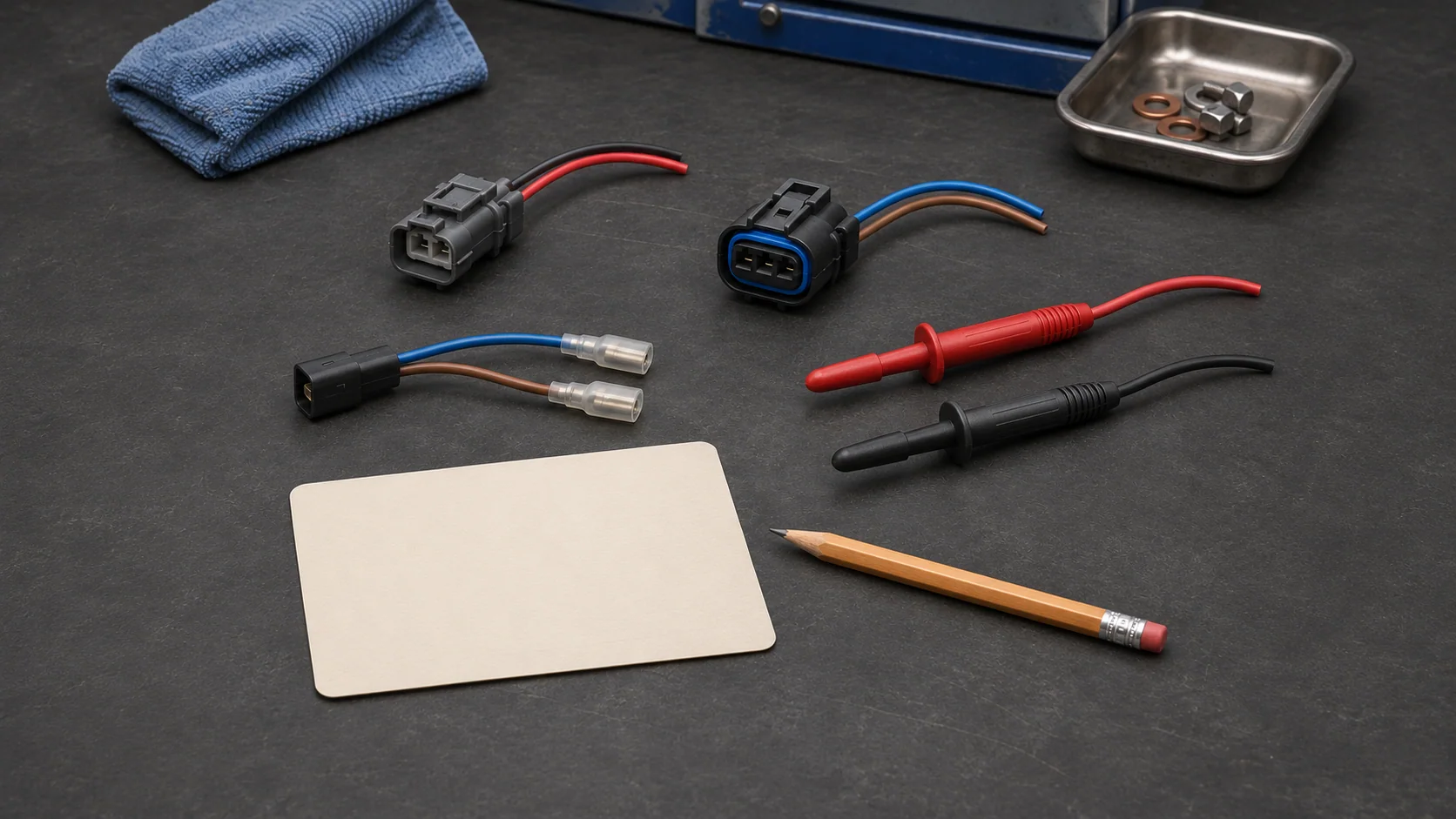
Pico Technology's connection guide explains that disconnecting and reconnecting a connector can temporarily change an intermittent fault. It also discusses suitable breakout leads as an alternative to direct probing, provided their terminals fit and the circuit remains connected as intended.
That creates a useful planning decision: can the required observation be obtained through an approved accessible point, a suitable breakout adapter or a permitted non-contact method? These options are not interchangeable measurements. Confirm that the chosen method still answers the original question.
If installing an adapter requires disconnecting the suspect connector, preserve what was observed beforehand and label the later capture as occurring after that disturbance. Do not present it as an untouched baseline.
Back-probing still has connector-specific limits
Pico warns that an unsuitable probe or excessive force can spread contacts or damage seals. Its guidance includes matching probe size, supporting the connection and checking stability before interpreting a waveform. A probe advertised for automotive use does not establish compatibility with the connector in front of you.
An OEM example shows why the restriction matters. Mitsubishi's How to Check Terminal service-information page prohibits probing its described waterproof connectors from the harness side because the wire seal can be damaged. That example is not a universal rule for every connector; it is a reason to retrieve the applicable instructions instead of assuming rear access is allowed.
Stop when the permitted access path or adapter fit is unresolved. Do not force a pin into a cavity, treat a mating contact as a convenient socket for a meter tip, or improvise a connector modification to obtain a reading.
Piercing adds a restoration obligation
Pico treats wire piercing as a last resort and warns against leaving damaged insulation unrepaired. A successful electrical connection does not settle how the entry point must be restored.
Before piercing is considered, confirm that the applicable procedure permits it and specifies a suitable repair or sealing method. Identify the location and required material. This article supplies no universal sealant, tape repair or approved piercing location.
Keep the original fault and any test-access damage as separate entries. Finding a damaged seal after testing does not establish when it became damaged. Likewise, a symptom disappearing after a connector was moved does not, by itself, prove a terminal repair is complete.
Leave an access record with the capture
Use the circuit-access and restoration record to retain:
- The electrical question, required circuit state and procedure reference.
- Connector, cavity, confirmed view and selected access point.
- Adapter or probe identity and the source permitting that method.
- Observations before disturbance, the disturbance made and capture timing.
- Access limitations, required restoration and its verification status.
Use explicit entries such as "adapter fit unresolved" or "restoration not yet verified" when appropriate. Preserve a later test separately, with the changed connection documented. The worksheet is an original handoff aid, not a vehicle procedure or proof that a circuit is undamaged.
Electrical evidence needs its connection context. Request STEP access to discuss your shop's electrical and network diagnostic workflow and current availability. No automated connector inspection, repair approval or universal vehicle coverage is claimed here.