
Mechanic Guides
Battery Tester Surface Charge: Complete the Preparation Before Reading the Verdict
Understand a battery tester surface-charge message. Preserve charge history, follow the correct preparation and keep the subsequent battery result separate.
Published · 5 min read
Quick answer
Surface charge can temporarily elevate a recently charged battery's voltage. A tester prompt about surface charge calls for the specified preparation; it is not a completed battery-health verdict.
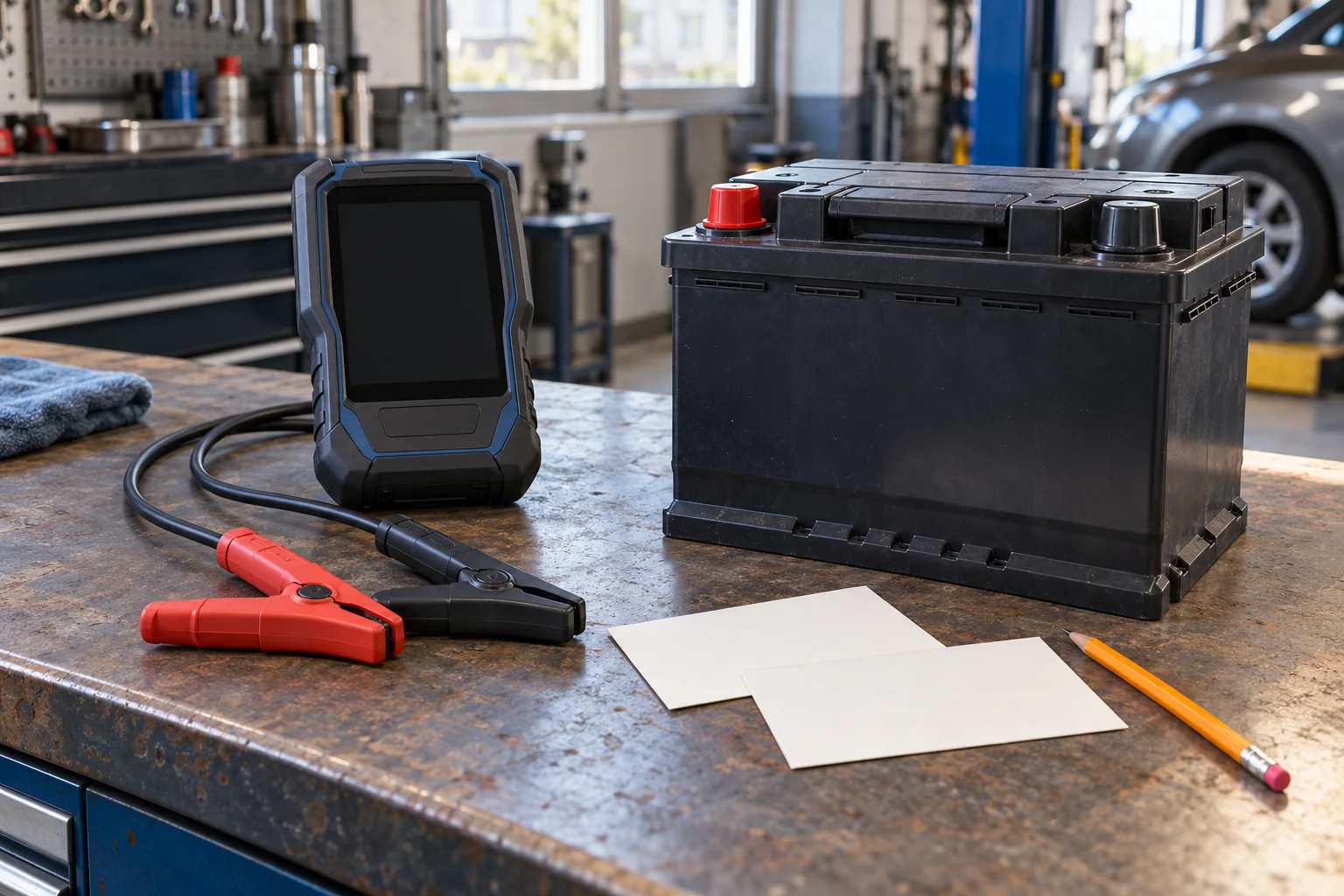
A starting battery reaches the bay just after charging. The tester pauses with a surface-charge message. That message belongs in the preparation record: it does not, by itself, establish a good or failed battery. Finish the applicable preparation and test sequence before reporting a condition decision.
This guide concerns professional records for 12-volt lead-acid starting batteries. It does not cover high-voltage traction batteries or prescribe a charging procedure. Use the current vehicle, battery and tester instructions for inspection, PPE, ventilation, connection points and stop conditions.
What surface charge changes
Recent charging can leave a temporary voltage elevation. A voltage observed in that condition may give a misleading impression of charge state. Midtronics discusses this limitation in its guide to misleading battery results, including the possibility of affected conductance readings.
That does not make every recently charged battery defective, and it does not make a high voltage proof of useful capacity. Keep three questions distinct: what preparation is required, what the completed test reports, and whether the original starting or discharge complaint has been resolved.
A surface-charge message also differs from an instruction to charge a depleted battery. Do not replace the actual wording with a generic note such as battery needs charge. That loses the information needed to choose the correct follow-up.
Use the identified tester's workflow
The Midtronics MDX-645P instruction manual, printed page 14, places SURFACE CHARGE DETECTED among messages that can appear before a result. For that tool, testing resumes after the required surface-charge removal. Page 12 lists CHARGE & RETEST among standard results and REST & RETEST under New Battery Test Results.
Those are examples from an identified manual, not a command sequence for every tester. Record the installed equipment, software where available, selected test mode and the current instructions being followed. A different model may handle preparation differently.
Use the prescribed method rather than borrowing a headlight-on duration or waiting period from a general article. Do not improvise a load or bypass a tester prompt to obtain a printable verdict. If preparation cannot be completed under the applicable instructions, leave the test pending and identify what is missing.
Preserve the before and after
Before preparation, save the exact message, timestamp and relevant charge history. Record when a charger was disconnected or the engine last ran if that information is known. Mark unknown history as unknown; do not estimate it from the voltage reading.
After the required preparation, save the subsequent test as a linked record. Include the battery identity, chemistry, label rating and standard, the inputs actually entered, connection location and any required temperature information. Preserve the original prompt alongside the new result instead of overwriting it.
The manufacturer's troubleshooting discussion also treats connection problems and unstable testing as separate messages. A second interruption therefore needs its own explanation. Do not assume that every unfinished test is another surface-charge event.
A fictional handoff example
In an invented shop example, technician A records a surface-charge prompt after a customer reports recent charging. The job changes hands before preparation is completed. A note saying battery good would turn an unfinished process into an unsupported conclusion.
A useful handoff instead says: exact prompt saved; preparation reference identified; required follow-up pending. Technician B can then complete the specified sequence and attach the resulting report. If the next result requests further action, that action remains open. No pass, replacement or completed repair is invented for this example.
A favorable completed battery result still answers only the question addressed by that test. If the vehicle's complaint remains, preserve it as unresolved and continue the applicable diagnosis. This article does not infer a starter, cable, alternator or parasitic-draw fault from the prompt.
A preparation record the next technician can use
Use the downloadable record to keep the incoming condition, preparation and later result in separate fields. Every entry should identify its evidence or remain visibly unknown. This is an original documentation aid, not a replacement for equipment instructions.
For conflicting methods, use the conductance versus load-test guide. For interpreting rating labels, the CCA, amp-hours and reserve-capacity guide addresses a different question.
To discuss how your shop carries test context and unfinished checks between technicians, request STEP early access.