
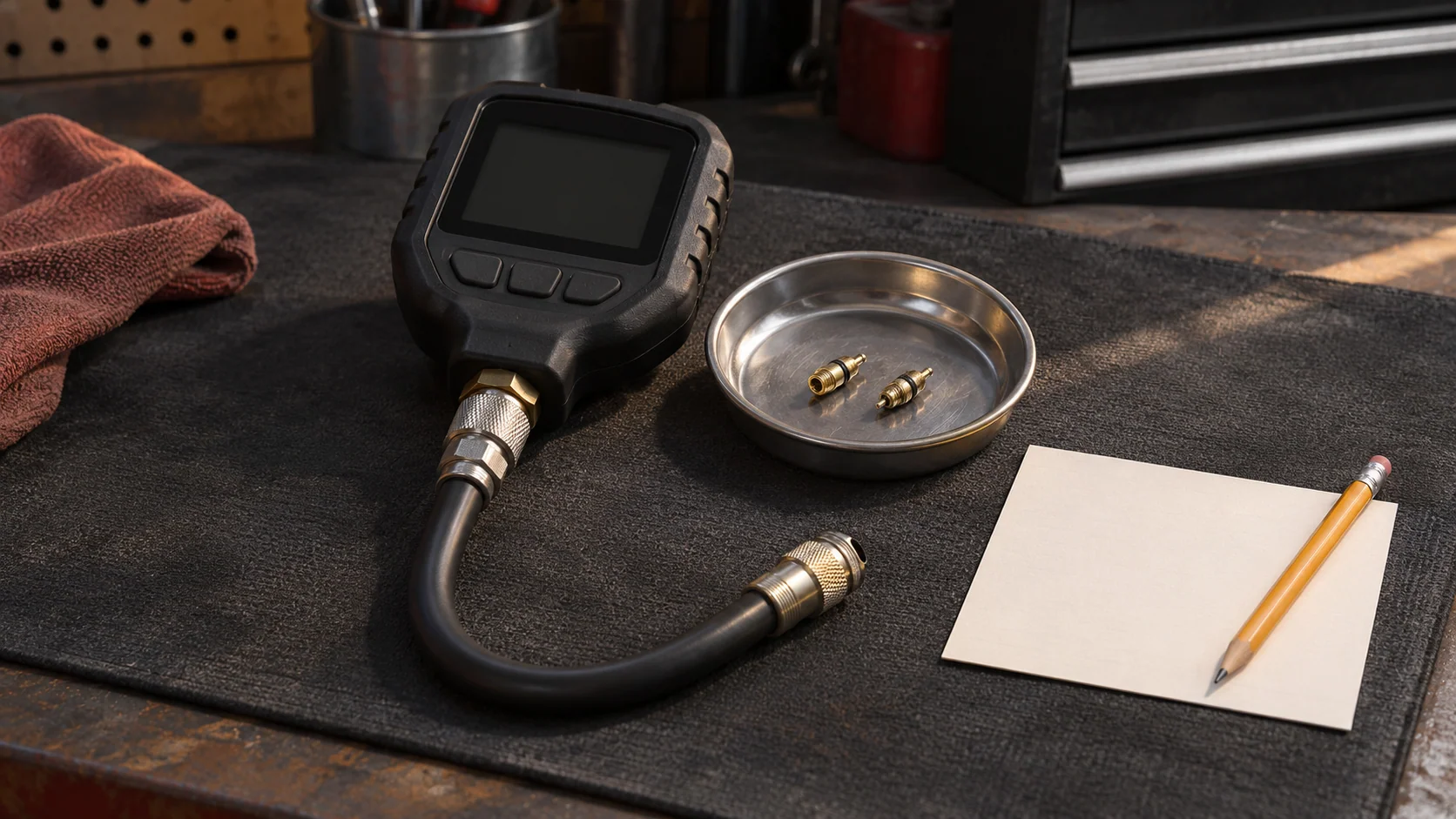
Identify the tester and the valve assembly
Write down the tester make, model and identification, the connected hose and adapters, and any known replacement history. Identify the part the manufacturer actually names. A search for a "Schrader valve" may lead to a valve core, a one-way valve or a larger coupling and valve assembly; the search term alone does not establish which part belongs in the tool.
For a concrete equipment example, Lang Tools lists compression valve core 41755 and describes that particular replacement as springless. That is a product-specific description, not evidence that every compression tester uses a springless core or that this part fits another brand. Match the current parts information for the actual tester before ordering or fitting a replacement.
Read the manufacturer's restriction
The identified Hella Gutmann Low-Pressure Diagnostic Kit manual, editorial date October 2014, printed page 23, requires its supplied one-way valve for the gasoline compression setup. It warns that a wrong insert, such as a tire valve, produces incorrect measured values. This is an example for that LPD kit, not a universal assembly instruction.
Similarly, Bosch's Compression Tester User's Manual 573847 Rev A, copyright 2014, includes a repair-parts note excluding an automotive tire air valve as a replacement. These warnings give a reason to check exact parts provenance. They do not supply a cross-brand core specification, opening-pressure value or field modification.
If the tool model, fitted core or applicable replacement information cannot be confirmed, retain that uncertainty. Physical fit and a familiar appearance do not resolve a manufacturer's compatibility requirement.
Describe the behavior before naming the fault
Record what prompted the tool question: a low displayed value, a reading that changed after cranking stopped, an altered hose assembly, or an unknown previous repair. Include when the behavior occurred and which setup produced it.
Those observations do not, by themselves, identify a defective core. They also do not establish worn rings, a leaking engine valve or another mechanical cause. Keep the suspected tester condition separate from the vehicle findings until the relevant check is completed.
Before inspecting or servicing equipment, follow the manufacturer's depressurization, disconnection and service instructions, together with the vehicle's safe-work requirements. The Bosch manual, for example, describes relieving tester pressure before removing the hose or adapter. A short editorial summary is not a substitute for the complete applicable procedure.
Keep the test mode and assembly together
Do not remove a core simply to convert an unfamiliar compression hose into a leak-down or pressure-drop tool. The Hella LPD manual specifies different one-way-valve configurations for its pressure-drop and compression modes, on printed pages 19 and 23. That distinction belongs to its documented equipment and workflow.
Our compression-test versus leak-down guide explains the different questions those tests answer. The current tool and vehicle procedures still determine the permitted setup. A hose that connects is not, by that fact alone, a validated measurement path for a different test.
Preserve the service and the repeat
Use the tester/core and repeat record to keep the following together:
- Original reading, units, cylinder, setup and actual test conditions.
- Tester, hose, adapter and fitted-core identification, including unknowns.
- Manufacturer parts reference, revision and compatibility confirmation.
- Service actually performed and the equipment-readiness check required afterward.
- Separate repeated reading, conditions, remaining limitations and next check.
If the engine condition, cranking procedure, gauge or adapter also changed, document those changes. A different reading afterward does not isolate the effect of the core alone. Keep the original record available and assess the new result against the applicable vehicle requirement; no universal pressure or cylinder-difference limit is supplied here.
The same separation of observations, tool questions and proposed causes is useful during electrical and network diagnosis. Request STEP access to discuss that workflow and availability for your shop. This guide does not claim STEP services compression testers, acquires pressure readings or approves engine repairs.