
Mechanic Guides
Thermocouple Extension Wire: Check the Grade Before Extending a Shop Probe
Compare sensing-grade, extension-grade and compensating cable before extending an external shop thermocouple. Includes a segment-by-segment acceptance record.
Published · 5 min read
Quick answer
Thermocouple-grade wire can form the sensing junction; extension-grade wire carries the signal between probe and readout within its own limits. Verify type, grade, connectors, polarity and local exposure for the complete assembly before accepting an extension.
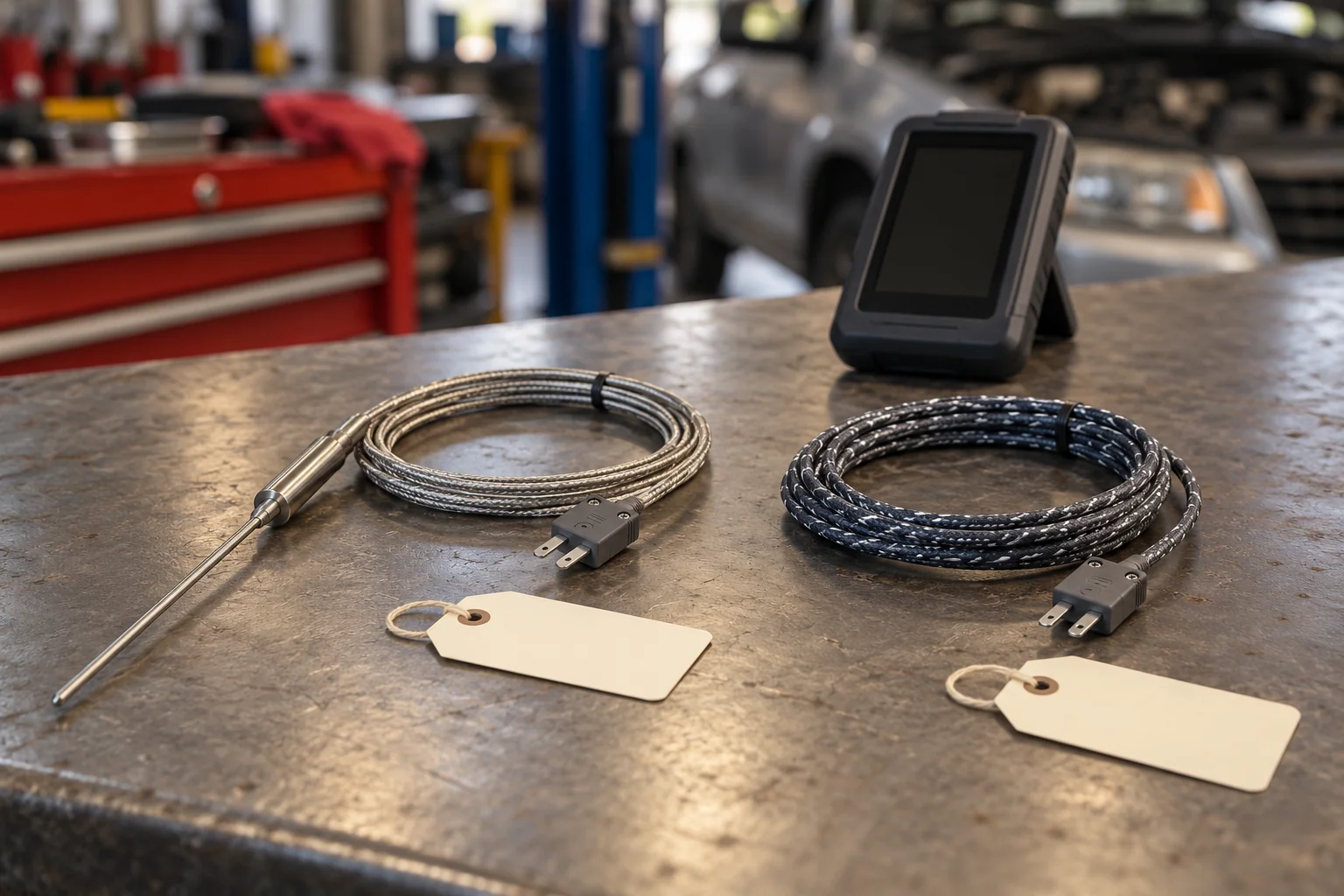
Start with the assembly you actually have
A technician wants an external contact-temperature probe to reach a measurement point while the readout stays on the cart. A cable with a familiar connector is available. Before using it, identify what that cable is and where each part would be exposed. A physically convenient extension is not yet an identified measurement assembly.
This guide concerns external shop thermocouples. It does not identify an installed vehicle sensor, authorize modifying its wiring or establish a vehicle temperature limit. Routing, attachment and any measurement must follow the applicable vehicle and equipment procedures.
Sensing wire and extension wire have different jobs
Omega's thermocouple-wire guide distinguishes wire used to form the sensing point from extension-grade wire used between the probe and instrument. It explains that an extension can carry a signal representing a higher sensing temperature while having a lower permitted ambient exposure of its own. Extension-grade wire is not a substitute for sensing-junction wire.
For the shop record, separate two questions: what temperature is the probe intended to measure, and what conditions will the extension itself encounter? Copy the cable's applicable rating from its own documentation. Do not assign it the probe's advertised range simply because both items carry the same thermocouple letter.
The same Omega guide treats Standard versus Special Limits of Error as an accuracy distinction. That is a separate question from sensing grade versus extension grade. A label about accuracy does not, on its own, identify where an assembly may be used.
Extension and compensating cable are not interchangeable names
TC Direct's cable comparison describes extension cable using the thermocouple conductor materials and an X designation, such as KX. It describes compensating cable using different conductor materials with an appropriate thermoelectric relationship over specified conditions, and C-based designations. Additional letters can matter.
The page illustrates why the full designation matters: its Type KCB example has a stated temperature restriction at the interconnection to the Type K sensor. Treat that as a product/type-specific example, not a general temperature permission for every cable marked K.
Before accepting a proposed substitute, obtain the manufacturer's compatibility statement for the exact cable and sensor combination. Record the complete designation and the conditions attached to it. If only a broad type or an incomplete label is known, keep substitution suitability unresolved. A continuity result would not supply the missing material or rating evidence.
Check every transition in the chain
Pico's thermocouple selection and use guidance calls for the correct extension-wire type, connector materials and polarity. Its connection discussion warns that unintended dissimilar-metal junctions can introduce measurement errors. These checks apply to the connections as well as the length of cable between them.
Trace the documented path from probe to extension to adapter to readout. For each transition, identify both mating parts and the reference that establishes compatibility. A connector photograph helps identify the item under discussion; it does not replace its part number or technical information.
Keep the cable's environmental exposure, connector limits and insulation information with the assembly record. Record the planned route and any unresolved local condition rather than approving the whole chain from the sensing tip's rating. This is a document check, not permission to route a cable near moving or hot vehicle parts.
Wire selection also does not replace the readout's reference compensation. Use the separate cold-junction-compensation guide for that question; changing cable grade is not an improvised temperature correction.
Make the acceptance decision reviewable
Use one row for each probe lead, extension and adapter in the original acceptance record:
- Item identity, complete type or grade designation and manufacturer reference.
- Intended role: sensing assembly, extension or documented compensation.
- Mating connector identities, compatibility evidence and polarity identification.
- Applicable local-exposure and assembly restrictions with source location.
- Planned position and any exposure that has not been established.
- Result: documented fit for the intended use, information missing, or unsuitable under the stated conditions.
In a fictional example, a probe is identified but its proposed extension has only a handwritten K tag. The shop retains the cable photograph and asks for the actual assembly documentation. It does not assign a temperature limit, certify the extension or discard an earlier reading as false. The missing grade and connector evidence remain visible.
After an extension is accepted under its instructions, retain its identity with any resulting temperature record. If the assembly later changes, name the changed item so a comparison can be assessed. A stable display alone does not certify the assembled measurement chain.
Attach the acceptance record to the diagnostic report. Request STEP Early Access to discuss the measurement setup, evidence and unresolved checks your shop needs to preserve between technicians.