A catalyst-efficiency code is not a complete diagnosis of the converter. On the Chevrolet Silverado 1500 5.3 gas engine, the controller evaluates catalyst performance using exhaust-sensor information and defined operating conditions. The result is meaningful only when the relevant engine, sensor and exhaust-system conditions are trustworthy.
This overview covers the 2019–2025 Chevrolet Silverado 1500 5.3 gas profile. Service information for the first and last years supports the conceptual explanation, not identical equipment, calibrations, sensor circuits or procedures for every truck in between. Confirm the exact engine and build. The applicable vehicle-specific information controls bank and sensor identification, monitor conditions, electrical connections, specifications, setup and repair verification.
What the catalyst does
The three-way catalyst helps reduce hydrocarbons, carbon monoxide and nitrogen oxides in the exhaust. Its active material promotes chemical reactions that convert hydrocarbons and carbon monoxide into water vapor and carbon dioxide, while reducing nitrogen oxides to nitrogen. Its condition and the exhaust supplied by the engine both matter.
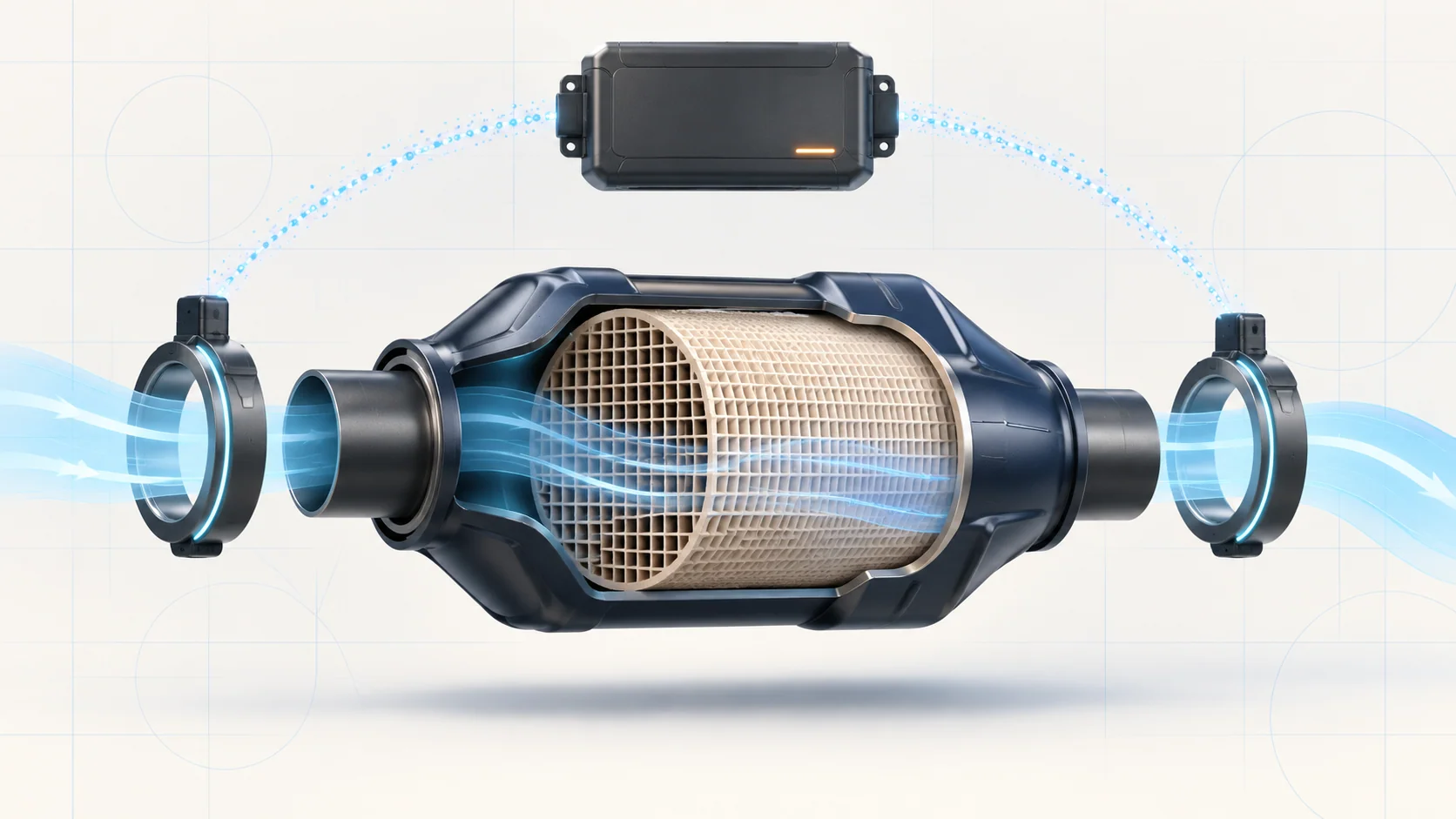
The catalyst also stores oxygen. Heated oxygen sensors before and after the catalyst provide information that the engine controller uses to evaluate that storage behavior. This is an indirect performance assessment, not a direct measurement of every tailpipe emission or a mechanical inspection of the converter.
On the endpoint applications examined, the catalyst diagnostic evaluates sensor response during an appropriate off-idle deceleration fuel-cut event. A functioning catalyst's oxygen storage makes the downstream response slower than the upstream response during that defined event. A downstream response approaching the upstream response can indicate reduced storage capability. Comparing arbitrary traces at idle does not reproduce the complete diagnostic test.
Three related functions that need separate evidence
The sensor signal, its heater and the catalyst monitor are related, but each has a different job. The signal describes exhaust oxygen as interpreted through the applicable sensing circuit. The heater helps the sensor reach a useful operating temperature. The catalyst diagnostic evaluates performance after its prerequisites are satisfied.
A heater problem can undermine readiness without proving converter damage. A high signal can involve a circuit, sensor or engine-operating condition; it does not by itself prove a rich mixture or failed catalyst. A valid sensor signal is necessary input, not a stand-alone certificate of catalyst health.
The controller also uses oxygen-sensor information for fuel control. That does not make a fuel-trim correction and a catalyst-efficiency result interchangeable. This article focuses on catalyst evaluation and the input faults that can mislead it, not on a complete fuel-system diagnostic procedure.
How the STEP guides fit together
| Guide | Diagnostic question | Boundary |
|---|---|---|
| P0420 — catalyst-efficiency guide | Has the Bank 1 catalyst-monitor concern been evaluated after related engine faults, contamination, sensor connections and exhaust condition? | The code is not an instruction to replace the converter immediately. |
| P0135 — oxygen-sensor heater guide | Is the heater electrical path operating as required for the affected sensor? | Confirm the exact year's heater-code family and procedure before using its commands or limits. |
| P0138 — oxygen-sensor signal-high guide | Is the reported high signal caused by the sensing circuit, sensor or a related operating condition? | A high signal is not a catalyst-efficiency verdict. |
The broad vehicle-library label does not prove that one code-specific test applies unchanged to every build. The heater information examined includes a different diagnostic family, so this overview does not transfer its pin assignments, test loads, current limits or replacement decisions to the linked guide or to the entire year range.
Common failure categories and symptoms
The driver may notice only a malfunction light, with otherwise normal drivability. Rough running, poor economy, unusual exhaust noise or power loss can point to associated concerns, but none is a universal symptom or proof of low catalyst efficiency.
- Catalyst deterioration or physical damage: degradation, damaged substrate, overheating or impact damage require the appropriate inspection and performance diagnosis.
- Exhaust-system faults: leaks, cracks, loose hardware, missing components, restriction or internal rattles can change the diagnostic picture. Efficiency and restriction are different questions; one finding does not prove the other.
- Sensor and electrical concerns: poor connections, damaged wiring, heater faults or signal faults can make the monitor's inputs unreliable. Inspect the correct sensor and circuit, not a guessed physical location.
- Conditions that harm the catalyst: misfire, fuel-control problems and oil or coolant consumption can contribute to deterioration. Replacing a converter without correcting the cause can leave the new part exposed to the same problem.
- An uncompleted test opportunity: the monitor may not have obtained its required operating conditions. That is a verification gap, not proof of a defective converter.
A diagnostic strategy before parts replacement
- Save the evidence. Record the complete fault list, code status and available event data before clearing anything. Confirm the complaint, exact engine equipment, affected bank, recent repairs and any fluid-consumption history.
- Resolve related faults in the prescribed order. Engine-running, fuel-control, temperature or oxygen-sensor concerns can affect catalyst evaluation. Do not use suspect sensor data to condemn the converter.
- Check the inputs and physical system. Follow the applicable heater or signal path when its fault is present. Inspect sensor connections and relevant harness condition safely. Evaluate exhaust integrity, visible damage and the listed contamination concerns rather than assuming they are absent.
- Establish a valid monitor opportunity. Use the exact vehicle's instructions for temperature, operating state and other prerequisites. Those conditions are test gates, not universal values and not permission to drive unsafely.
- Interpret a completed result. Establish that the relevant monitor actually ran and produced a usable result for the affected bank. A monitor that has not completed is not a failed catalyst test. Likewise, cleared codes, a dark warning light or incomplete readiness do not demonstrate a passing repair.
- Repair the supported cause. Work may involve wiring or connections, an oxygen sensor, an exhaust defect, an upstream engine condition or a converter that fails its applicable diagnosis. A control-module or converter replacement needs the full supporting path, not a code-name inference.
- Verify after repair. Restore components and connections, complete required setup and run the prescribed verification. Confirm valid sensor operation, relevant monitor completion and the absence of the original fault under suitable conditions. If the monitor remains incomplete, repair verification remains incomplete.
Safety and service boundaries
Exhaust components and oxygen sensors can stay hot after shutdown. Allow appropriate cooling, use eye protection and follow safe lifting and support practices. Never work beneath a truck supported only by a jack. Use suitable exhaust extraction for running tests; do not run the engine in an enclosed space without it.
A severe misfire can overheat a catalyst. If a flashing malfunction light accompanies severe rough running, reduce load and stop safely; do not repeatedly provoke the fault to force a monitor result. Arrange diagnosis or recovery if continued operation is unsafe.
Use properly rated electrical equipment and the exact circuit procedure. Do not improvise jumpers, apply battery voltage to a sensor signal or bypass monitoring to hide a fault. The illustration is a functional concept, not a wiring or component-location diagram.
For road verification, record data safely or use another technician; do not watch scan data while driving or disregard traffic and road conditions to satisfy a monitor window. The useful outcome is a supported chain of evidence: reliable inputs, a valid test, a proven cause, a targeted repair and successful verification.