What this code means
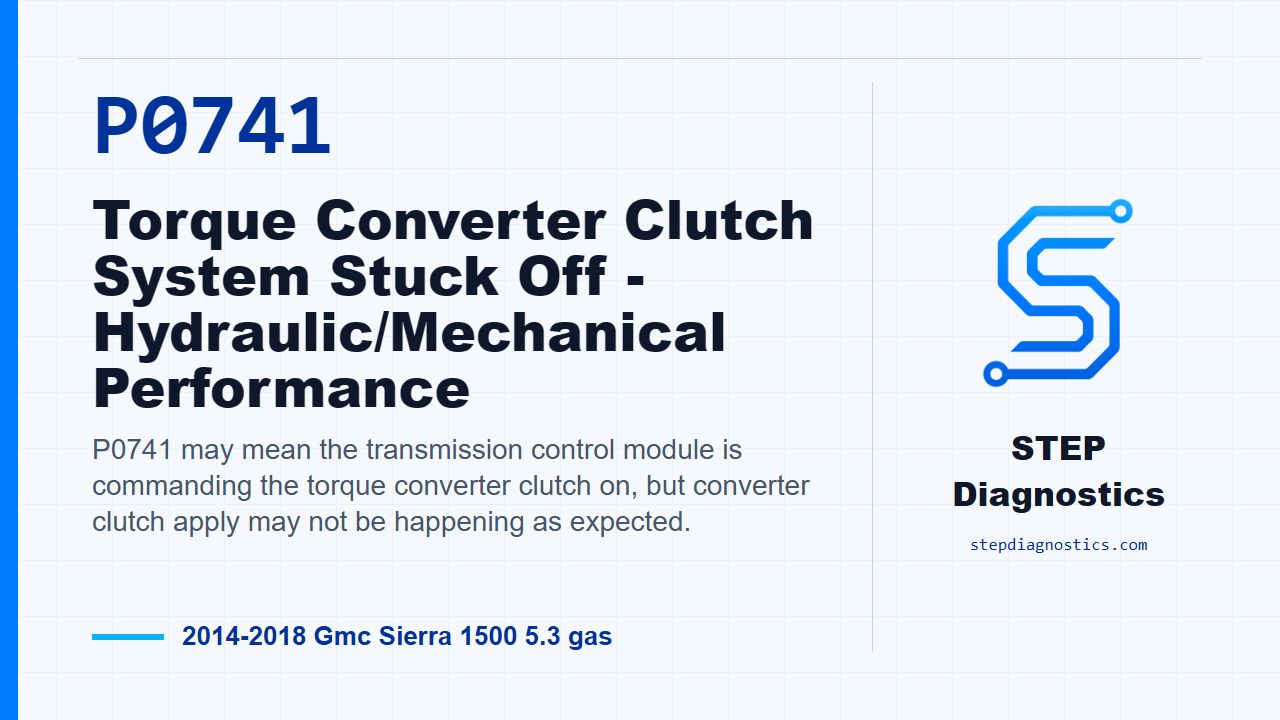
P0741 may mean the transmission control module is commanding the torque converter clutch on, but converter clutch apply may not be happening as expected.
What the vehicle may do
- The vehicle may have extra converter slip or reduced lockup operation.
- The transmission may change shift feel or limit certain functions after the code sets.
- The driver may notice higher cruising RPM or different drivability under converter clutch apply conditions.
Possible fault areas
- Possible fluid level or fluid condition concern.
- Possible hydraulic pressure control concern.
- Possible control solenoid valve assembly concern.
- Possible valve body, pump cover, seal, bushing, or converter internal leak concern.
- Possible torque converter clutch mechanical concern.
- Possible speed signal reporting concern that can affect converter clutch timing.
Diagnostic path
Open: what P0741 is telling you
On this 2014 to 2018 GMC Sierra 1500 with the 5.3 gas engine, P0741 is a torque converter clutch performance code. In plain terms, the module may be commanding the converter clutch on, but the clutch may not be applying the way it should. The driver may notice extra converter slip, different shift feel, reduced lockup operation, or the transmission may limit some functions after the code sets. The possible fault area is broad: fluid condition, hydraulic pressure control, the solenoid valve assembly, valve body or pump cover leakage or sticking valves, turbine shaft sealing, torque converter issues, or the module seeing speed information that does not match what is really happening. Treat this as a hydraulic and mechanical diagnosis first, not as a quick parts call.
Start with the basic checks
Before getting into the torque converter clutch testing, start with the basic system checks and follow a structured diagnostic approach. If other codes are present, check what they mean first. You do not want to chase P0741 while another fault is preventing the monitor from running correctly or changing how the transmission is being controlled.
Set up the verification correctly
For the first verification, run the engine at idle in Park, apply the parking brake, and chock the drive wheels. Then verify the transmission fluid level and condition are correct. If the fluid level or condition is not right, correct that first. If it is correct, turn the ignition on and clear the transmission control module codes with the scan tool.
Road test and monitor gate
Before the road test, set up the scan tool so you can capture and review multiple transmission data parameters together afterward. During the road test, the module needs to see 2 attempts at torque converter lockup. If P0741, or a closely related torque converter clutch fault, sets during that verification, move into circuit and system testing. If it does not set, reproduce the operating conditions for the monitor, or reproduce the captured conditions from the stored data, then confirm whether P0741 returns.
Use the enable criteria and setting logic as guardrails
Do not use the enable criteria as a diagnosis; use them as a monitor gate. For P0741, the gate includes ignition voltage between 8.6–32 V, engine speed between 400–7,500 RPM for 5 s, transmission fluid temperature −6.6 to +130°C (+20 to +266°F), throttle position greater than 8 percent, engine torque greater than 50 Nm (36 lb ft), and TCC PWM duty cycle greater than 60 percent for 5 s with the clutch commanded on. The fault logic is the important part: TCC Pressure greater than 750 Kpa (109 PSI) for 6 s, TCC slip greater than 130 RPM for 5 s when the TCC is commanded ON, and that condition must happen 2 times.
If the code returns, move into hydraulic and solenoid testing
Once verification points you into testing, check that transmission line pressures are within the specified ranges. If they are not, stay on the pressure problem and diagnose high or low fluid pressure before going farther down the P0741 path. If line pressure is in range, turn the ignition off and remove the Q8 control solenoid valve assembly. Use the DT-47825 control solenoid test plate, or an equivalent regional tool, and verify that a pressure change occurs for each solenoid during the solenoid performance test. If a pressure change does not occur, replace the Q8 control solenoid valve assembly.
If solenoid pressure response is good, inspect the mechanical leak and valve areas
If the solenoids respond with the expected pressure change, slow down and inspect the mechanical and hydraulic areas that can create converter clutch slip. In the pump cover area, look for TCC control, converter feed limit, and pressure regulator valves that are sticking from debris, binding, valve damage, or scored bores. Also check for damaged or loose turbine shaft bushings and leakage between the stator or tower assembly and the cover. Inspect the turbine shaft O-ring seal for damage or leakage. At the converter, look for debonded or worn TCC friction material, a distressed one-way stator clutch, missing or damaged internal seals, internal leakage, or overheating from lack of lubrication or cooler flow. In the lower valve body, check the TCC regulator apply valve, bore plug, and clutch select valve for sticking, leakage, damage, or bore wear. Also consider whether the control system may be reporting high output shaft speed and causing incorrect converter clutch timing, and inspect the transmission fluid pump seal assembly for damage or leakage. Repair or replace only what the inspection confirms is necessary.
Verification and adapts
After the repair is complete, keep verification separate from testing. Verify the repair and confirm the code stays gone. Then, after transmission-related repairs, reset the transmission adapts so the control side is not working from old learned data.
Takeaway
The takeaway on P0741 is simple: prove the monitor ran, prove the slip fault returned, verify pressure control, then inspect the hydraulic and mechanical leak paths that can keep the converter clutch from holding. For more diagnostic training, visit stepdiagnostics.com.
Final check
P0741 is often best approached as a command-versus-response hydraulic and mechanical diagnosis: confirm the monitor conditions, verify pressure control, then inspect the leak and apply paths before aL
For more guided automotive diagnostics, visit STEP Diagnostics.