What this code means
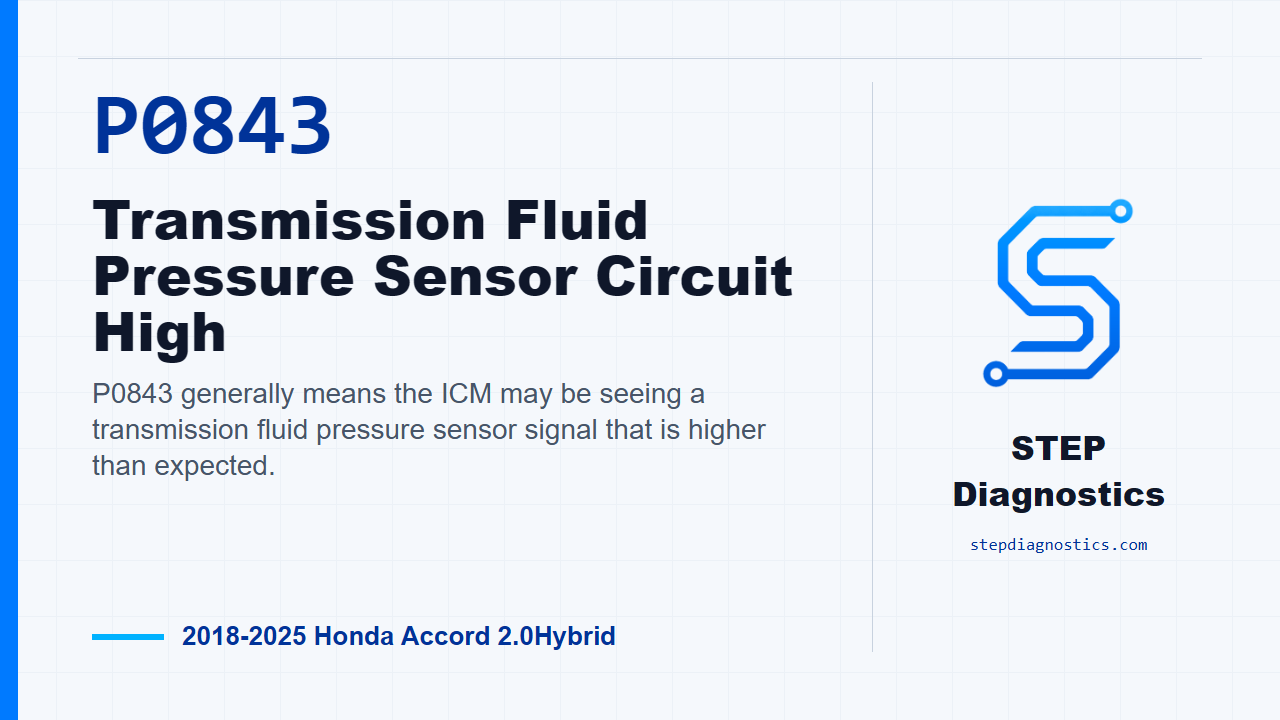
P0843 generally means the ICM may be seeing a transmission fluid pressure sensor signal that is higher than expected.
What the vehicle may do
- The vehicle may show transmission-related drivability symptoms.
- The warning light may be on, and the code may be stored even if the symptom is intermittent.
Possible fault areas
- Possible pressure sensor signal circuit issue
- Possible sensor circuit power or ground side issue
- Possible transmission fluid pressure sensor issue
- Possible ICM-related issue
Diagnostic path
Opening context
For this 2018 to 2025 Honda Accord 2.0 Hybrid, P0843 is a transmission fluid pressure sensor circuit high code in the ICM system. In plain terms, the ICM may be seeing the oil pressure sensor signal higher than expected. The vehicle may show transmission-related drivability symptoms, and the possible fault areas can include the pressure sensor signal circuit, the sensor circuit power or ground side, the transmission fluid pressure sensor, or the ICM. Start with the basic system checks and follow a structured diagnostic approach before narrowing in on this code.
Confirm the fault is present
Begin by confirming the fault. Turn the vehicle to ON mode, then watch the HDS value for Oil Pressure Sensor 1 Voltage. If that value is 4.65 V or more, the failure is duplicated. That gives you a live direction instead of chasing a stored code with no current symptom.
Check the pressure sensor circuit output
There is no direct standalone test for the transmission fluid pressure sensor itself here, so the diagnosis works through the related circuits and components. Disconnect the transmission fluid pressure sensor 3P connector. With IG Mode ON, inspect the disconnected connector female terminals according to the pressure sensor inspection table. The normal unit output voltage condition is About 5 V on the listed checks. If this inspection is normal, the diagnostic result points to a problem with the transmission fluid pressure sensor. If it is abnormal, keep moving into the related circuit checks.
Check VCC2 and SG2 continuity
Next, check for opens on the VCC2 and SG2 circuits. Disconnect the transmission fluid pressure sensor 3P connector and ICM connector A, 28P. With IG Mode OFF, inspect between the disconnected pressure sensor connector female terminals and the disconnected ICM connector A female terminals. Normal continuity for the VCC2 open-wire inspection is less than 1 Ω, and normal continuity for the SG2 open-wire inspection is less than 1 Ω. If either one is abnormal, the problem is in the circuit.
Check PODCL1 continuity
Then move to the PODCL1 open-wire inspection. Disconnect the transmission fluid pressure sensor 3P connector and ICM connector P, 36P. With IG Mode OFF, inspect between the disconnected pressure sensor connector female terminals and the disconnected ICM connector P female terminals. The normal condition for the PODCL1 open-wire inspection is less than 1 Ω. If that check is abnormal, the problem is in the circuit.
ICM conclusion and caution
If the transmission fluid pressure sensor inspection and the related circuit inspections all indicate normal conditions, the remaining diagnostic result is a problem with the ICM. Before calling it, make sure the correct terminals were identified during probing. If the connector terminal view is unclear, pause, recheck the earlier diagnostic path, and avoid guessing.
Takeaway
The key on P0843 is to prove the high pressure-sensor voltage first, then separate a sensor-side result from an open in VCC2, SG2, or PODCL1, and only leave the ICM as the conclusion after the other inspections are normal. For more diagnostic training, visit stepdiagnostics.com.
Final check
P0843 is often approached by confirming the high sensor-voltage condition, then separating a sensor-side concern from circuit continuity issues before considering the ICM.
For more guided automotive diagnostics, visit STEP Diagnostics.