What this code means
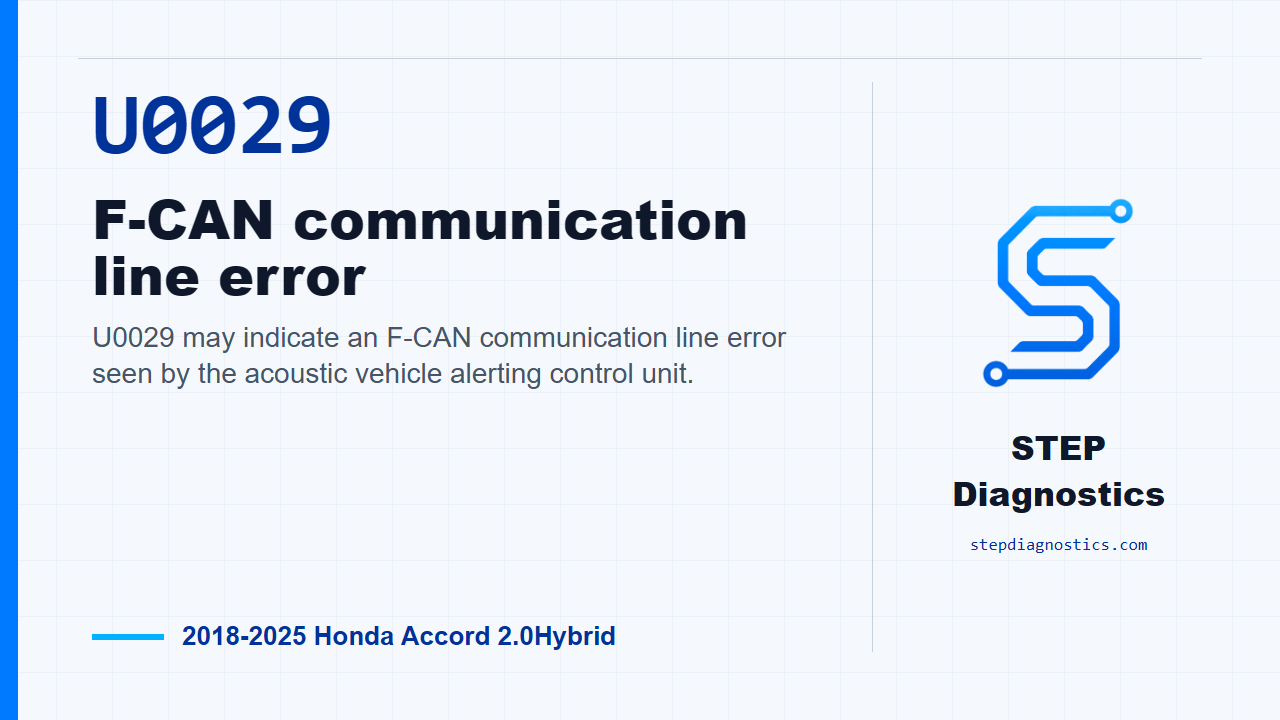
U0029 may indicate an F-CAN communication line error seen by the acoustic vehicle alerting control unit.
What the vehicle may do
- The vehicle may show network-related warnings.
- The acoustic vehicle alerting system may have symptoms, or the code may store with limited obvious driver complaint.
- The concern can be intermittent if network communication drops in and out.
Possible fault areas
- Possible F-CAN communication path concern.
- Possible gateway or broader network communication concern.
- Possible multiple-code network diagnostic situation involving B-CAN context.
Diagnostic path
Open on U0029
On this Accord Hybrid, U0029 is an F-CAN communication line error tied to the acoustic vehicle alerting control unit. In plain terms, that control unit may be losing clean communication on the F-CAN network. The vehicle may show network-related warnings, may have symptoms around the acoustic alerting system, or it may store the code with very little obvious driver complaint. Possible fault areas can include the F-CAN communication path, gateway-related communication issues, or a broader multiple-code network problem. Start this one calmly: confirm what else is stored before focusing on U0029 by itself.
Start with the basic diagnostic approach
Before chasing the U0029 path, start with the basic system checks and follow a structured diagnostic approach. This is a network communication fault, so do not jump straight to parts. Make sure the scan information makes sense, confirm the code set in the correct vehicle context, and look at whether the vehicle is dealing with one communication fault or a group of them.
Handle gateway communication context first
Next, check whether a gateway-related network communication code is stored at the same time. If it is, diagnose that gateway communication issue first. That matters because U0029 is being reported from the acoustic vehicle alerting control unit, but the root problem may be upstream in how the network is communicating. Fixing the broader gateway communication concern first keeps you from chasing a downstream symptom.
If multiple codes are present
If you are troubleshooting multiple DTCs, do not treat U0029 as an isolated failure yet. Use the multiple-code B-CAN diagnostic path first, then come back to U0029 after the network picture is clearer. If the return point in that earlier path is not clear, pause, recheck the earlier diagnostic path, and avoid guessing.
Understand how U0029 sets
The setting logic is straightforward: the acoustic vehicle alerting control unit stores U0029 when it detects a BUS-OFF condition in F-CAN continuously for a set number of times. So the diagnostic direction is not to assume the alerting unit is bad. The direction is to prove why that unit is seeing the F-CAN bus drop into that fault state, especially when other network codes are present.
Verify separately
After the category-specific network checks and any needed correction are complete, keep verification separate from testing. Clear the code, operate the vehicle under conditions that let the communication monitor run, and confirm U0029 does not return. The takeaway: for U0029, sort out the broader network context first, then verify the acoustic vehicle alerting control unit no longer sees F-CAN BUS-OFF behavior. For more diagnostic training, visit stepdiagnostics.com.
Final check
U0029 is best approached as a network communication diagnosis: check the broader communication context first, then confirm the code stays gone.
For more guided automotive diagnostics, visit STEP Diagnostics.