What this code means
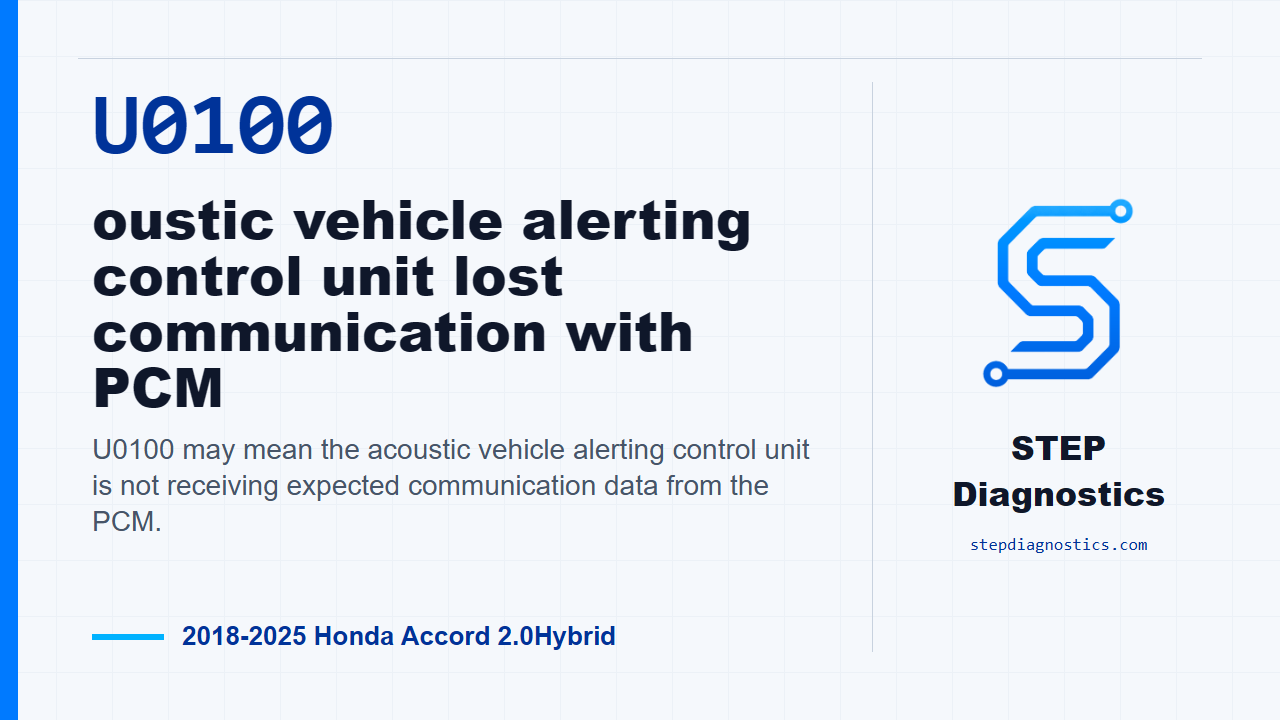
U0100 may mean the acoustic vehicle alerting control unit is not receiving expected communication data from the PCM.
What the vehicle may do
- The vehicle may set a warning or store a communication fault.
- The acoustic vehicle alerting system may not behave normally.
- The concern can appear when a control module does not start up or communicate as expected.
Possible fault areas
- Possible PCM power or ground circuit concern.
- Possible PCM start-up concern.
- Possible CAN communication or gateway-related network concern.
- Possible multiple-code network diagnosis concern.
Diagnostic path
Opening context
On this Accord Hybrid, U0100 means the acoustic vehicle alerting control unit has lost communication with the PCM. In plain terms, the alerting control unit is expecting data from the PCM and may not be seeing it. The vehicle may set a warning, and the acoustic alerting system may not behave normally. Broadly, this can point toward a communication network issue, a PCM start-up issue, or a possible PCM power or ground problem. The key is not to jump straight to a module call. Work the communication path in order.
How the code sets
The diagnostic logic is straightforward: if the acoustic vehicle alerting control unit cannot receive the specified data from the PCM, it decides there is an abnormality and stores U0100. So the diagnosis needs to prove whether the PCM is able to start normally, whether its power and ground circuits are healthy, and whether the CAN communication path is intact.
Start with basic checks
Before getting deep into the network, start with the basic system checks and keep the diagnosis structured. If other codes are present, do not ignore them or treat U0100 in isolation. Check what the other codes mean first, especially if they point toward network communication, ignition feed, ground, or control-module start-up concerns.
Check PCM power and ground first
Next, check the PCM power and ground circuit before chasing the rest of the communication fault. This matters because U0100 may store if the PCM does not start normally, and it may also store because of a PCM power or ground circuit failure. If the PCM is not awake and powered correctly, the alerting control unit can lose the data it expects even though the communication line itself is not the root issue.
Move into CAN communication diagnosis
After the PCM power and ground side has been checked, continue into the CAN lost-communication diagnostic path for the network connection through the gateway. This is where the test focus shifts from basic module power-up to whether the communication network can carry the PCM data the alerting control unit needs. The detailed branch path for that CAN test is not available here, so if the next return point is unclear, pause, recheck the earlier diagnostic path, and avoid guessing.
Key on for testing
When the diagnostic path calls for live communication checks, turn the vehicle to the ON mode. That gives the modules the operating state needed for the communication fault to be evaluated.
Verification and takeaway
Keep verification separate from the fault isolation. Once the suspected issue has been corrected, verify the repair and confirm the code stays gone under the same kind of operating conditions that allowed the fault to be detected. The takeaway for U0100 is simple: prove PCM power-up and power-ground integrity first, then work the CAN communication path in order. For more diagnostic training, visit stepdiagnostics.com.
Final check
U0100 should be approached as a communication diagnosis, with PCM power and ground checked before deeper CAN network testing.
For more guided automotive diagnostics, visit STEP Diagnostics.