What this code means
P006A can indicate that measured airflow and airflow estimated from the MAP sensor differ beyond the PCM's allowed range.
P006A concerns a comparison made by the PCM. It compares airflow measured by the MAF sensor with airflow estimated from the MAP sensor output. The stored condition means those sources of airflow information differ beyond the allowed range used by the controller.
The diagnostic path therefore considers both the sensor reading and the air path being evaluated. Intake connections, PCV components, the air cleaner and housing, and the MAF-related checks all have a place in the procedure. The code describes the disagreement; the inspections work through the possible areas associated with it.
What the vehicle may do
- Measured and MAP-based airflow may differ beyond the allowed range.
Possible fault areas
- Possible fault areas include intake air and PCV system components.
- The air cleaner element, intake duct, or housing may need attention.
- MAF sensor/IAT sensor 1 may also be a fault area.
Address the listed MAP and BARO sensor codes first when they are present. Then follow the air-cleaner inspection and the confirmation under recorded conditions. Matching the snapshot parameters preserves the operating context in which the fault is being checked.
The physical inspections examine connection condition, damage and blockages. The MAF checks then use two distinct engine states: stopped and running with engine speed changing. The expected stopped-engine reading and the expected response during changing speed answer different questions, so keep both results.
Diagnostic path
Understand the stored condition
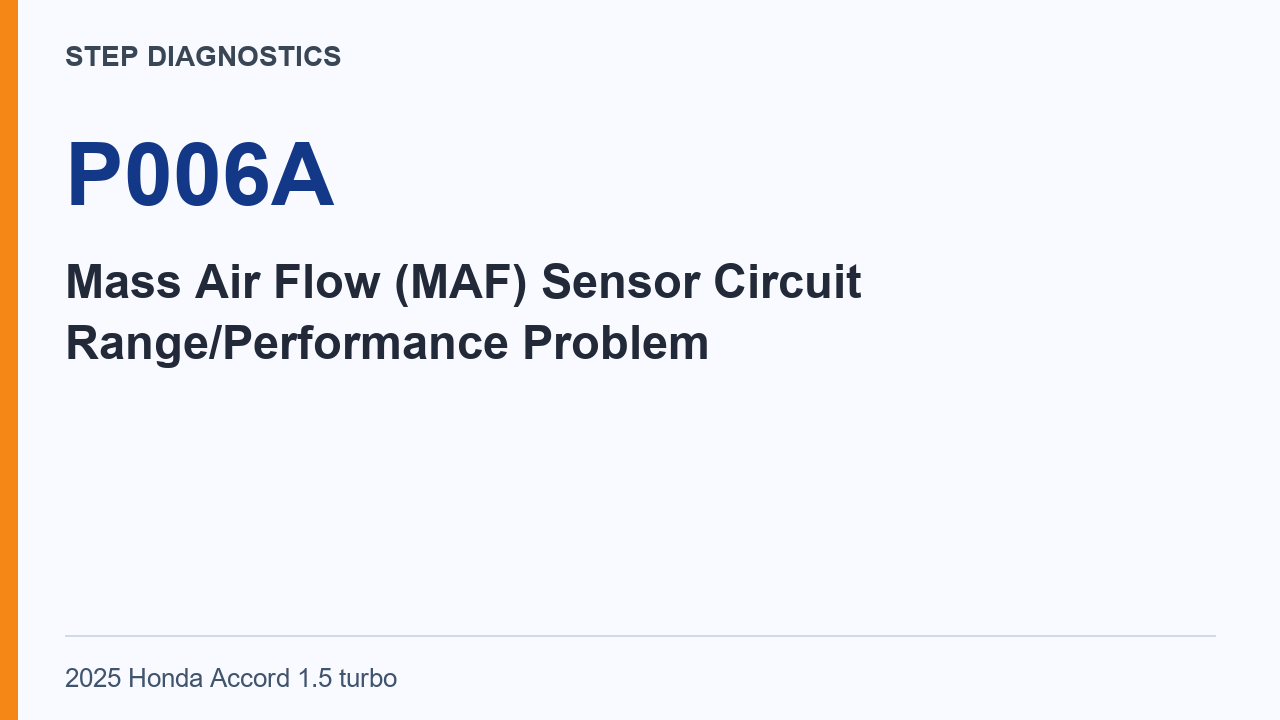
P006A means Mass Air Flow (MAF) Sensor Circuit Range/Performance Problem. The PCM compares airflow measured by the MAF sensor with airflow estimated from the MAP sensor output. It stores P006A when that difference is outside its specified range. This is an internal PCM check.
Required preliminary checks
If any listed MAP Sensor [PGM-FI] codes, P2073 or P2074, or BARO Sensor [PGM-FI] codes, P2228 or P2229, are present, address them first. Those sensor-code checks take priority over the P006A checks.
Air cleaner element
Next, carry out the Air Cleaner Element Inspection.
Check P006A under the recorded conditions
Start the engine. With no load and the transmission in P or N, hold the engine at 3,000 rpm until the radiator fan comes on. Then let the engine idle. Test-drive for several minutes in the same range as the recorded on-board snapshot parameters. Match Engine Speed, Vehicle Speed, MAP Sensor Voltage, and TP Sensor. Monitor HDS [OBD STATUS (PGM-FI)] for DTC P006A.
The on-board snapshot provides the reference operating conditions for this part of the procedure. Engine Speed, Vehicle Speed, MAP Sensor Voltage and TP Sensor are the listed parameters to match. This gives the following OBD-status observation a defined context instead of combining observations made at unrelated operating points.
Intake air and PCV connections
Check the intake air and PCV system connections, and look for damage. Include the PCV valve, PCV hose, and Purge (PCS) line. Also check all parts through the turbocharger joint to the throttle body. The connections should be in good condition, with no damage. An abnormal result means there is a problem with intake air system and/or PCV system components.
Intake duct and air cleaner housing
Check the intake air duct and Air cleaner housing connections. Look for blockages in these parts. The connections should be in good condition, with no blockages. An abnormal result means there is a problem with intake air system components.
MAF reading with the engine stopped
With the engine stopped, check HDS [MAF Sensor]. The reading should be about 0.2 grams per second. An abnormal result means there is a problem with MAF sensor/IAT sensor 1.
This is the stopped-engine part of the sensor check. Compare the reading with the approximate value given here while the engine remains stopped. The later running-engine check uses changing engine speed and a different expected behavior, so it should be recorded as a separate result.
MAF response as engine speed changes
Start the engine. Vary the engine speed between 2,000 rpm and 3,000 rpm while checking HDS [MAF Sensor]. The reading should change as engine speed changes. An abnormal result means there is a problem with MAF sensor/IAT sensor 1.
Here the question is whether the reading responds as engine speed changes through the stated range. The procedure describes a change in the reading, rather than a single fixed running value. Follow that stated behavior criterion and keep it distinct from the earlier stopped-engine numerical comparison.
What the results tell you
The visual checks identify problems with intake air or PCV components, connections, and intake blockages. With the engine stopped, HDS [MAF Sensor] should read about 0.2 grams per second. With the engine running between 2,000 rpm and 3,000 rpm, the reading should change with engine speed. An abnormal result in either MAF check points to MAF sensor/IAT sensor 1.
Final check
The checks can point to intake air or PCV component problems, intake blockages, or an abnormal MAF sensor/IAT sensor 1 result.
The results should tell a connected story: which intake and PCV areas were in good condition, whether blockages were found, what the MAF reading was with the engine stopped, and whether it changed with engine speed. Apply each stated fault-area conclusion to its own result. That preserves the distinction between an air-path finding and the MAF sensor/IAT sensor result.