What this code means
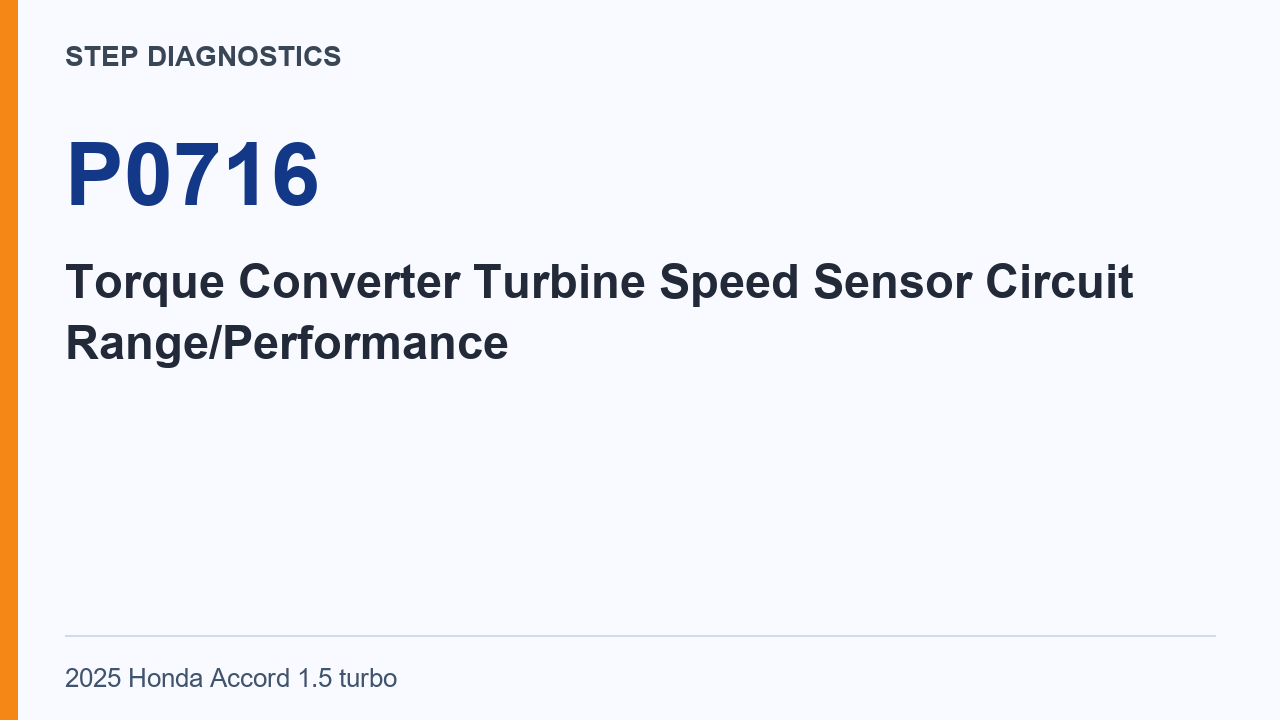
P0716 can indicate that the turbine speed sensor reading is lower than the CVT drive pulley speed sensor reading.
P0716 concerns the relationship between the torque converter turbine speed reading and the CVT drive pulley speed reading. The TCM stores the code when the turbine speed reading is lower than the pulley speed reading in the condition described by this procedure.
The diagnostic comparison uses two HDS signals. Their names matter because the result comes from their relationship during the specified operation. The procedure's normal comparison is that the readings are almost the same, and its result branches distinguish the turbine speed sensor from the TCM.
What the vehicle may do
- The turbine speed reading can be lower than the pulley speed.
Possible fault areas
- The turbine speed sensor may have a problem.
- The TCM may have a problem.
The initial confirmation uses the supported vehicle, freely rotating wheels and stated operating period. The speed-signal observation follows through the AT Data List. The comparison stage then uses the lift setup again and the stated D-mode operation.
Keep the secure support, wheel-clearance and VSA conditions with the operations they accompany. These are part of the procedure's test setup. The final comparison should be read while the named speed signals are being observed under the specified condition.
Diagnostic path
Understand the stored condition
P0716 means Torque Converter Turbine Speed Sensor Circuit Range/Performance. It concerns the turbine speed sensor reading. The TCM stores this code when that reading is lower than the CVT drive pulley speed sensor reading. The possible fault areas are the turbine speed sensor and the TCM.
Initial confirmation
Raise the vehicle on a lift. Make sure it is securely supported and all four wheels can rotate freely. Start the engine, then disable the VSA. Run the vehicle at speeds over 19 miles per hour (30 kilometers per hour) for at least 30 seconds. Then slow down and stop the wheels.
Observe the speed signals
Use the HDS Function AT > Data List. Watch the readings for Torque Converter Turbine Speed and Input Shaft(Drive Pulley) Speed rpm.
The turbine-speed reading and input-shaft/drive-pulley reading are separate data items. The check uses both, so retain the full signal identity when observing them. This preserves the connection between the code's lower-turbine-speed description and the subsequent comparison.
Compare the sensor readings
Raise the vehicle on a lift. Make sure it is securely supported and all four wheels can rotate freely. Start the engine, then disable the VSA. Rotate the front wheels in D position/mode. Compare the HDS [Torque Converter Turbine Speed] with the HDS [Input Shaft (Drive Pulley) Speed rpm]. Under normal conditions, the two readings are almost the same. If the comparison is abnormal, there is a problem with the turbine speed sensor. If the comparison is normal, there is a problem with the TCM.
The normal criterion here is the relationship between the two readings: almost the same. Apply that stated comparison during the specified D-mode operation. The procedure associates an abnormal comparison with the turbine speed sensor and a normal comparison with the TCM. Those conclusions therefore belong to this paired-signal check under its operating setup.
Final check
The speed comparison can point to the turbine speed sensor or the TCM.
The useful result is the comparison of the named speeds together with the vehicle setup in which it was made. Retain the initial confirmation separately from the comparison outcome, then follow the sensor or TCM branch given for that outcome.