What this code means
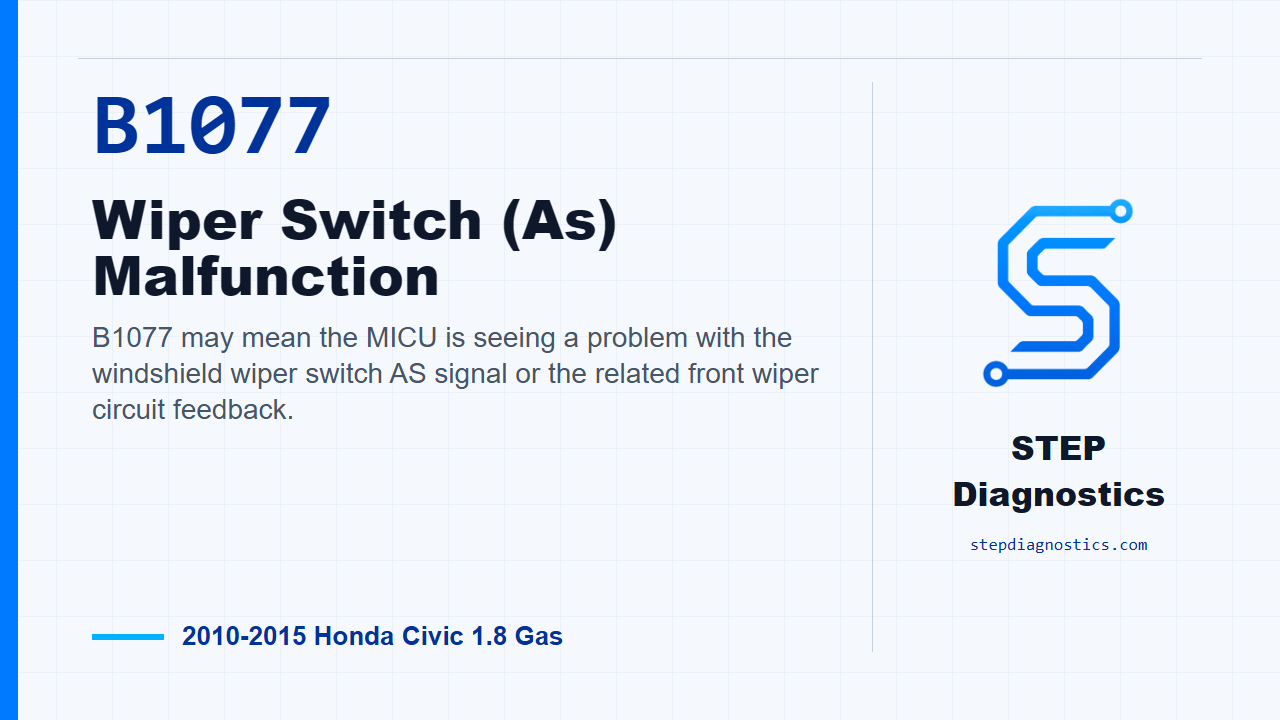
B1077 may mean the MICU is seeing a problem with the windshield wiper switch AS signal or the related front wiper circuit feedback.
What the vehicle may do
- The windshield wipers may not operate correctly.
- The wipers may fail to run, park, or pulse normally.
- The code may be intermittent if the circuit concern is not present all the time.
Possible fault areas
- Possible wiper motor or pulse signal issue.
- Possible FR_WIPER_AS circuit issue.
- Possible fuse, relay, ignition feed, battery feed, or ground issue.
- Possible relay control or MICU-side circuit issue.
Diagnostic path
Opening context
On this 2010 to 2015 Honda Civic with the 1.8 gas engine, B1077 is a wiper switch AS malfunction in the MICU and front wiper switch monitoring circuit. In plain terms, the control unit may not be seeing the wiper AS signal the way it expects. The customer may have wipers that do not run correctly, do not park or pulse normally, or the system may set the code even when the concern is intermittent. The broad fault areas can include the wiper motor and its pulse signal, the FR_WIPER_AS line, fuse and relay power feeds, relay control, grounds, and the MICU side of the circuit. Before connector testing, make sure you can positively identify the under-dash fuse and relay box connectors, because the pin locations matter on this one.
Start by proving the complaint and choosing the path
Start by clearing the code with the HDS. Cycle the ignition OFF and back ON, using LOCK 0 and ON II, or OFF mode and ON mode on a start-stop car. Then command the windshield wipers on LOW or HIGH for 15 seconds or more, and turn the switch back OFF. The first split is simple: does the wiper motor work or not? If the motor works, stay on the FR_WIPER_AS signal path and check whether B1077 comes back with the HDS. If B1077 is not indicated after that check, treat it as an intermittent failure and the system is OK at this time. If B1077 is still indicated, continue into the motor AS signal check.
If the wiper motor works, check the AS signal path
With the ignition OFF, run the windshield wiper motor test and watch for two things: the motor has to run, and it has to pulse normally. If it does not run and pulse normally, the diagnostic result is to replace the windshield wiper motor. If it does run and pulse normally, move to the FR_WIPER_AS wire check. Disconnect the windshield wiper motor 4P connector and under-dash fuse and relay box connector C, the 38P connector. Check continuity on the FR_WIPER_AS circuit between windshield wiper motor 4P connector No. 3, white wire, and under-dash fuse and relay box connector C No. 23, white wire. If the result is continuity, repair a short to ground in that wire. If there is no continuity, repair an open or high resistance in that wire.
If the motor does not work on a keyless access vehicle
If the wiper motor does not work and the vehicle has keyless access, the path moves into the wiper motor drive circuit. First check fuse No. A1-5, rated 30 A, in the under-hood fuse and relay box, and fuse No. B6, rated 7.5 A, in the under-dash fuse and relay box. If either fuse is not OK, replace the fuse or fuses. If they blow again, repair the short to ground on the affected fuse circuit. If the fuses are OK, test the windshield wiper main relay. If the relay fails, replace the windshield wiper main relay and recheck. If the relay is OK, check the +B_WIPER feed at the windshield wiper main relay 4P socket No. 4, white wire, to body ground with the relay disconnected and the vehicle OFF. You should have battery voltage. If you do not, repair an open or high resistance in that wire. Next, turn the vehicle ON and check the IG1_OPTION feed at main relay socket No. 6, white wire, to body ground. Again, the expected result is battery voltage; if it is missing, repair the open or high resistance in that wire. Then turn the vehicle OFF and check the GND circuit at main relay socket No. 5, black wire, to body ground. If there is no continuity, repair the open or high resistance in the ground wire, or correct the poor ground at G401.
Continue the keyless access drive-circuit checks
After the power, ignition feed, relay, and ground checks pass on the keyless access path, test the relay control module. If it is not OK, replace the relay control module. If it is OK, keep moving through the circuit continuity checks with the vehicle OFF, the windshield wiper main relay disconnected, and relay control module connectors A and B disconnected. Check FR_WIPER_MAIN_RLY_OUT from windshield wiper main relay 4P socket No. 3, red wire, to relay control module connector A No. 16, red wire. No continuity means repair the open or high resistance. If that passes, check FR_WIPER_INT_RLY_CL- from relay control module connector A No. 7, blue wire, to under-dash fuse and relay box connector C No. 22, blue wire. If that is open or high resistance, repair it. If it passes, disconnect the wiper motor 4P connector and check FR_WIPER_HI from relay control module connector A No. 13, yellow wire, to wiper motor connector No. 4, yellow wire. Then check FR_WIPER_LO from relay control module connector A No. 14, blue wire, to wiper motor connector No. 2, blue wire. Any failed continuity check in those two lines calls for repairing the open or high resistance. If all of those checks pass, run the windshield wiper motor test again. If the motor runs and pulses normally, the result is a faulty MICU, and the repair is to replace the under-dash fuse and relay box. If the motor does not run and pulse normally, replace the windshield wiper motor.
If the motor does not work on a vehicle without keyless access
If the wiper motor does not work and the vehicle does not have keyless access, start with fuse No. B46, rated 30 A, in the under-dash fuse and relay box. If the fuse is not OK, replace it. If it blows again, repair the short to ground on the No. B46 30 A fuse circuit. If the fuse is OK, turn the ignition to LOCK 0, remove the windshield wiper intermittent relay, turn the ignition ON II, and check the IG1_FR_WIPER feed at the intermittent relay 5P connector No. 7, green wire, to body ground. The expected result is battery voltage. If it is missing, repair the open or high resistance in that wire. If battery voltage is present, test the windshield wiper intermittent relay and the windshield wiper high-low relay. If either relay is faulty, replace the faulty relay.
Finish the non-keyless continuity path
If both relays test OK on the non-keyless path, turn the ignition to LOCK 0 and disconnect under-dash fuse and relay box connector C. With the wiper intermittent relay and high-low relay disconnected, check FR_WIPER_INT_RLY_CL- from the intermittent relay 5P connector No. 5, blue wire, to under-dash connector C No. 22, blue wire. If there is no continuity, repair the open or high resistance. Then disconnect the wiper motor 4P connector and check FR_WIPER_HI from the high-low relay 5P connector No. 9, yellow wire, to wiper motor connector No. 4, yellow wire. If that fails, repair the open or high resistance. Next check FR_WIPER_LO from the high-low relay 5P connector No. 2, blue wire, to wiper motor connector No. 2, blue wire. Again, no continuity means repair the open or high resistance. If all three circuit checks pass, run the windshield wiper motor test. If the motor runs and pulses normally, the result is a faulty MICU, and the repair is to replace the under-dash fuse and relay box. If the motor does not run and pulse normally, replace the windshield wiper motor.
Repair check and close
Keep the verification separate from the circuit testing. After the repair, clear the code, operate the wipers through the same conditions, and confirm B1077 stays gone. The key to this diagnosis is not guessing at the MICU or the motor too early. First decide whether the wiper motor works, then follow the correct power, ground, relay, and signal path for the vehicle configuration. For more diagnostic training, visit stepdiagnostics.com.
Final check
B1077 is often best approached by first separating a working-motor signal issue from a no-operation power and relay circuit issue.
For more guided automotive diagnostics, visit STEP Diagnostics.