What this code means
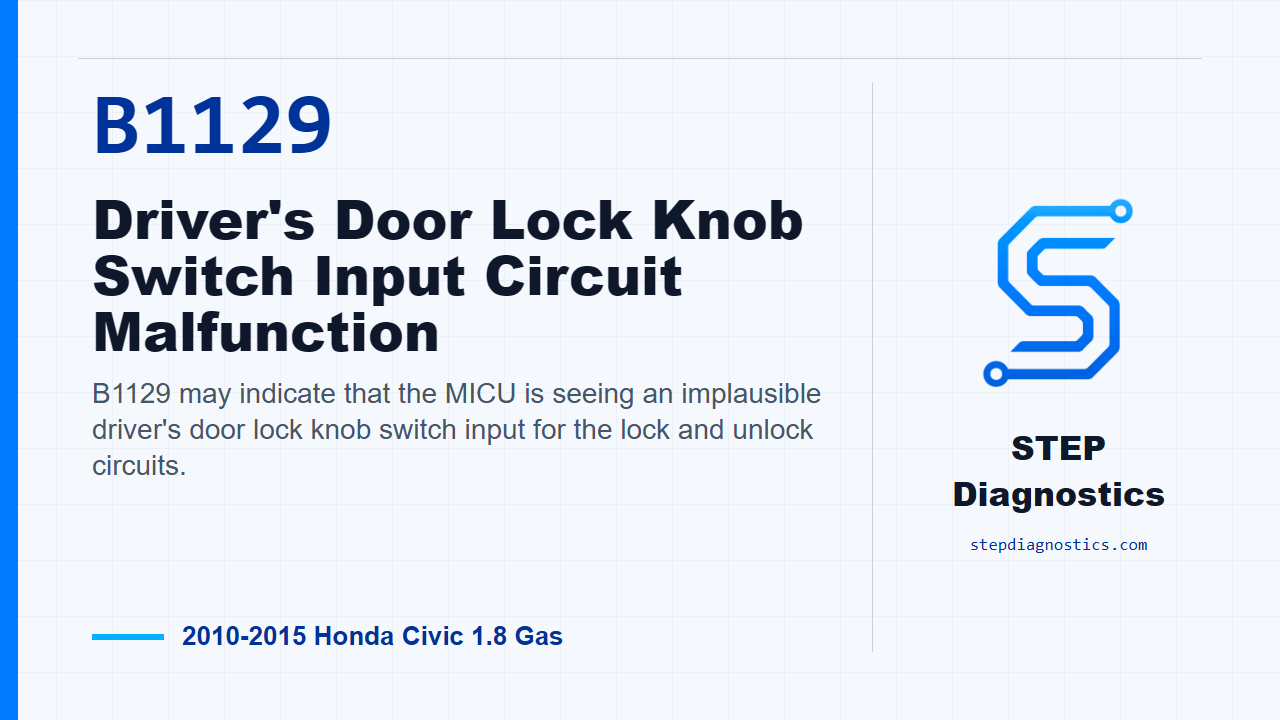
B1129 may indicate that the MICU is seeing an implausible driver's door lock knob switch input for the lock and unlock circuits.
What the vehicle may do
- Power door lock operation may be inconsistent.
- Keyless entry response may be inconsistent.
- Security system behavior may be affected.
Possible fault areas
- Driver's door latch switch area
- Lock and unlock signal wiring
- Connector condition
- MICU input side of the circuit
Diagnostic path
Open on what B1129 is looking at
On this Civic, B1129 points to the driver's door lock knob switch input circuit through the MICU. In plain terms, the module may be seeing the lock and unlock switch inputs in a way that does not make sense. The vehicle may have power door lock, keyless entry, or security behavior that seems inconsistent. Broadly, this can involve the driver's door latch switch, the lock and unlock signal wiring, connector condition, or the MICU side of the circuit. We are going to diagnose it electrically, using the switch data first, then isolating the latch, and then checking the two signal wires for a short to ground.
Check the switch data first
Start in the keyless transmitter data list. Put the driver's door lock knob switch in the lock position, then watch the ON/OFF information for DRIVER'S DOOR LOCK KNOB SWITCH (LOCK) and DRIVER'S DOOR LOCK KNOB SWITCH (UNLOCK). The question at this point is simple: are both information indicators ON? If both are ON, keep going and isolate the driver's door latch from the circuit. If both are not ON, treat it as an intermittent failure; the system is OK at this time.
Isolate the driver's door latch
Next, turn the ignition switch to LOCK (0). Disconnect the driver's door latch 10P connector. With that connector unplugged, go back to the same data list and check the ON/OFF information for the driver's door lock knob switch LOCK and UNLOCK inputs. Now the question is whether either information indicator is still ON. If either one is still ON with the latch disconnected, the latch is not the only thing pulling the input, so move into the wire short check. If neither indicator is ON, the diagnostic path calls the driver's door knob switch faulty, and the repair is to replace the driver's door latch.
Check the lock and unlock signal wires for a short to ground
For the shorted wire check, keep the ignition switch at LOCK (0), keep the driver's door latch 10P connector disconnected, and disconnect the under-dash fuse/relay box connector X (10P). Make sure you have the correct under-dash fuse/relay box connector identified before unplugging and testing it. Then check continuity from each signal circuit to body ground. For DR_SILCON_UNLOCK, test from under-dash fuse/relay box connector X (10P) No. 4 (WHT) to body ground. For DR_SILCON_LOCK, test from under-dash fuse/relay box connector X (10P) No. 5 (LT GRN) to body ground. If there is continuity, repair a short to ground in the wire. If there is no continuity, the diagnostic path calls the MICU faulty, and the repair is to replace the under-dash fuse/relay box.
Verify separately and close
After the indicated repair is handled, keep verification separate from the fault isolation. Verify the repair and confirm the code stays gone. The key takeaway on B1129 is not to jump straight to a latch or module call. Use the data list first, unplug the latch to see whether the input clears, then prove whether the lock or unlock signal wire is shorted to ground. For more diagnostic training, visit stepdiagnostics.com.
Final check
B1129 is often best approached by watching the switch data, isolating the driver's door latch, and then checking the lock and unlock signal wires for a possible short to ground.
For more guided automotive diagnostics, visit STEP Diagnostics.