What this code means
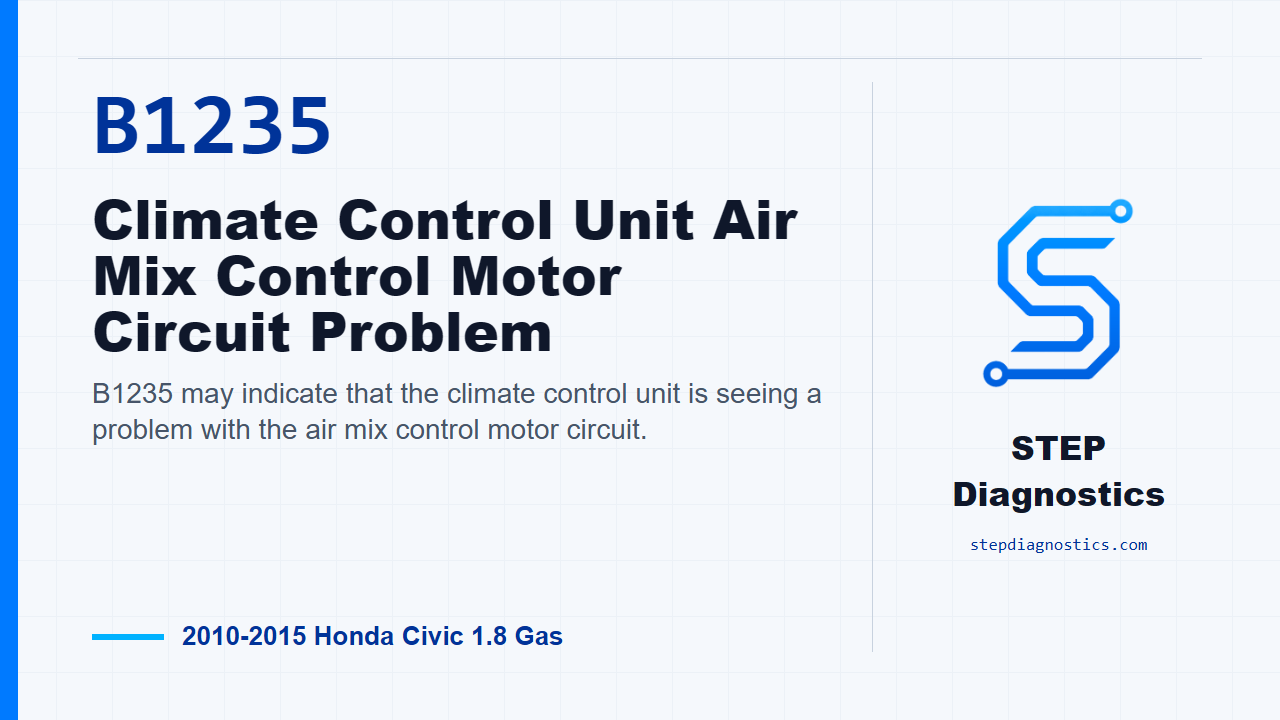
B1235 may indicate that the climate control unit is seeing a problem with the air mix control motor circuit.
What the vehicle may do
- The vehicle may have temperature blend control that does not respond normally.
- The air coming from the vents may stay warmer or cooler than requested.
- The concern can be intermittent if wiring or connector contact is poor.
Possible fault areas
- Possible wiring or connector issues in the air mix control motor circuit.
- Possible air mix control motor concern.
- Possible air mix linkage or door concern.
- Possible climate control unit concern after circuit and motor checks pass.
Diagnostic path
Opening context
On this 2010 to 2015 Honda Civic with the 1.8 gas engine, B1235 points to a climate control unit air mix control motor circuit problem. In plain terms, the control head may not be able to drive or confirm movement of the temperature blend motor correctly. The driver may notice temperature control that does not respond normally, air that stays too warm or too cool, or an intermittent blend-door complaint. The possible fault areas can include the motor circuit wiring and connections, the air mix control motor, the linkage or door it moves, and, after those checks pass, the climate control unit itself. The key is to prove the circuit first before condemning a module or actuator.
Confirm the code before testing
Start by verifying the problem. Clear the DTCs with the HDS. Turn the ignition switch to LOCK (0), then turn it back to ON (II). Run the self-diagnostic with the HDS or through the climate control unit, then check for codes again. If B1235 is indicated again, keep going into the circuit checks. If it does not return, treat it as an intermittent failure and inspect for loose wires or poor connections in the air mix control motor circuit.
Check the motor drive wires for an open
Next, check the M-HOT and M-COOL wires for an open. Turn the ignition switch to LOCK (0). Disconnect the climate control unit 32P connector and the air mix control motor 7P connector. For M-HOT, check continuity between climate control unit 32P connector No. 3, PNK, and air mix control motor 7P connector No. 7, PNK. For M-COOL, check continuity between climate control unit 32P connector No. 4, LT BLU, and air mix control motor 7P connector No. 6, LT BLU. If both circuits have continuity, the M-HOT and M-COOL wires pass this part of the test. If continuity is missing, repair the open in the wire or wires between the climate control unit and the air mix control motor.
Check the same wires for a short to ground
With the ignition still at LOCK (0), and both connectors still disconnected, check each circuit for continuity to body ground. Check M-HOT from climate control unit 32P connector No. 3, PNK, to body ground. Then check M-COOL from climate control unit 32P connector No. 4, LT BLU, to body ground. If either circuit shows continuity to ground, repair the short to body ground in the wire or wires between the climate control unit and the air mix control motor. If there is no continuity to ground, the wiring has passed the open and ground-short checks, so move on to the motor side of the diagnosis.
Decide between the motor, linkage, door, or control unit
At this point, test the air mix control motor. If the air mix control motor tests OK after the wiring has already passed, replace the climate control unit. If the air mix control motor does not test OK, replace the air mix control motor, or repair the air mix control linkage or door as needed. The detailed air mix control motor test is the deciding step here, so if that test is not available, pause and do not guess past it.
Closing takeaway
For B1235, keep the path clean: confirm the code, prove the two control wires are not open, prove they are not shorted to ground, then use the motor test to separate an actuator or linkage fault from a climate control unit fault. For more diagnostic training, visit stepdiagnostics.com.
Final check
This code is often best approached as a circuit-and-actuator diagnosis before considering the control unit.
For more guided automotive diagnostics, visit STEP Diagnostics.