What this code means
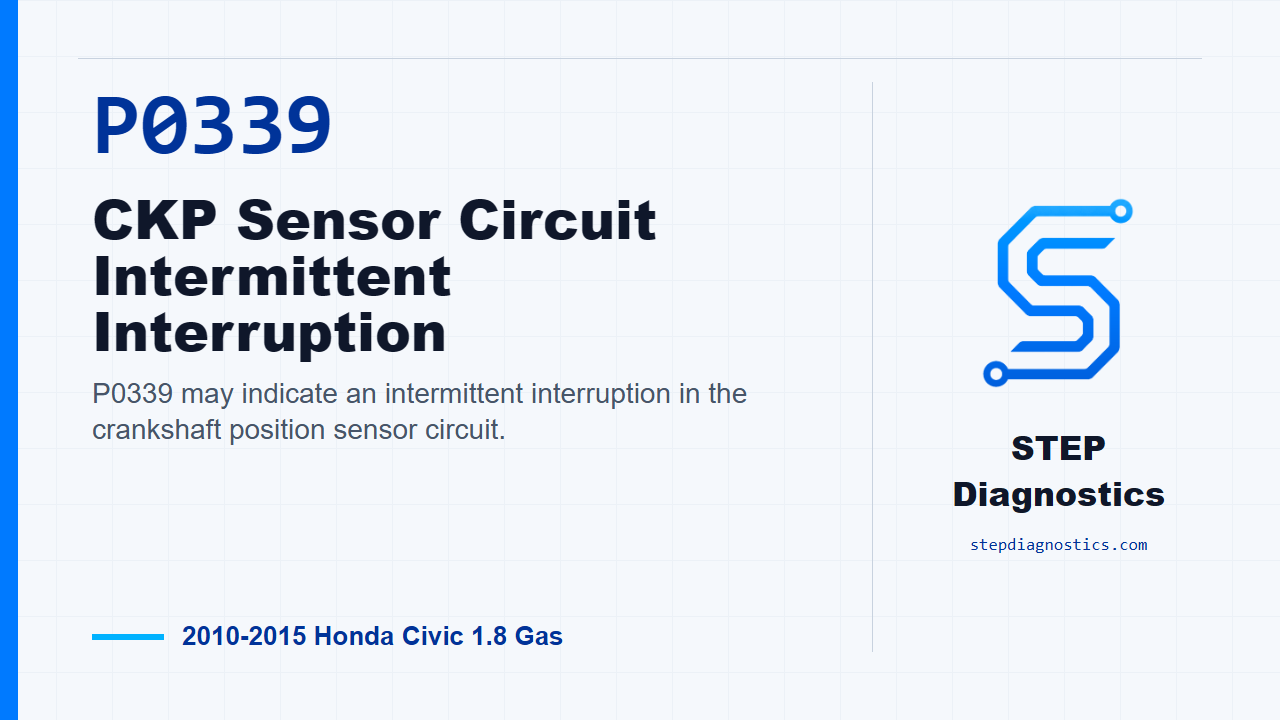
P0339 may indicate an intermittent interruption in the crankshaft position sensor circuit.
What the vehicle may do
- The vehicle may crank longer than normal.
- The engine may run unevenly or stall.
- The concern may only appear under certain driving conditions.
Possible fault areas
- Possible CKP sensor signal path issue.
- Possible poor connector or terminal contact.
- Possible ECM/PCM connection concern.
- Possible engine or body ground concern.
- Possible CKP pulse plate issue.
Diagnostic path
Set up the diagnosis
On this 2010-2015 Honda Civic 1.8 gas application, P0339 means the ECM/PCM has seen an intermittent interruption in the crankshaft position sensor circuit. The vehicle may crank longer than normal, run unevenly, stall, or only act up under certain driving conditions. Broadly, this can involve the CKP sensor signal path, connector or terminal issues, grounds, the ECM/PCM connection, or the CKP pulse plate. Before getting into the test, record the freeze data and any on-board snapshot, because this code is intermittent by nature and the captured operating conditions matter. Also make sure you are on the correct application; this path excludes K24Z7.
Initial CKP noise check
Start with the basic system checks. Turn the ignition switch to ON (II), clear the DTC with the HDS, then start the engine and let it idle for 10 seconds. Watch CKP NOISE in the HDS data list. If CKP NOISE shows 0 counts, move on to the connection and terminal checks. If it does not show 0 counts, go duplicate the condition on a road test.
Try to duplicate the intermittent fault
For the road test, drive the vehicle for several minutes in the range of the recorded freeze data, especially engine speed and vehicle speed. Then check CKP NOISE again in the HDS data list. If it shows 0 counts, the failure has been duplicated, so continue with the connection and terminal checks. If it does not show 0 counts, treat it as an intermittent fault that is not active right now; the system is OK at this time, but still check for poor connections or loose terminals at the CKP sensor and the ECM/PCM.
Check the CKP circuit connections
Next, inspect for poor connections or loose terminals at the CKP sensor, the ECM/PCM, the engine ground, and the body ground. If any connection or terminal is not OK, repair that connection or terminal and then verify the repair. If the connections and terminals are OK, keep going to the CKP pulse plate check.
Inspect the CKP pulse plate
Remove the CKP sensor and visually check the CKP pulse plate for damage. If the pulse plate is damaged, replace the CKP pulse plate and then verify the repair. If the pulse plate is not damaged, replace the CKP sensor and then verify the repair.
Verify the repair
Keep verification separate from the testing. Turn the ignition switch to LOCK (0), reconnect all connectors, then turn the ignition switch to ON (II). Reset the ECM/PCM with the HDS, do the ECM/PCM idle learn procedure, and do the CKP pattern clear and CKP pattern learn procedure. Start the engine and let it idle for 10 seconds, then check for Pending or Confirmed DTCs with the HDS. If P0339 is indicated again, check for poor connections or loose terminals at the CKP sensor and the ECM/PCM, then restart the diagnostic path from the first CKP noise check. If P0339 is not indicated, troubleshooting for this code is complete. If any other Pending or Confirmed codes are present, handle those on their own diagnostic path.
Takeaway
The key with P0339 is not to guess at an intermittent crank signal fault. Capture the conditions, use CKP NOISE to decide whether the fault is active or duplicated, prove the connector and ground side, then inspect the pulse plate before final verification. For more diagnostic training, visit stepdiagnostics.com.
Final check
P0339 often needs an intermittent-fault approach: capture the conditions, try to duplicate the signal concern, check the connection points, inspect the pulse plate, and verify that the code stays gone
For more guided automotive diagnostics, visit STEP Diagnostics.