What this code means
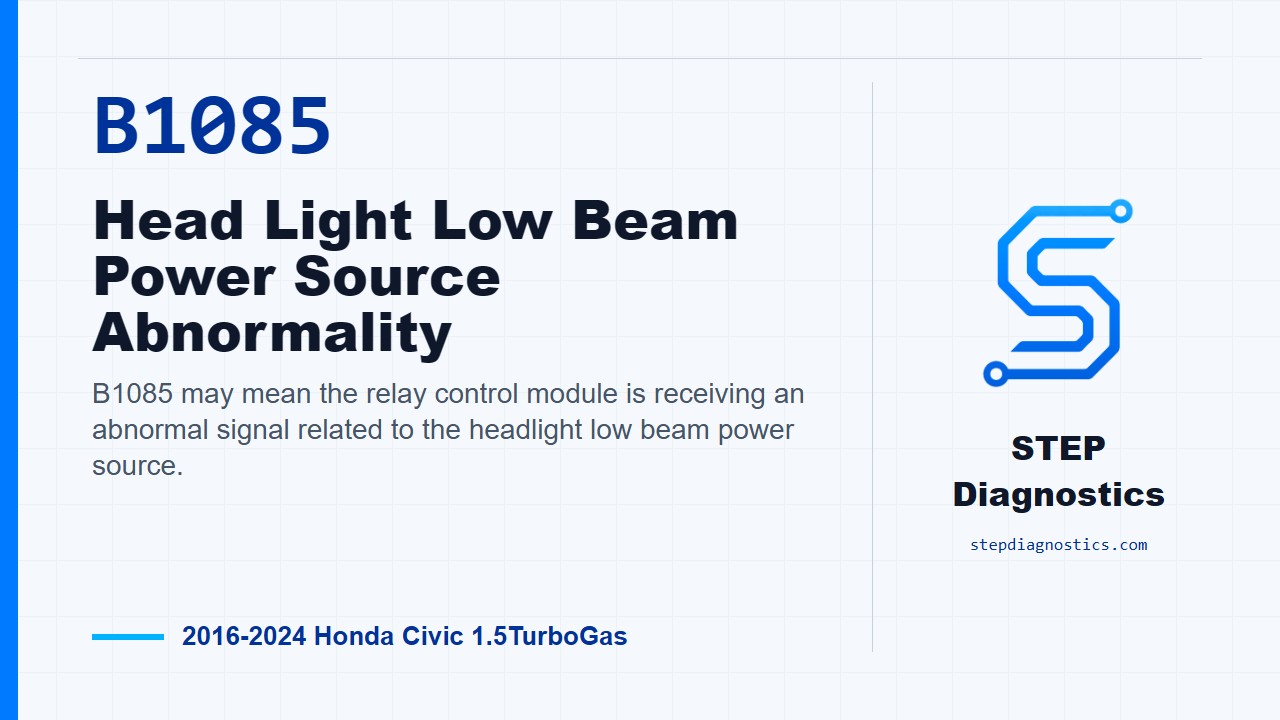
B1085 may mean the relay control module is receiving an abnormal signal related to the headlight low beam power source.
What the vehicle may do
- The vehicle may have a low beam lighting concern.
- A lighting warning may be present.
- The code may also be found during a scan even if the symptom is intermittent.
Possible fault areas
- Possible headlight-side abnormality signal concern.
- Possible relay control module involvement.
- Possible related front lighting control unit or body network context.
Diagnostic path
Opening context
On this Honda Civic, B1085 is for a head light low beam power source abnormality in the relay control module area. In plain language, the relay control module may be seeing an abnormal signal from the headlight side and storing the code. The vehicle may have a low beam concern, a lighting warning, or the issue may only show up during a scan. Broadly, the possible fault areas can include the headlight unit side, the relay control module side, or the network and lighting control inputs that affect this circuit. Start calm and don’t jump straight to a part.
Start with the basic path
Before getting into B1085, start with the basic system checks and follow a structured diagnostic approach. If the car has more than one body or lighting code stored, handle that correctly first instead of treating B1085 in isolation.
Prioritize related lighting faults first
Next, if there are other front lighting control unit faults present, diagnose those indicated systems first. That matters because B1085 is set by the relay control module based on an abnormality signal coming in from the headlight side. If the left or right front lighting control unit is already reporting a problem, that information can change how you interpret B1085.
Understand the set logic
The logic here is straightforward: when a unit abnormality signal is input from the headlight to the relay control module, the relay control module determines there is an abnormality and stores B1085. So the diagnostic direction is not just, “the relay module has a code.” It is, “the relay module received an abnormal headlight-side signal,” and that is why the earlier lighting-code check matters.
Inspect the relay control module
Once the earlier checks and any related front lighting faults have been dealt with, move to the relay control module inspection. Stay disciplined here: inspect the module as the next step in the path, and do not skip the earlier code-priority work, because that can send you in the wrong direction.
Confirmation procedure
For confirmation, turn the vehicle to the ON mode. Then turn the combination light switch to the ON position. After that, wait for at least 6 seconds. Keep this verification separate from the inspection work: you are recreating the operating condition that allows the module to evaluate the fault.
Takeaway and CTA
The key with B1085 is to treat it as a relay-control-module lighting abnormality input, not as an automatic part call. Check the broader body and lighting code picture first, handle related front lighting faults before chasing this one, inspect the relay control module in order, and then verify under the ON mode and light-switch-ON condition for at least 6 seconds. For more diagnostic training, visit stepdiagnostics.com.
Final check
B1085 is best approached by checking the broader lighting-code context first, then following the relay control module inspection and confirmation sequence in order.
For more guided automotive diagnostics, visit STEP Diagnostics.