What this code means
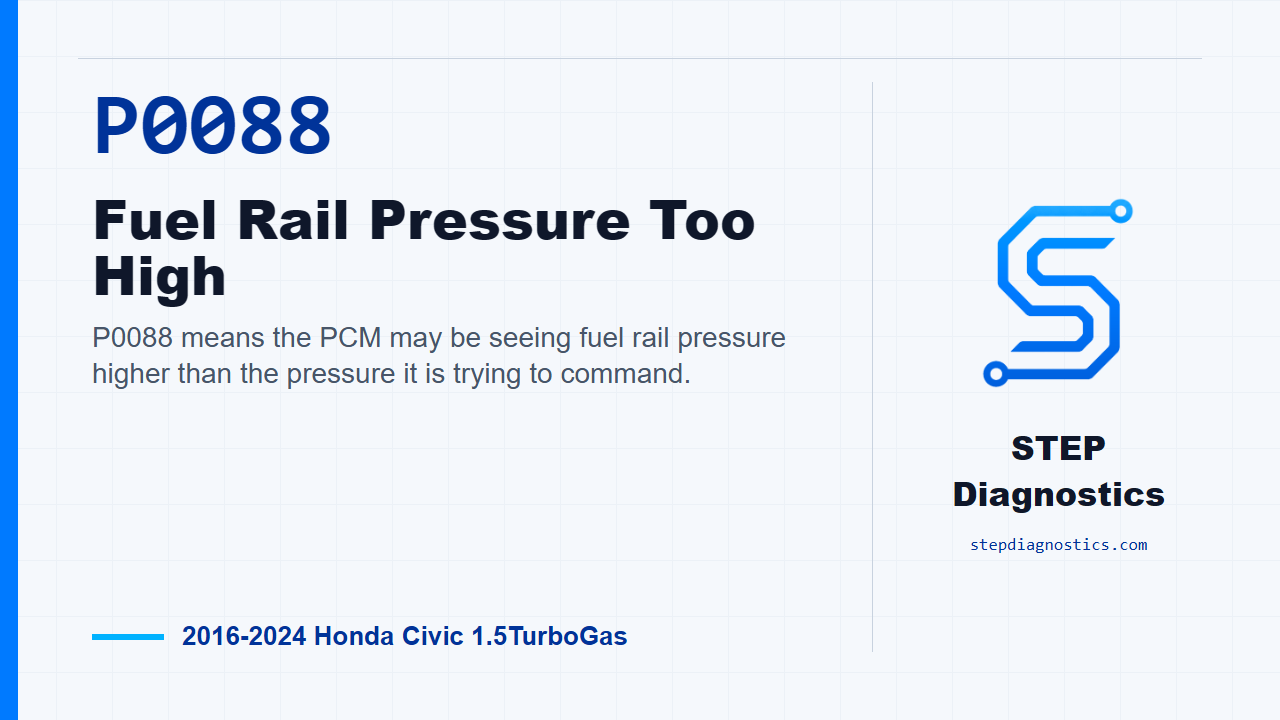
P0088 means the PCM may be seeing fuel rail pressure higher than the pressure it is trying to command.
What the vehicle may do
- The vehicle may have a warning light.
- It may run rough, hesitate, or have other driveability symptoms.
- In some cases, the code may set with limited noticeable symptoms.
Possible fault areas
- Possible fuel pressure sensing issue.
- Possible fuel rail pressure behavior issue.
- Possible high-pressure fuel pump control issue.
Diagnostic path
Opening context
On this 2016 to 2024 Honda Civic with the 1.5 turbo engine, P0088 is a fuel rail pressure too high code. In plain terms, the PCM may be seeing actual high-pressure fuel pressure run higher than the pressure it is trying to command. The vehicle may have driveability complaints, may run rough, may hesitate, or may only set the light depending on when the fault shows up. Broadly, this can involve possible fuel pressure sensing issues, fuel rail pressure behavior, or high-pressure fuel pump control. Start with the basic system checks and use a structured diagnostic approach before getting into the P0088 path.
Code logic and prerequisites
The logic for P0088 is command versus response. If actual high pressure fuel pump pressure is higher than the target pressure, the PCM judges that as abnormal and stores the code. Before chasing P0088 by itself, check for other related fuel pressure sensor, injector, ignition coil, cylinder air-fuel variation, or high-pressure fuel pump faults. If any of those are present, deal with what they mean first, because they can steer the diagnosis away from the P0088 path.
Confirmation procedure one
To try to duplicate the fault, start the engine. Hold the engine at 3,000 rpm with no load, with the CVT in P or N, or the manual transmission in neutral, until the radiator fan comes on. Then let the engine idle. From there, run the HDS DI FUEL PRESSURE TEST. If that test result is not OK, the failure has been duplicated and this confirmation section is complete.
Confirmation procedure two
If you need to duplicate it under the captured conditions, test-drive the vehicle for several minutes in the same general range as the recorded operating data. Use the captured engine speed, vehicle speed, MAP, throttle position, accelerator pedal position, coolant temperature, intake air temperature, converted fuel pressure from the pressure sensor, and direct-injection fuel pressure as your guide. If the failure duplicates, the confirmation is complete.
Fuel rail pressure sensor inspection, first check
Next, inspect the fuel rail pressure sensor readings. Start the engine, then again hold 3,000 rpm with no load until the radiator fan comes on, and let it idle. With a CVT, shift to D while holding the brake pedal firmly, then press the accelerator. With a manual transmission, snap the throttle several times. While raising engine speed in this check, do not shift the transmission and do not take your foot off the brake pedal. Compare HDS Fuel Pressure Converted From PF Sensor to HDS Fuel Pressure Direct Injection System. Those two values should be almost the same. If that comparison is abnormal, the diagnostic path points to a problem with the fuel rail.
Fuel rail pressure sensor inspection, second check
For the second fuel rail pressure sensor check, disconnect PGM-FI main relay 2. Start the engine and let it idle until it stalls. After it stalls, crank the engine several times. Then check HDS Fuel Pressure Converted From PF Sensor. The value should be less than 1,000 kPa, and a reading of several hundred kPa is normal. If this check is abnormal, the diagnostic path again points to a problem with the fuel rail.
High pressure fuel pump inspection
Only move into the high-pressure fuel pump inspection after the fuel rail pressure sensor checks normal. Start the engine, hold 3,000 rpm with no load until the radiator fan comes on, and let it idle. Then, with the brake pedal held firmly, shift the transmission to D and press the accelerator. Again, do not shift the transmission or release the brake while raising engine speed. Check the HDS Relief Valve data. If that value is abnormal, the diagnostic path points to a problem with the high-pressure fuel pump.
Closing takeaway
The clean way through P0088 is to prove the pressure fault first, compare commanded and sensed fuel pressure behavior, clear the fuel rail checks before moving to the pump, and then verify the fault no longer duplicates. For more diagnostic training, visit stepdiagnostics.com.
Final check
For P0088, keep the diagnosis focused on whether actual high-pressure fuel pressure is higher than target pressure, then separate fuel rail sensing checks from high-pressure pump checks.
For more guided automotive diagnostics, visit STEP Diagnostics.