What this code means
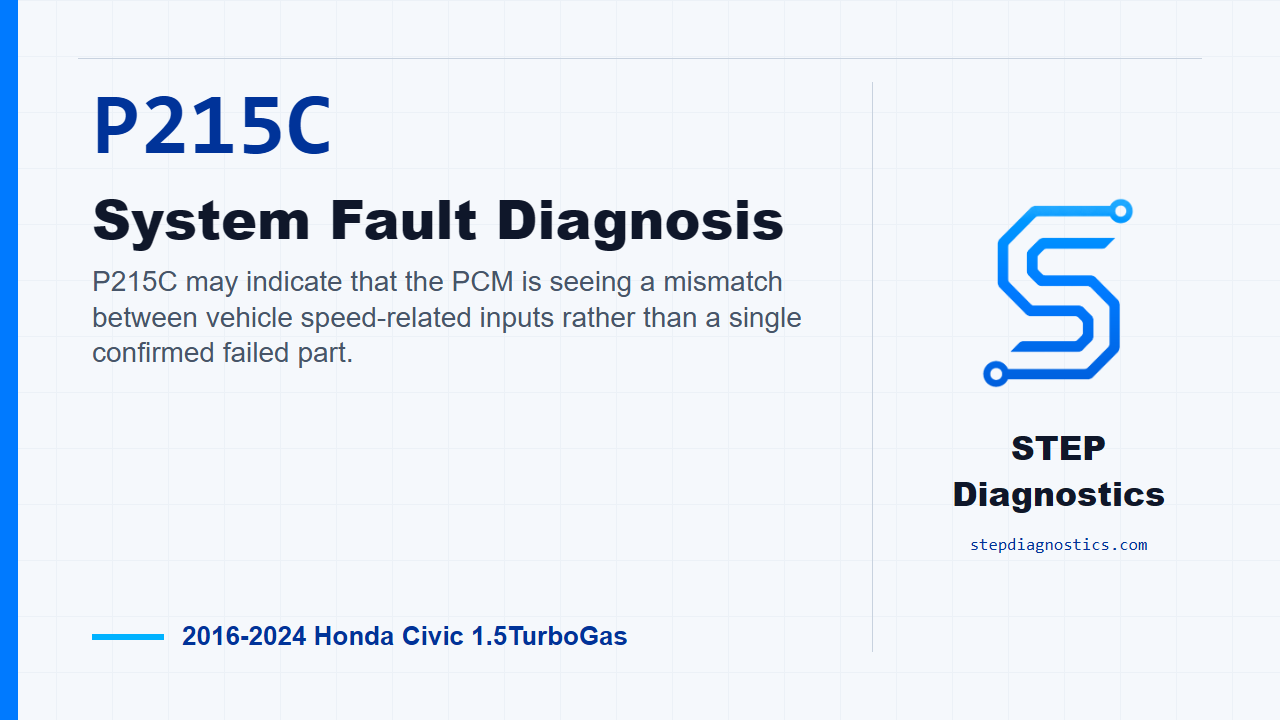
P215C may indicate that the PCM is seeing a mismatch between vehicle speed-related inputs rather than a single confirmed failed part.
What the vehicle may do
- The vehicle may show warning lights related to engine, stability, or speed-signal systems.
- The driver may notice possible speedometer, traction control, or drivability effects depending on the related fault present.
- The condition can often appear alongside other speed-signal codes.
Possible fault areas
- Possible front wheel speed signal concerns.
- Possible output shaft speed signal concerns.
- Possible connector, wiring, or signal integrity concerns.
- Possible related speed-sensor or encoder system concerns that should be diagnosed first.
Diagnostic path
Opening context
On this 2016 to 2024 Honda Civic with the 1.5 turbo engine, P215C is a speed-correlation code. In plain terms, the PCM is comparing the output shaft speed signal against the average front wheel speed signals, and it is looking for those signals to agree. When they do not line up the way the PCM expects, the vehicle may show warning lights, may have speed-signal related drivability concerns, or may limit certain control functions. Broadly, the possible fault areas can involve the front wheel speed signal side, the output shaft speed signal side, connector or signal integrity issues, or another related speed-code condition that needs to be handled first.
Start with the basic path
Before chasing P215C directly, start with the basic system checks and follow a structured diagnostic approach. The first important decision is whether other speed-related codes are present. If there are front wheel speed, vehicle speed, output shaft speed, or magnetic encoder related faults stored, diagnose those first. Do not jump into P215C until those related signal problems have been addressed, because this code is based on comparing those signals to each other.
Understand what sets the code
The logic behind P215C is a comparison. The PCM looks at the output shaft, or countershaft, speed sensor output and compares it with the average output from the front wheel speed sensors. If the difference is more than the calibrated limit for long enough, the PCM decides the speed relationship is abnormal and stores P215C. The exact internal limit and time used for that decision are not provided here, so do not make up a threshold. Use the available scan data and the required confirmation drive to guide the next move.
Run the confirmation drive
Once the related speed-signal faults have been handled, reproduce the operating conditions for P215C. Start the engine. Then test-drive the vehicle at a vehicle speed above 19 mph (30 km/h) for more than 30 seconds. After that, monitor the HDS [OBD STATUS (PGM-FI)] for DTC P215C.
Verification and takeaway
Keep the verification separate from the fault isolation. For P215C, the confirmation run is the key check: engine running, road speed above 19 mph (30 km/h) for more than 30 seconds, then check whether P215C reports again in HDS [OBD STATUS (PGM-FI)]. The takeaway is simple: this is a correlation problem, so prove the individual speed inputs first, then confirm the PCM no longer sees a mismatch. For more diagnostic training, visit stepdiagnostics.com.
Final check
P215C is best approached as a speed-signal correlation check: handle related speed-input faults first, then run the confirmation drive and verify the code stays gone.
For more guided automotive diagnostics, visit STEP Diagnostics.