What this code means
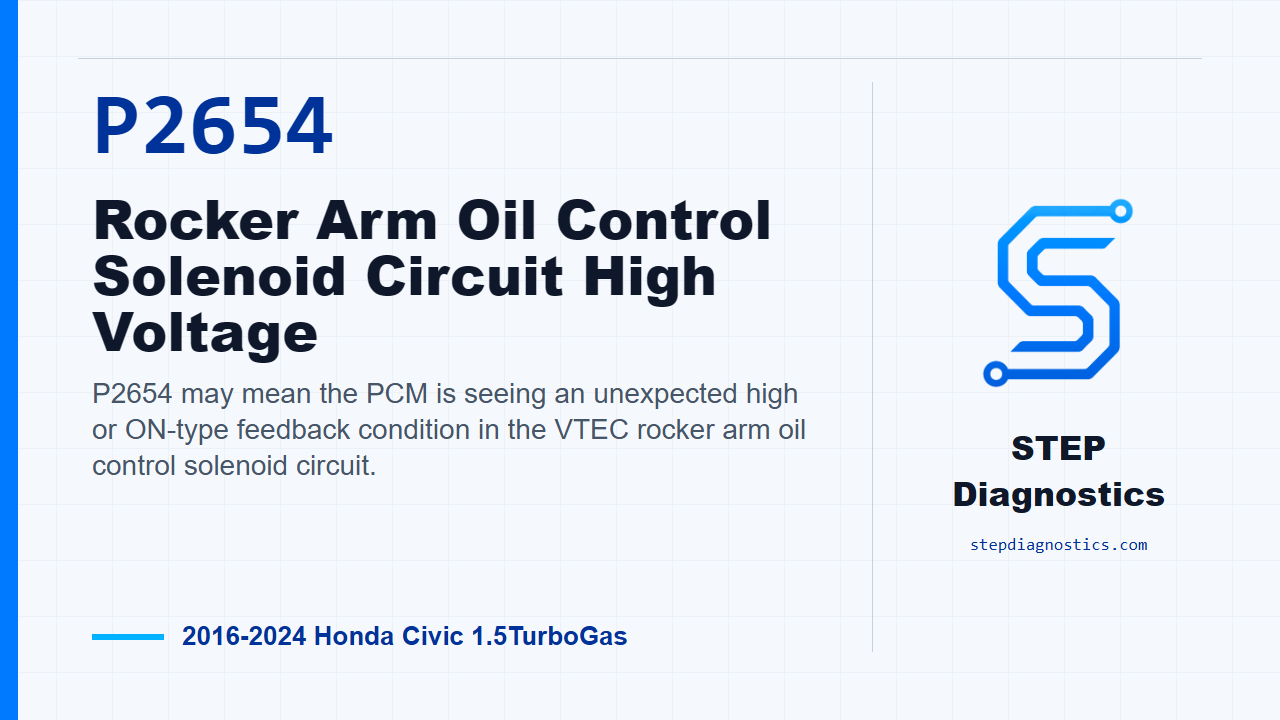
P2654 may mean the PCM is seeing an unexpected high or ON-type feedback condition in the VTEC rocker arm oil control solenoid circuit.
What the vehicle may do
- The check engine light may be on.
- The vehicle may have altered VTEC operation.
- The vehicle can have reduced performance or other drivability changes.
- In some cases, the driver may not notice a clear symptom.
Possible fault areas
- A possible rocker arm oil control solenoid or valve issue.
- Possible wiring, connector, or circuit problems in the solenoid control path.
- A possible PCM concern after the other checks are normal.
Diagnostic path
Open and frame the fault
On this Civic, P2654 points to a high-voltage fault in the VTEC rocker arm oil control solenoid circuit. In plain terms, the PCM is seeing the rocker arm oil control solenoid return signal ON when it is commanding that output OFF. The vehicle may have a check engine light, may limit normal VTEC operation, and can have drivability changes, although the symptom may not always be obvious. Broadly, possible fault areas can include the rocker arm oil control solenoid or valve, the related wiring and connectors, or, after the rest of the checks pass, the PCM. Start with the basic system checks and follow a structured diagnostic approach before getting into the circuit tests.
Command the system first
Begin by turning the vehicle to the ON mode. Then use the HDS to run the VTEC TEST. This gives you a controlled way to command the circuit before moving into component and wiring checks.
Check the rocker arm oil control solenoid
Next, prepare for the rocker arm oil control solenoid inspection by disconnecting the rocker arm oil control solenoid 2P connector. With that connector disconnected, use the male terminals and IG Mode for the solenoid internal circuit inspection. The normal condition is About 13.9 – 16.9 Ω (at room temperature). If this inspection is abnormal, the problem is with the rocker arm oil control valve.
Prepare safely before PCM connector work
Before disconnecting the PCM connector, jump the SCS line with the HDS, and wait more than 1 minute. Do not skip that pause before unplugging the PCM connector.
Check the VTS2 and PG wiring paths
Now prepare for the VTS2 and PG open wire inspection. Disconnect the rocker arm oil control solenoid 2P connector, and disconnect PCM connector E, the 80P connector. With the solenoid connector disconnected at the female terminals, the PCM connector E disconnected at the female terminals, and the vehicle in IG Mode, check the PG and VTS2 open wire paths. The normal condition for PG is There is less than 1 Ω. The normal condition for VTS2 is also There is less than 1 Ω. If this inspection is abnormal, the problem is in the circuit.
PCM judgment after the circuit checks
If the rocker arm oil control solenoid inspection is normal, and the VTS2 and PG open wire inspection is normal, then the remaining cause is determined to be the PCM. If anything in the earlier path does not line up, pause, recheck the earlier diagnostic path, and avoid guessing.
Verify separately and close
Keep verification separate from the testing path. After the identified fault is corrected, verify the repair and confirm the code stays gone. The takeaway on P2654 is simple: command the system, check the solenoid, protect the PCM before connector work, prove the VTS2 and PG wiring paths, and only then make the PCM call. For more diagnostic training, visit stepdiagnostics.com.
Final check
P2654 is often approached by commanding the VTEC circuit, checking the solenoid, checking the related wiring paths, and only then judging the PCM if the earlier checks are normal.
For more guided automotive diagnostics, visit STEP Diagnostics.