What this code means
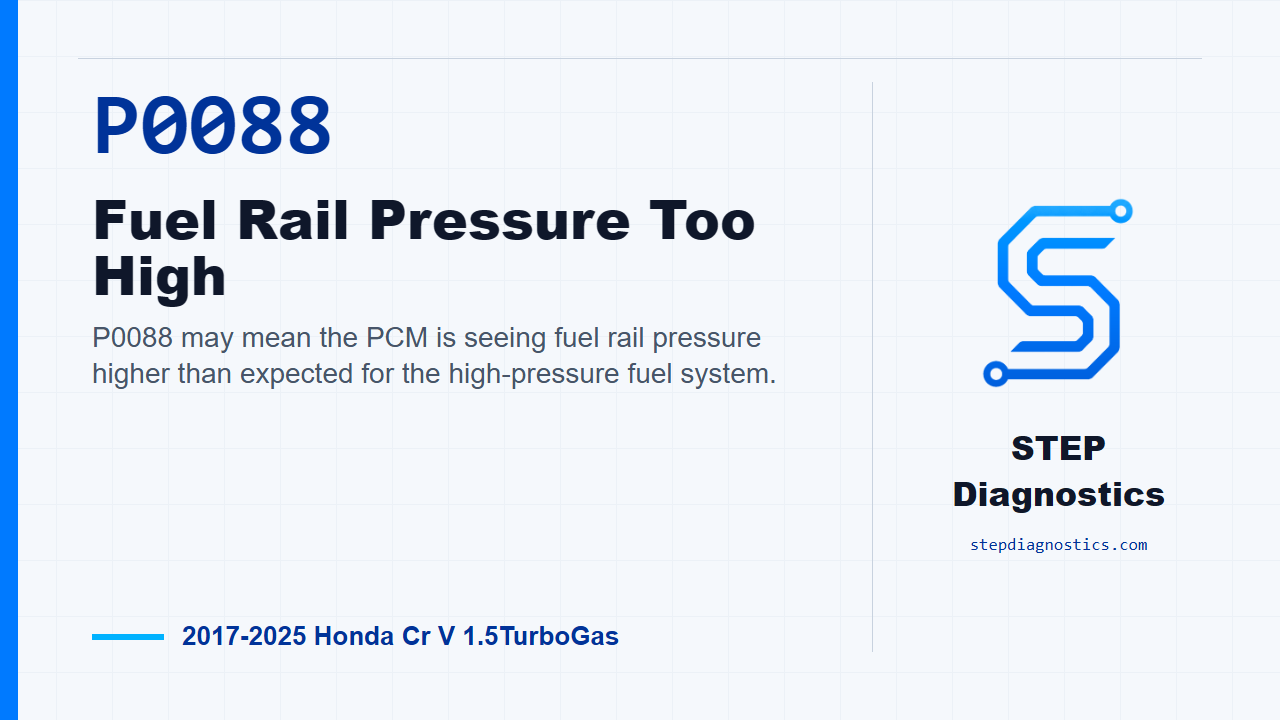
P0088 may mean the PCM is seeing fuel rail pressure higher than expected for the high-pressure fuel system.
What the vehicle may do
- The vehicle may run rough or hesitate.
- The vehicle may have reduced power.
- The warning light may come on.
Possible fault areas
- Fuel rail pressure sensing may be involved.
- The high-pressure fuel pump side may be involved.
- Related fuel, ignition, or combustion concerns may affect the pressure-control diagnosis.
Diagnostic path
Opening and diagnostic direction
On this CR-V with the 1.5 turbo, P0088 means the fuel rail pressure is being seen as too high. In plain terms, the PCM is comparing what it wants from the high-pressure fuel system against what it is actually seeing, and this code can set when actual high-pressure fuel pump pressure is higher than the target pressure. The vehicle may run rough, hesitate, have reduced power, or turn the warning light on, depending on how the fault shows up. Broadly, the possible areas can include fuel pressure sensing, the high-pressure fuel pump side of the system, and related fuel or combustion issues that can affect the pressure-control picture. Start with the basic system checks, and if other codes or the related indicated systems are present, check what they mean first before chasing P0088 by itself.
Confirm the fault before component testing
Once the preliminary checks are handled, duplicate the concern in order. Start the engine. Then hold the engine at 3,000 rpm with no load, in P or N, until the radiator fan comes on, and let it idle. Run the HDS DI FUEL PRESSURE TEST. If that test result is not OK, the failure has been duplicated. If needed, use the second confirmation route: test-drive the vehicle for several minutes under the same captured operating conditions, including engine speed, vehicle speed, MAP, throttle position, accelerator pedal position, coolant temperature, intake air temperature, and the two fuel-pressure-related readings. If the failure duplicates there, the confirmation portion is complete.
Use the scan tool functions that support this path
For this code path, the key HDS areas are the PGM-FI function test for the DI FUEL PRESSURE TEST and the PGM-FI data list. Use those as the scan tool side of the diagnosis while you compare commanded behavior against the pressure feedback the PCM is working from.
Fuel rail pressure sensor check under load
Next, check the fuel rail pressure sensor behavior. Start the engine, hold it at 3,000 rpm with no load in P or N until the radiator fan comes on, then let it idle. With the brake pedal pressed firmly, shift to D position or D mode and press the accelerator pedal. Do not shift the transmission or take your foot off the brake while raising engine speed. Compare HDS Fuel Pressure Converted From PF Sensor against Fuel Pressure Direct Injection System. Under normal conditions, those two values are almost the same. If that comparison is abnormal, the diagnostic path points to a problem with the fuel rail.
Fuel rail pressure sensor check after pressure bleed-down
The next fuel rail pressure sensor check is done with PGM-FI main relay 2 disconnected as preparation. Start the engine and let it idle until it stalls. After it stalls, crank the engine several times. Then confirm HDS Fuel Pressure Converted From PF Sensor. Normal is less than 1,000 kPa, and it is also normal if the value shown is several hundred kPa. If this check is abnormal, the path again points to a problem with the fuel rail.
High-pressure fuel pump check
Only move into the high-pressure fuel pump inspection after the fuel rail pressure sensor has been confirmed normal. Start the engine, hold it at 3,000 rpm with no load in P or N until the radiator fan comes on, and let it idle. Then, with the brake pedal pressed firmly, shift to D position or D mode and press the accelerator pedal. Again, do not shift the transmission or take your foot off the brake while raising engine speed. Confirm the HDS Relief Valve value. Normal is shown as normal. If it is abnormal, the path points to a problem with the high-pressure fuel pump.
Takeaway
The clean way through P0088 is to confirm the high-pressure fault first, make sure the pressure feedback agrees with the direct injection pressure data, then only judge the high-pressure pump after the sensor side checks normal. Keep confirmation separate from component testing, and do not guess at parts just because the rail pressure is high. For more diagnostic training, visit stepdiagnostics.com.
Final check
P0088 is best approached as a command-versus-actual fuel pressure problem: confirm the fault, validate the pressure feedback, then evaluate the high-pressure pump side only after the sensor side looks
For more guided automotive diagnostics, visit STEP Diagnostics.