What this code means
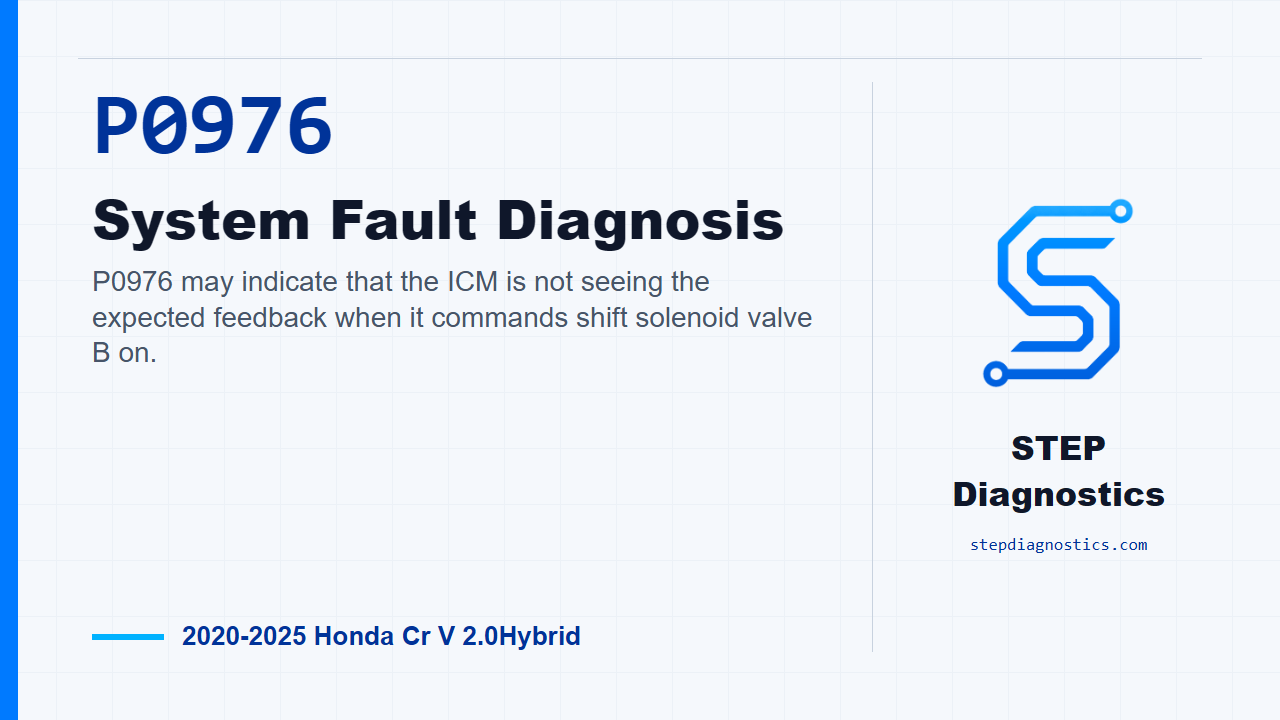
P0976 may indicate that the ICM is not seeing the expected feedback when it commands shift solenoid valve B on.
What the vehicle may do
- The vehicle may show a transmission warning or related indicator behavior.
- The vehicle may have abnormal drive feel or shifting-related symptoms.
- The vehicle can sometimes limit operation depending on how the fault is detected.
Possible fault areas
- Possible shift solenoid valve B concern.
- Possible SH-B control circuit or connector concern.
- Possible ICM concern after related checks indicate normal.
Diagnostic path
Open and frame the fault
This one is for P0976 on the ICM system. In plain language, this code may mean the ICM is not seeing the feedback it expects when it commands shift solenoid valve B on. The vehicle may show transmission-related warning behavior, abnormal drive feel, or limited operation, depending on how the fault is acting. Broadly, think in terms of a possible solenoid B issue, a possible SH-B control circuit problem, connector concerns, or, after the other checks pass, a possible ICM fault. For this diagnostic, the setting logic is simple: if the return signal does not match the ICM command to turn on shift solenoid valve B, the ICM calls it abnormal and stores P0976.
Start with the setup and confirmation routine
Before getting into the pinpoint checks, start with the basic system checks and follow a structured diagnostic approach. Then reproduce the operating conditions for this code. Raise the vehicle on a lift, make sure it is securely supported, and make sure all four wheels can rotate freely. Use the HDS Direct Input Clutch Test Assistances Mode, and run the vehicle at a steady speed with the low clutch engaged for at least 10 seconds. When you stop the test, apply the brakes and bring the wheels down slowly. Do not brake hard while the vehicle is running on the lift, because that can damage the driveline.
Check the shift solenoid valve B path first
Next, move into the shift solenoid valve B inspection. Disconnect the shift solenoid valve cover assembly connector, the 5P connector. Then run the same confirmation routine. The normal condition for this check is that P0976 is not indicated. There is not a direct component-only test for the solenoid in this path, so the diagnosis works through the related components and the way the fault responds. If this inspection is normal, the path points to a problem with shift solenoid valve B. If it is abnormal, the path points you toward other related components instead of stopping at the solenoid.
Inspect the SH-B circuit for a short to ground
If the solenoid-side check does not settle it, go to the SH-B shorted wire inspection. Disconnect the shift solenoid valve cover assembly connector, the 5P connector, and disconnect ICM connector P, the 36P connector. Then inspect the SH-B circuit for a short to ground with IG Mode OFF. The normal condition is more than 1 MΩ. If that inspection is abnormal, there is a problem in the circuit. Before probing, make sure you have the correct connector and circuit identification in front of you; if the circuit location is not clear, pause, recheck the earlier diagnostic path, and do not guess.
Only then judge the ICM
After the solenoid-side inspection and the SH-B circuit inspection have both indicated normal, the remaining call in this diagnostic path is the ICM. At that point, the result is a problem with the ICM. The key is not to jump there early; the circuit and solenoid path have to be worked in order first.
Verify the repair
Keep verification separate from the category-specific testing. Once the fault area has been corrected, verify the repair by repeating the confirmation routine: vehicle safely supported, wheels free, HDS Direct Input Clutch Test Assistances Mode, steady operation with the low clutch engaged for at least 10 seconds, then a slow brake stop. The pass condition is that P0976 is not indicated.
Takeaway and CTA
Takeaway: for P0976, confirm the fault under the controlled drive condition, check how the solenoid B path responds, prove the SH-B circuit is not shorted to ground, and only call the ICM after the earlier inspections pass. For more diagnostic training, visit stepdiagnostics.com.
Final check
This code is often approached by confirming the fault, checking the solenoid B path, checking the SH-B circuit, and only then judging the ICM.
For more guided automotive diagnostics, visit STEP Diagnostics.