What this code means
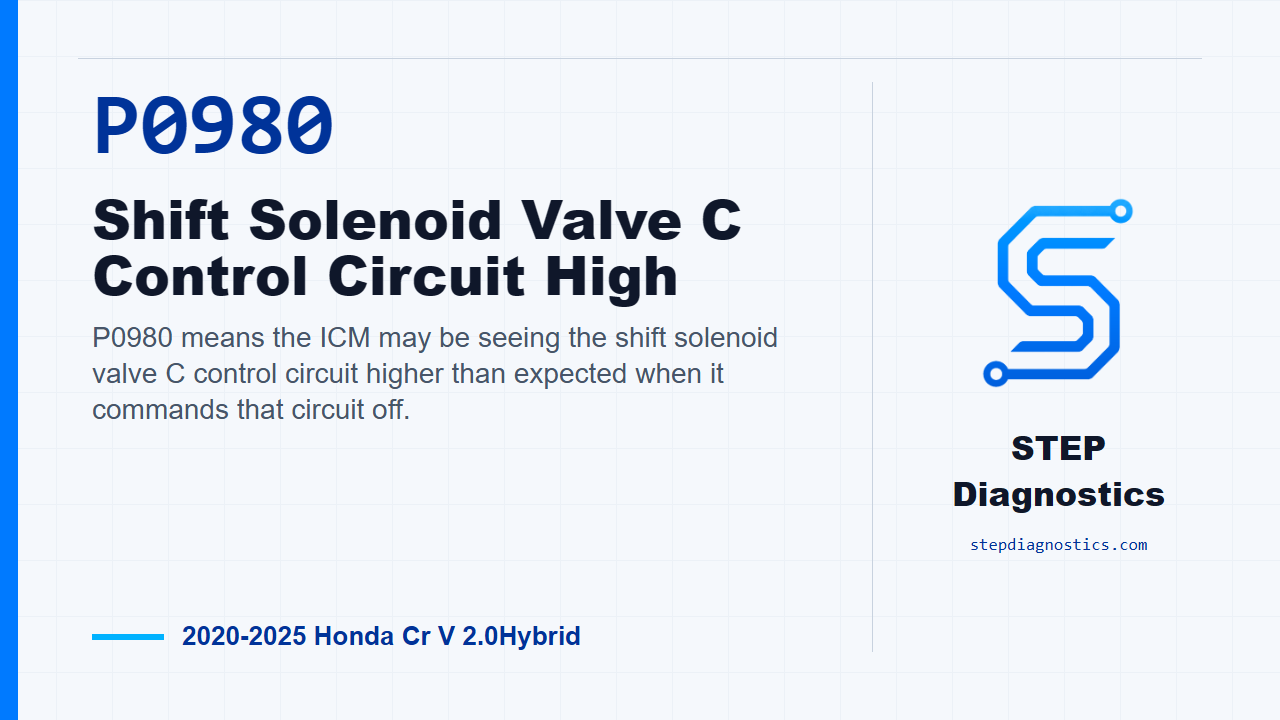
P0980 means the ICM may be seeing the shift solenoid valve C control circuit higher than expected when it commands that circuit off.
What the vehicle may do
- The vehicle may store the code with a warning light.
- It may have shift-related driveability symptoms.
- Symptoms can vary depending on when the ICM sees the circuit fault.
Possible fault areas
- A possible issue in the shift solenoid valve C control circuit.
- Possible connector or wiring concerns at the shift solenoid valve cover assembly or ICM.
- A possible shift solenoid valve C fault area.
- A possible ICM fault area after related checks test normal.
Diagnostic path
Code overview
On this 2020 to 2025 Honda CR-V Hybrid, P0980 means the ICM is seeing the shift solenoid valve C control circuit staying higher than it expects when it commands that circuit off. The vehicle may show shift-related driveability issues, or it may simply store the code. Broadly, this can involve the solenoid C control circuit, connector or wiring issues, the shift solenoid valve cover assembly connection, or possibly the ICM. Since there is no direct standalone test for the solenoid itself in this path, the diagnosis works through the related circuit checks and the way the ICM responds.
Start the diagnostic path
Start with the basic system checks and follow a structured diagnostic approach before getting into the circuit test. Then turn the vehicle to READY TO DRIVE mode. Put the transmission in P position or P mode, and let it sit there for at least 1 second. That gives you the operating setup for the confirmation portion of the test.
Shift solenoid valve C inspection
For the shift solenoid valve C inspection, disconnect the shift solenoid valve cover assembly connector, the 5P connector. Clear the DTC from the ICM with the scan tool. Then use a jumper wire to connect terminal No. 3 of that 5P connector to body ground. Now run the confirmation procedure for the related opposite-side circuit check. The normal result is that the expected related code is indicated. If that happens, this inspection is considered normal, and the diagnostic path points to a problem with shift solenoid valve C. If the result is abnormal, the path points away from the solenoid itself and toward other related components.
Check the SH-C circuit for an open
Next, check the SH-C circuit for an open. Disconnect the shift solenoid valve cover assembly connector, the 5P connector, and disconnect ICM connector P, the 36P connector. Perform the open-wire inspection using the correct connector terminal identification for that circuit. The normal condition is less than 1 Ω. If that check is abnormal, the problem is in the circuit. If terminal identification is not clear or available at the vehicle, pause, recheck the earlier diagnostic path, and do not guess at terminal locations.
ICM decision point
If the shift solenoid valve C inspection and the SH-C open-wire inspection both indicate normal conditions, the remaining diagnostic conclusion is a problem with the ICM. Keep that as the final decision point in this path; do not jump there until the related circuit checks have been proven normal.
Close
The key on P0980 is to prove the circuit response in order: set up the vehicle, force the control-side check, verify the SH-C circuit is not open, and only then consider the ICM as the remaining fault area. For more diagnostic training, visit stepdiagnostics.com.
Final check
P0980 is handled as an electrical control-circuit diagnosis: prove the commanded circuit response first, then check the SH-C circuit, and only use the ICM conclusion after the related inspections are
For more guided automotive diagnostics, visit STEP Diagnostics.