What this code means
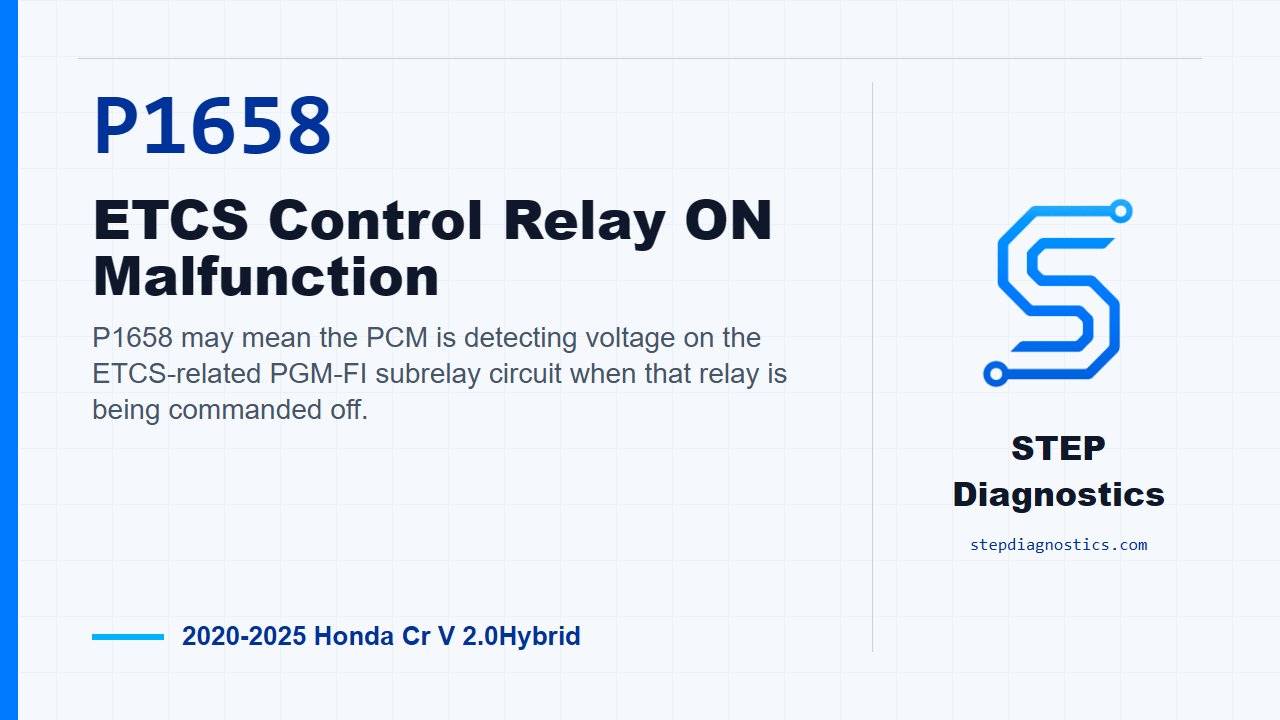
P1658 may mean the PCM is detecting voltage on the ETCS-related PGM-FI subrelay circuit when that relay is being commanded off.
What the vehicle may do
- The vehicle may turn on a warning light.
- Throttle response may be reduced or limited in some cases.
- The code may store intermittently if the fault is only present under certain conditions.
Possible fault areas
- Possible relay control-side circuit issue.
- Possible relay output-side circuit issue.
- Possible wiring, connector, or terminal issue.
- Possible issue with loads connected to the relay output circuit.
- Possible PCM fault area after the circuit inspections are normal.
Diagnostic path
Opening context
On this 2020 to 2025 Honda CR-V 2.0 hybrid, P1658 is an ETCS control relay ON malfunction. In plain terms, the PCM may be seeing power where it should not when the PGM-FI subrelay is being commanded off. The vehicle may have a warning light, may have reduced throttle response, or may simply store the code depending on when the fault shows up. The broad fault areas can include the relay control side, the relay output side, wiring or connector issues around those circuits, connected loads on the relay output, and, only after the circuit checks pass, a possible PCM issue.
Start with the basic checks and duplicate the fault
Before getting into pinpoint testing, start with the basic troubleshooting checks. Then turn the vehicle to ON mode and run the HDS ETCS TAC test. If the test reports not OK, the failure is duplicated. If you do not have a clear OK or not OK result from that test, pause and do not guess at the branch; recheck the earlier diagnostic path before moving on.
Check the FI_SUB_RLY_CL- circuit for a short to ground
Next is the FI_SUB_RLY_CL- shorted wire inspection. Before disconnecting the PCM connector, use the HDS to jump the SCS line and wait more than 1 minute. Then set up the test with PCM connector A, 72P, disconnected and the PGM-FI subrelay disconnected. Use the proper short-circuit inspection method and the correct terminal map for this circuit. With PCM connector A, 72P, disconnected, female terminals, and IG Mode OFF, check FI_SUB_RLY_CL- for a short to ground. A normal result is more than 1 MΩ. If the result is abnormal, the problem is in that circuit.
Check the FI_SUB_RLY_OUT circuit for a short to power
After that, move to the FI_SUB_RLY_OUT shorted wire inspection. Again, before disconnecting the PCM connector, jump the SCS line with the HDS and wait more than 1 minute. For this check, PCM connector A, 72P, is disconnected, the PGM-FI subrelay is disconnected, and the listed connected loads are unplugged for the vehicle market: the EVAP canister purge valve connectors, the EVAP leak check module where used, and A/F sensor Sensor 1. Then use the proper short-circuit inspection method and the correct terminal map for FI_SUB_RLY_OUT. With PCM connector A, 72P, disconnected, female terminals, and IG Mode ON, check FI_SUB_RLY_OUT for a short to power. A normal result is not shorted. If the result is abnormal, the problem is in that circuit.
PCM decision point
Only if the other inspection items show normal results do you move into PCM inspection. At that point, the diagnostic path determines the remaining PCM as the cause. If the PCM inspection is evaluated as failed, the fault is identified as a problem with the PCM.
Verification and takeaway
Keep repair verification separate from the circuit testing. The takeaway for P1658 is simple: duplicate the fault with the ETCS TAC test, inspect FI_SUB_RLY_CL- for a ground short, inspect FI_SUB_RLY_OUT for a power short, and only consider the PCM after the circuit checks are normal. For more diagnostic training, visit stepdiagnostics.com.
Final check
Follow the branch order: confirm the fault, check the relay control circuit, check the relay output circuit, and only then evaluate the PCM.
For more guided automotive diagnostics, visit STEP Diagnostics.